Insta360 alternatives worth considering
Insta360 owns the invisible-stick trick and the clip-on camera. These five are what you buy when one specific thing about that lineup does not fit your trip.
Part of Cameras.
We earn a commission if you buy through our links, at no extra cost to you. It never changes what we recommend or the order we rank it in — how this works.
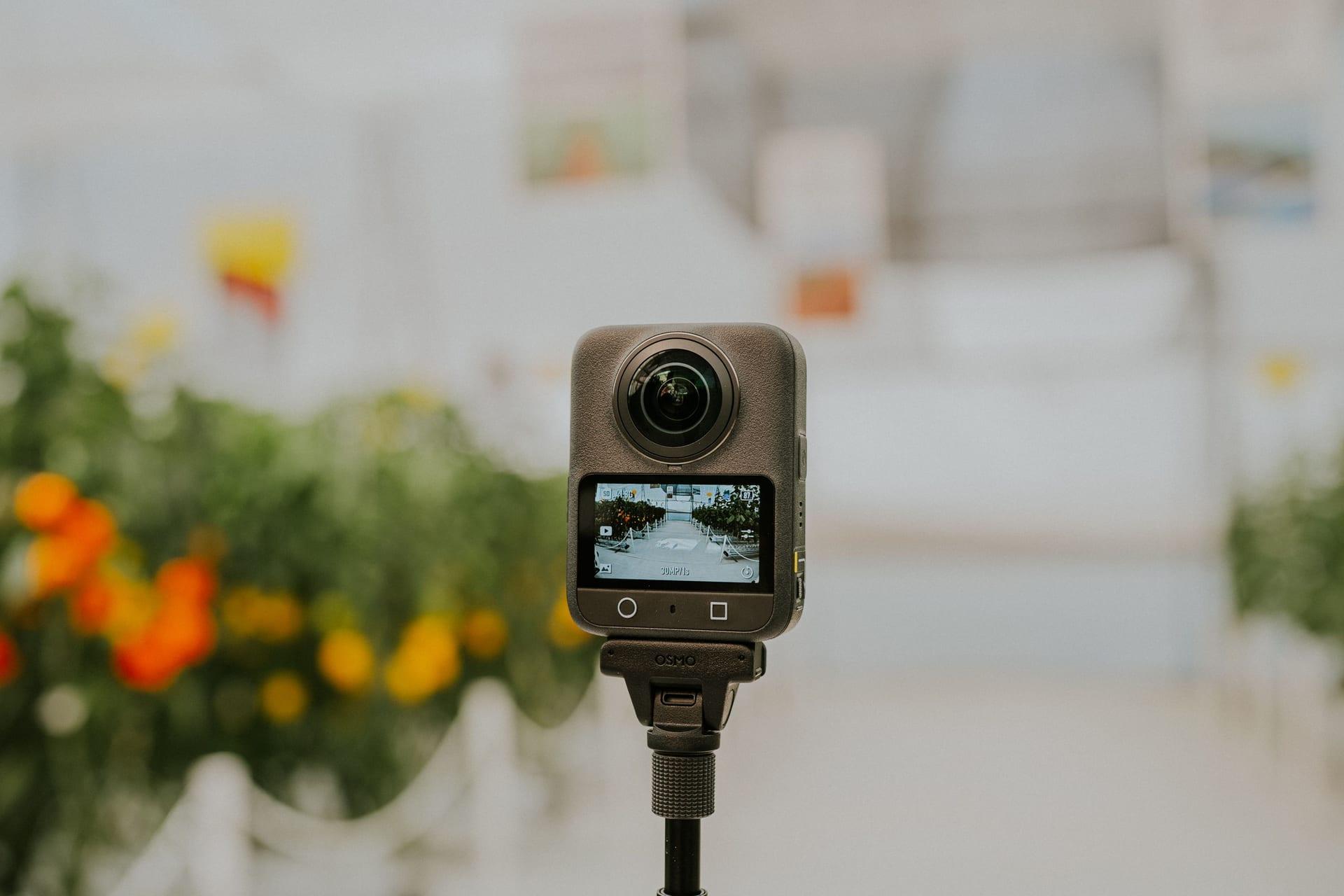
What Insta360 is genuinely best at
An alternatives page that pretends the incumbent is bad is not useful, and in this case the incumbent is the reason several of these categories exist at all. Four things are honestly Insta360's.
The invisible selfie stick, and the reframing workflow around it. The X-series put a floating third-person camera in reach of anyone with a pole, and the app that turns a sphere into a normal clip is the most polished version of that workflow anyone sells. If what you want is to film yourself paddling without aiming, Insta360 is not a brand you leave lightly.
User-replaceable lenses on the X5. On a 360 camera the glass is the part that fails first, and the X5 is the body that turned that from a service job into a part you swap yourself. GoPro now does this too on the MAX2; Insta360 did it first on this class of camera.
Depth without a case. IP68 to 49ft (15m) on the X5 is the deepest bare rating of any camera on this site, 360 or flat. That is a real specification, not marketing, and it is the main reason the X5 wins our 360 roundup.
The clip-on format. The GO line is a 53g camera you forget you are wearing, and nothing else is shaped like it. The alternatives below get close on size or on price, never on both plus the magnet.
If one of those four is what you are shopping for, the honest answer is to buy the Insta360 and stop reading. Everything below is for buyers whose binding constraint is something else.
How a camera qualified as an alternative
“Alternative” is a word that usually means “cheaper and worse”. Three rules keep this list from turning into that.
It has to beat the Insta360 at one named published figure. Not vibes, not a review score — a number a manufacturer prints: a deeper bare water rating, a larger sensor, a longer runtime, a lower weight, or a mount fitting you already own. If a camera cannot win one of those outright, it is not an alternative, it is a substitute.
It has to be currently purchasable. Every camera on this page was checked against a live retail listing on 13 November 2026. Discontinued bodies and pre-orders are not alternatives, and this is also why a few perennial forum suggestions are missing — the cameras people name from four years ago are mostly not for sale anymore.
It has to give something back, and the page has to say what. Every entry below names the trade in the same sentence as the win. A roundup where nothing loses is an advertisement, which is the whole reason our editorial policy exists.
| Camera | Replaces | Does better | Gives back |
|---|---|---|---|
| GoPro MAX2 | Insta360 X5 / X4 | 8K 7680x3840 sphere, GoPro fingers built in, field-replaceable lenses | 5m (16ft) bare against 15m; no published runtime figure |
| DJI Osmo Action 6 | Insta360 Ace Pro 2 | 1/1.1" sensor, f/2.0-f/4.0 variable aperture, 20m bare, 240 min published | 149g, smaller mount ecosystem, top-of-category price |
| GoPro HERO13 Black | Ace Pro 2 / X5 as an all-rounder | HyperSmooth 6.0, built-in fingers, the largest accessory catalog | 33ft (10m) bare — the shallowest flagship rating here |
| GoPro HERO (2024) | Insta360 GO Ultra / GO 3S | Tiny, cheap, and mounts to the whole GoPro ecosystem | 16ft (5m), built-in battery, 4K30 ceiling, no magnet mounting |
| AKASO Brave 8 Lite | Any Insta360 on price | IPX8 10m, two batteries and seven mounts in the box | Stabilization gives up in chop; low light is where the price shows |
Reason by reason
“I want the 360 shot, but not from Insta360.” There is exactly one other current answer, and it is the GoPro MAX2. It publishes the largest 360 frame size of anything we track at 8K 7680x3840, its lenses are replaceable in the field, and it carries GoPro's own mounting fingers so every two-prong clamp you own already fits. The trade is water: 5m (16ft) bare is a third of the X5's rating, which is a serious downgrade on a lake. MAX2 against the X5 is that decision in full.
“I was buying the Ace Pro 2 for the image.” Then the DJI Osmo Action 6 is the alternative, because it is the only flat camera we track with a larger published sensor — 1/1.1 inch against the Ace Pro 2's 1/1.3 inch — and it adds a variable f/2.0-f/4.0 aperture, which means it can stop down for glare off water instead of needing a screw-on ND filter. It also publishes 20m bare and 240 minutes at 1080p/24, both of which beat the Ace Pro 2's 12m and 180 minutes. What you give back is the flip screen, which is genuinely useful when you are standing in front of the camera.
“Everything I own is a GoPro mount.” This is the most common real reason, and it is a good one. Switching brands means an adapter on every clamp, boom and chesty you already own, or buying them again. The HERO13 Black keeps all of it, adds the steadiest stabilization anyone publishes, and holds a removable Enduro battery rated for full camera functionality down to 14°F (-10°C). It gives back depth — 33ft (10m) bare is the shallowest flagship rating here.
“I want something tiny and I do not want to spend GO Ultra money.” The GoPro HERO (2024) is the closest thing, and it is genuinely small — GoPro publishes 46% less mass than a HERO13 Black — with built-in fingers so it mounts to everything. Read two specifications before you buy it, though: 16ft (5m) is a snorkel-adjacent rating rather than a diving one, and the battery is built in, so a dead camera is a power bank problem rather than a ten-second swap. It also does not do the magnetic clip-on trick, which is the actual thing people like about the GO line — GO Ultra vs GO 3S covers that lineup on its own terms.
“I just want to spend much less.” The AKASO Brave 8 Lite is the honest budget answer: IPX8 to 10m bare, which matches the HERO13 Black on paper, plus two batteries, a charger and seven mounts in the box, so there is nothing else to buy on day one. The stabilization is where the money shows — it gives up in chop exactly when you want it most — and low light is the second place. GoPro vs AKASO is the long version, and the budget roundup ranks the whole cheap end.
What switching actually costs
Leaving a brand is never just the price difference between two bodies, and four costs are worth adding up before you decide.
Mounts and adapters. If you own Insta360 cages, clamps and the magnetic GO mounts, none of that transfers. Going to GoPro means the two-prong fitting is native, which is the cheapest switch available. Going to DJI means an adapter on each two-prong mount you already own — small money, but count the mounts first. Mount compatibility sets out what fits what.
Batteries and chargers. Every brand uses its own cells and its own multi-charger. Two spare batteries and a charger is a real part of the switching cost, and it is the one people forget until the first long day — batteries and power banks covers what to buy and what to avoid.
The editing workflow. Insta360's app is built around reframing a sphere; GoPro Quik and the DJI app are built around trimming flat clips. Neither is hard, but the muscle memory is real and a 360 library does not open in a flat-camera app. Editing on a phone is the realistic version of that workflow on any of them.
Cases, filters and lens guards. All model-specific, all a second purchase. Filters and dome ports and cases and dive housings both list what fits which body.
If you were buying a specific Insta360
The alternatives above answer general reasons. These are the four specific starting points buyers actually arrive with.
You were buying an X5. You want depth, replaceable lenses and the reframing workflow. Only the MAX2 keeps the format, and it trades 15m for 5m to get you GoPro mounts and a bigger sphere. If depth is the reason you were buying the X5 in the first place, there is no alternative and you should buy the X5 — X5 vs X4 is the cheaper-within-brand version.
You were buying an X4 to save money. The honest comparison is the MAX2 against it on price and the X5 against it on depth. All three shoot 8K spheres, and the differences land on water rating, lens replaceability and which mounts you already own.
You were buying an Ace Pro 2. This is the most competitive slot in the category. The Osmo Action 6 publishes a larger sensor and a deeper rating; the HERO13 Black publishes better stabilization and the biggest accessory catalog; the Ace Pro 2 keeps the flip screen and a 12m bare rating. HERO13 vs Ace Pro 2 and Osmo Action 5 Pro vs Ace Pro 2 are both that decision with published figures attached.
You were buying a GO Ultra or GO 3S. Be honest about what you wanted: if it was the magnet and the 53g, nothing else does it and you should buy the Insta360. If it was simply “small and cheap”, the HERO (2024) is small, cheap and mounts to everything — with a built-in battery and a 16ft (5m) rating as the price of that.
What does not count as a reason
Three arguments come up a lot and none of them should move you on their own.
Resolution on the box. Every flagship here shoots more pixels than almost anyone can display, and on a 360 camera the number means something different again because reframing crops the sphere. 4K vs 5.3K vs 8K has the arithmetic.
Subscription bundles. Every brand sells one, every brand prices the camera around it, and none of them changes what the camera does on the water. Buy the body you want at the price in front of you.
Which brand a forum prefers. The useful question is narrower: what is the one thing your trip actually needs — depth, runtime, mounts, weight or price — and which camera publishes the better number for it. How to choose an action camera puts those in order, and GoPro vs Insta360 vs DJI is the three-brand version of this page.
If you are staying with Insta360 anyway
Plenty of people arrive at this page, read the trade-offs and buy the Insta360 after all. That is a perfectly good outcome, and these are the pages that help with the rest of the decision: the X5 specification read for the current 360 flagship, the Ace Pro 2 read for the flat body, and X5 against Ace Pro 2 if you are deciding between the two formats inside one brand.
If it is the X5 specifically
This page covers the whole lineup. If the camera you are weighing up is the X5 on its own - the 15m-rated 360 body with user-replaceable lenses - the X5 alternatives page maps each reason people look past that one camera, from price to the reframing workflow, to the body that answers it.
01
The five alternatives
Ordered by how often the reason behind each one actually comes up for lake and trail buyers. Every one of them gives something back, and each entry says what.
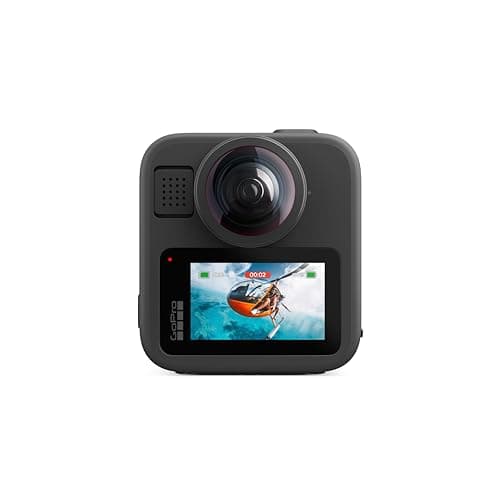
- 5m (16ft) bare
- 8K 7680x3840 at 30/25/24
- 1960mAh Enduro · runtime not published
- 6.5
- 9.5
- 7.5
- 9.5
- 7.0
GoPro MAX2
GoPro
True 8K on a sphere, replaceable lenses and GoPro's own mounting fingers — held back on this site by a 5m water rating, the shallowest of any 360 camera we rank.
Riders and hikers who want one camera to cover everything and already own GoPro mounts
- 8K 360 at 7680x3840 — the highest published 360 frame size of any camera we rank, which is what reframing actually spends
- Replaceable lenses, changeable in the field, so a scratched lens is a part and not a service job
- Built-in GoPro mounting fingers: every two-prong mount, clamp and boom already fits
- Six microphones for 360 audio, and Max HyperSmooth with 360-degree Horizon Lock
- Single-lens 4K at 60fps in 16:9, 9:16 and 4:3, so it can stand in for a flat camera
- 5m (16ft) bare is the shallowest 360 rating here — a third of the Insta360 X5's 15m
- GoPro publishes no recording time for the 1960mAh battery, so endurance cannot be compared on paper
- 195g with fingers and battery, the heaviest 360 body we rank
- 8K 360 files are slow to reframe and heavy to edit on an older laptop
Specs from Backscatter, GoPro MAX2 published specification listing.
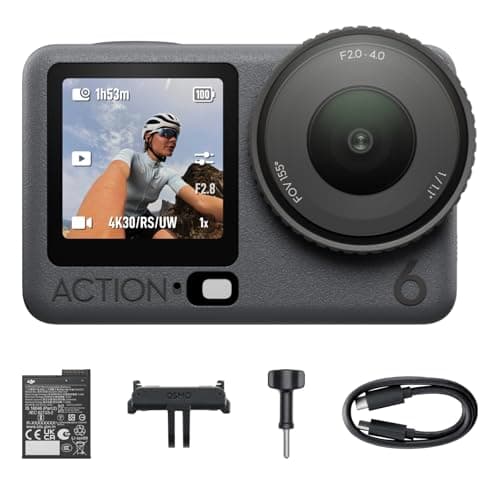
- 20m bare / 60m with case
- 1950mAh · 240 min at 1080p24
- 1/1.1" with f/2.0-f/4.0 aperture
- 9.5
- 9.0
- 9.5
- 8.0
- 9.5
DJI Osmo Action 6
DJI
The first action camera with a variable aperture, on the largest sensor in the class — and it keeps the 20m bare rating and the 240-minute runtime that made the Action 5 Pro the long-day pick.
Bright water and flat light in the same afternoon, on trips measured in days rather than hours
- 1/1.1-inch sensor — the largest in any flat action camera we track, and it shows in flat light
- Variable f/2.0-f/4.0 aperture: it can stop down for glare off the water instead of needing an ND filter
- Keeps the 20m bare rating, the 1950mAh removable battery and the 240-minute published runtime
- -20° to 45°C operating range, and 64GB built in (50GB usable) for the day you forget the card
- 4K at up to 120fps for slow motion, 8K/30 for cropping in the edit
- 149g, the heaviest flagship here — noticeable on a helmet, irrelevant on a hull
- 8K stops at 30fps and costs card space and battery for detail a phone screen never shows
- Mount ecosystem is still smaller than GoPro's, and the magnetic quick-release adapters are a separate purchase
- Sits at the top of the category price bracket — the Action 5 Pro does most of this for less
Specs from DJI Osmo Action 6 published specifications.
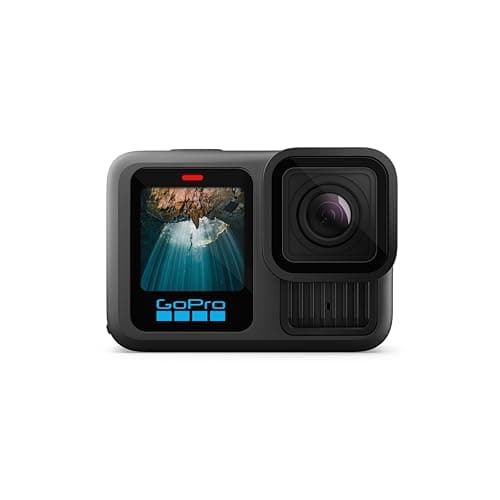
- 33ft (10m), no housing
- 1900mAh Enduro
- 1.5h at 5.3K30 / 2.5h at 1080p30
- 8.0
- 9.5
- 8.5
- 9.5
- 9.0
GoPro HERO13 Black
GoPro
The safest default for lake and trail: 33ft without a housing, the steadiest footage in the category, and a mount for literally everything.
Anyone who wants one camera to handle the kayak, the bike and the family trip
- HyperSmooth 6.0 with AutoBoost is the steadiest stabilization we can find published figures for
- Built-in mounting fingers plus 1/4-20 threads — it fits the GoPro ecosystem and a normal tripod
- Enduro battery is rated to keep full camera functionality down to 14°F (-10°C)
- Replaceable lens cover, so a scratched lens is a $20 problem and not a $400 one
- 33ft is shallower than the DJI and it is the shallowest of the three flagships
- Anything past 33ft needs the separate Protective Housing
- HB-Series lenses and ND filters are all extra purchases
Specs from GoPro HERO13 Black published specifications.
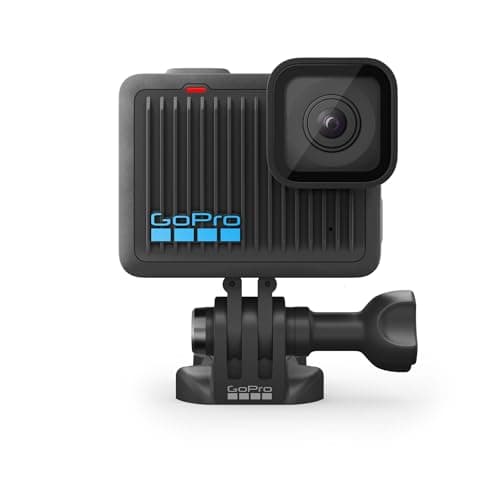
- 16ft (5m)
- 4K30, 2.7K60 slo-mo
- Built in, not user-removable
- 6.0
- 7.5
- 6.0
- 9.0
- 7.0
GoPro HERO (2024)
GoPro
The cheapest real GoPro, and the one whose 16ft rating you have to take seriously before you take it snorkeling.
A first camera, a kid's camera, or a second angle that mounts anywhere
- Genuinely tiny — 46% less mass than HERO13 Black
- Built-in mounting fingers, and GoPro lists it as compatible with 35+ mounts
- HyperSmooth stabilization at the lowest GoPro price
- Simple enough to hand to someone who has never used one
- 16ft (5m) is a snorkel-adjacent rating, not a diving one
- The battery is built in — you cannot carry a spare, you carry a power bank
- 4K30 is the ceiling; no 4K60, no high-frame-rate 4K
Specs from GoPro HERO published specifications.
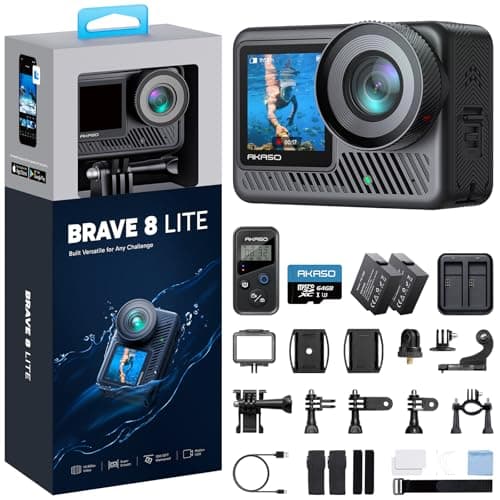
- IPX8 10m / 60m with case
- 2 × 1550mAh included
- 140 min at 4K / 150 min at 1080p
- 7.5
- 6.5
- 8.0
- 8.5
- 6.5
AKASO Brave 8 Lite
AKASO
Two batteries and a bag of mounts in the box at a fraction of flagship money — buy it knowing the stabilization gives up first.
A pool, a calm lake, a first camera you are not precious about
- IPX8 to 10m bare, which matches the HERO13 Black's rating on paper
- Ships with two batteries, a charger and seven mounts — nothing else to buy on day one
- 4K60 and dual screens at a price well under the flagships
- Uses GoPro-standard two-prong mounting, so the whole accessory world fits
- SuperSmooth stabilization is a step behind HyperSmooth and RockSteady in chop
- The 60m rating belongs to the separate housing, not the camera
- Low light is where the price shows most
Specs from AKASO Brave 8 Lite published specifications.
02
How we picked
We do not lab-test, bench-test or dive-test cameras, and we do not own test units. What we do instead is read the manufacturer's published specifications, read the independent reviews that genuinely do test, read owner reports for the failure modes specs never mention — fogging, salt corrosion, cold battery collapse, mount slippage — and then weight all of it for 360 cameras used on lake and trail. Where a number is not published, the page says “not published” rather than filling the cell.
The full method, including what we refuse to do, is on the editorial policy page.
- 30%Water survival
- Exposed lenses change the rules — rated depth and lens-guard availability both count.
- 25%Reframing payoff
- A 360 camera is only worth it if the reframing genuinely saves shots you would have missed.
- 20%Battery in the cold
- Stitching two sensors costs power; cold costs more.
- 15%Mount ecosystem
- Invisible-selfie-stick geometry is the whole trick, and it depends on the mount.
- 10%Edit time
- Every 360 clip needs a pass before anyone can watch it.
03
Questions people actually ask
01What is the best alternative to Insta360?
It depends which Insta360 you were buying. For an X5 or X4, the GoPro MAX2 is the only other current true-8K 360 camera. For an Ace Pro 2, the DJI Osmo Action 6 publishes a larger sensor and a deeper bare water rating. For a GO Ultra, the GoPro HERO (2024) is the small, cheap, mountable alternative — though it does not do the magnetic clip-on trick.
02Is there a cheaper alternative to Insta360?
Yes — the AKASO Brave 8 Lite sits well under flagship money and ships with two batteries, a charger and seven mounts. It matches the HERO13 Black's 10m bare rating on paper. The honest trade is stabilization, which gives up in chop, and low light, where the price shows most.
03Does any other brand make a 360 camera like the Insta360 X5?
GoPro does, with the MAX2: 8K at 7680x3840, field-replaceable lenses, six microphones and built-in GoPro mounting fingers. The difference that matters on the water is depth — GoPro publishes 5m (16ft) bare for the MAX2, against IP68 to 49ft (15m) for the X5.
04Can I use my Insta360 accessories on another camera?
Some of them. The invisible selfie stick uses a standard 1/4-20 thread, so it fits other cameras with that fitting — but it only disappears from footage on a 360 camera, because the trick depends on the pole sitting in the blind seam between two lenses. Cases, lens guards and the magnetic GO mounts are model-specific and do not transfer.
05What does Insta360 do that nobody else does?
Two things. The invisible selfie stick plus the reframing workflow, which produces a floating third-person shot with no second person involved — only GoPro's MAX2 competes, and only on the 360 side. And the GO form factor: a 53g magnetic camera you clip to a hat brim or a strap, which no other brand currently sells in that shape.
06Is a GoPro better than an Insta360 for kayaking?
Neither wins outright. A GoPro fits every mount on the market and stabilizes best in chop; an Insta360 X5 goes deeper without a case and lets you choose the angle after the paddle instead of aiming during it. GoPro or Insta360 for kayaking works through it with a boat in mind.
04
Read this next
DJI Osmo Action alternatives
The same page for the DJI lineup, reason by reason.
GoPro alternatives
The same question pointed the other way, with Insta360 among the answers.
GoPro vs Insta360 vs DJI
The three-brand version, by what each one publishes.
Best 360 action cameras
If the 360 format is the part you are keeping.
Insta360 X5 vs Ace Pro 2
Deciding between the two formats inside the Insta360 lineup.
The best action cameras
The main roundup, ranked for lake and trail.
05
Sources
- DJI Osmo Action 6 published specifications
- GoPro HERO13 Black published specifications
- Backscatter, GoPro MAX2 published specification listing
- GoPro HERO published specifications
- AKASO Brave 8 Lite published specifications
Specifications are quoted from the manufacturer pages above as they read on the dates shown. Where a figure is not published, this site says so rather than estimating one. We have not tested these products.