Insta360 GO Ultra vs GO 3S
Same water rating, same Action Pod problem, two very different cameras. One is lighter; the other is the one you can actually shoot with at dusk.
Part of Cameras.
We earn a commission if you buy through our links, at no extra cost to you. It never changes what we recommend or the order we rank it in — how this works.
Buy the Insta360 GO Ultra unless weight is the only thing you care about. It has a 1/1.28-inch sensor against the GO 3S's 1/2.3-inch, a microSD slot taking cards up to 2TB against the GO 3S's fixed 64GB or 128GB, a 500mAh camera battery against 310mAh, and it charges roughly twice as fast. Buy the GO 3S if 39.1 grams against 52.9 grams genuinely decides it, or if the price gap matters more than low-light footage. Both are rated IPX8 to 33ft (10m) for the camera itself, both have an Action Pod rated IPX4 splash-resistant only, and both reach 196ft (60m) with the Dive Case — the water story is identical.
The specification table
Everything below is from Insta360's own GO-series hardware specification page, which lists the GO Ultra and GO 3S side by side — the cleanest possible source for a comparison, because both columns were measured and published by the same manufacturer under the same conditions. Where a figure is not in that table, the row says where it came from instead.
| GO Ultra | GO 3S | |
|---|---|---|
| Released | August 21, 2025 | June 13, 2024 |
| Camera weight | Approx. 52.9g | Approx. 39.1g |
| Action Pod weight | Approx. 108.5g | Approx. 96.3g |
| Sensor | 1/1.28" | 1/2.3" |
| Aperture | F2.85 | F2.8 |
| 35mm-equivalent focal length | 14.27mm | 16mm |
| Minimum focusing distance | 0.3m | 0.5m |
| Storage | No built-in storage; microSD up to 2TB | 64GB or 128GB built in, no card slot |
| Camera battery | 500mAh | 310mAh |
| Action Pod battery | 1450mAh | 1270mAh |
| Camera runtime | 70 min (1080p24, Endurance Mode) | 38 min (1080p30) |
| Camera + Action Pod runtime | 200 min (1080p24, Endurance Mode) | 140 min (1080p30) |
| Camera charge to 100% | Approx. 20 min | Approx. 35 min |
| Action Pod charge to 100% | Approx. 40 min | Approx. 65 min |
| Waterproof rating | Camera IPX8; Action Pod IPX4 | Camera IPX8; Action Pod IPX4 |
| Camera depth, standalone | 33ft (10m) | 33ft (10m) |
| With the Dive Case | 196ft (60m) | 196ft (60m) |
| Dustproof | IP5X | IP5X |
| Operating temperature | -4°F to 104°F (-20°C to 40°C) | -4°F to 104°F (-20°C to 40°C) |
| Bluetooth | BLE 5.4 | BLE 5.0 |
| Top video mode | 4K60 (Insta360 GO Ultra spec page) | 4K30 (named reviews; not in the hardware table) |
The sensor is the whole argument
A 1/1.28-inch sensor against a 1/2.3-inch sensor is not a small step. It is roughly four times the sensor area, and sensor area is what decides whether footage shot under tree cover, at dusk, or in the hour either side of sunrise is usable or just noisy. Everything else on this page is a preference. This one is a capability.
It matters more on a clip-on camera than it does on a full-size one, for a reason that is easy to miss: these cameras get worn in exactly the conditions where light is bad. Under a hat brim. On a chest strap inside a jacket. Walking back to the car when the sun has gone. A full-size camera gets picked up for the good shot; a wearable gets left running through everything, which means it spends a far higher share of its life in dim light.
That is the honest reason to spend more here. Not resolution — the GO 3S does 4K, and 4K is plenty. The reason is that the GO Ultra's footage holds together in the light you will actually be in.
Fixed storage, which is the trap
The GO 3S has no card slot. Insta360 sells it as 64GB or 128GB, the storage is built in, and that is the capacity you own for the life of the camera. The GO Ultra has no built-in storage at all and takes a microSD card up to 2TB.
On paper this reads like a minor packaging difference. In use it is the thing most likely to annoy you about owning a GO 3S. A wearable that you clip on and forget fills up, because the whole point is that you are not managing it shot by shot. With a card you carry a second one and swap. With fixed storage you stop, connect a phone or a laptop, and offload before you can keep shooting — which is the exact opposite of a camera you are meant to forget about.
It also narrows your purchase decision at the counter. If you buy the 64GB GO 3S and later wish it were larger, the fix is a different camera. Our memory card picks only apply to one of these two cameras, and the speed classes that actually matter for 4K are a GO Ultra question only.
Weight: the one thing the GO 3S wins
39.1 grams against 52.9 grams. In most camera comparisons a 13.8-gram difference would be noise. On a camera whose entire category exists because of weight, it is a real argument.
Where it shows up is clothing with nothing structural behind it: a cap brim, a thin shirt placket, a child's collar, a pet harness. On a PFD strap, a chest magnet or a hat with a stiff brim, both weights disappear and the difference stops mattering. So the useful question is narrow: is the thing you are clipping to flimsy? If yes, the GO 3S is lighter and that is a reason. If it is a strap, a vest or a magnet, this row is a tie in practice regardless of what the number says.
Worth noting the direction of travel, because it is unusual: the newer camera here is the heavier one. The GO Ultra spent its extra grams on the sensor, the battery and the card slot. That is a trade we would make, but it is a trade, and anyone who bought into this format purely for the weight should know the new model went the other way.
Battery and charging
The GO Ultra's camera cell is 500mAh against the GO 3S's 310mAh, and its Action Pod is 1450mAh against 1270mAh. Insta360 publishes 70 minutes for the GO Ultra camera alone in Endurance Mode at 1080p24 and 38 minutes for the GO 3S camera alone at 1080p30; with the Action Pod, 200 minutes and 140 minutes respectively.
Read those as rankings, not as promises: the two cameras were measured at different frame rates and the GO Ultra figure uses a low-power mode the GO 3S number does not. What the figures do establish reliably is the order — the GO Ultra lasts meaningfully longer at every comparable setting, and neither camera lasts a full day on its own without the pod.
Charging is the less-discussed win. Insta360 puts the GO Ultra camera at about 20 minutes to full against about 35 for the GO 3S, and the Action Pod at about 40 minutes against about 65. On a trip where you charge over lunch or off a power bank in a dry bag, that difference is worth more than the capacity on paper. The general case for carrying one is on power on long days.
What is identical, including the part that floods
The water story on these two cameras is the same number for the same number, and it is the most important thing on the page for anyone buying for lake use:
Camera IPX8, rated to 33ft (10m) standalone, on both. Action Pod IPX4 — splash-resistant only — on both. Camera plus Action Pod in the Dive Case, 196ft (60m), on both. IP5X dustproof on both. Operating range -4°F to 104°F (-20°C to 40°C) on both.
Which means the way these cameras die is also identical. The Action Pod carries the flip screen and the long battery, so it is the half you want to be using — and it is only splash-resistant. Dock the camera in the pod, take the assembled thing swimming, and the camera would have been fine while the pod was never rated for it. The rule is one sentence long and it applies to both models: when the camera is going in water, take it out of the Action Pod first. Our GO Ultra review goes through that rating pair in more detail.
If you want a clip-on camera that does not have a two-rating problem at all, the answer is a conventional body: the smallest GoPro and the flagships are all rated as one sealed unit. That comparison is the best GoPro for family vacations, and the depth question in general is how deep an action camera can actually go.
Which one we would actually buy
The GO Ultra, for this site's buyer, without much hesitation. Lake and trail use means early starts, tree cover and late finishes, which is exactly where the bigger sensor earns its money — and the card slot removes the one genuinely irritating limitation of the format. It is the clip-on camera we would hand to someone who wants a wearable to be a real second camera rather than a gadget.
The GO 3S is still a sensible buy in one specific case: you want the lightest thing that shoots 4K, you are clipping it to something flimsy, and you are shooting in daylight. It is also the cheaper way to find out whether you like the format at all, which is a legitimate reason to start here — the clip-on camera people regret is the one they bought because it was tiny and then never wore, and that risk costs less on this body.
If you are still deciding whether a wearable belongs in your kit at all, the comparison above this one is how to choose an action camera, and the easiest action cameras to use covers the case where simplicity is the actual requirement.
01
The two cameras, and the card only one of them takes
Both do the same hands-free job. The card belongs with the GO Ultra, because the GO 3S has no slot for one — which is itself one of the three reasons to pick between them.
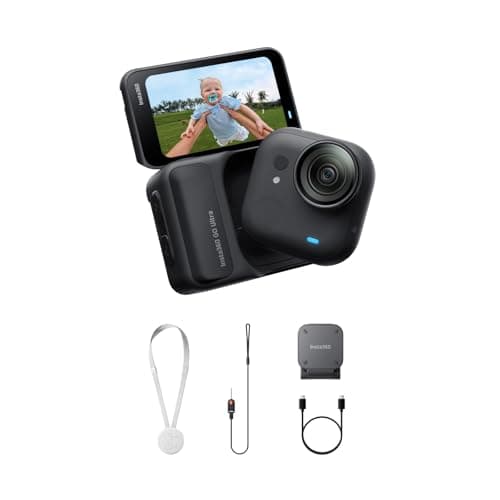
- IPX8 to 33ft (10m), camera only
- 53g
- Up to 170 min with the Action Pod
- 7.0
- 8.0
- 7.5
- 8.0
- 8.0
Insta360 GO Ultra
Insta360
53 grams and IPX8 to 10m on its own — the camera you actually clip on for a paddle instead of leaving in the dry bag.
Hands-free clips where a full-size camera would never leave the bag
- 53g means it goes on a hat brim, a PFD strap or a chest magnet and you forget it is there
- IPX8 to 10m for the camera itself, with a 1/1.28" sensor that is far larger than the size suggests
- Action Pod adds a flip screen and the long runtime when you want it
- Removable microSD, so you are not stuck with fixed onboard storage
- The Action Pod is not rated to the same depth as the camera — read the two ratings separately
- Magnetic mounting is convenient but is not a mechanical lock in real chop
- No interchangeable lens cover, so a scratch is permanent
Specs from Insta360 GO Ultra published specifications.
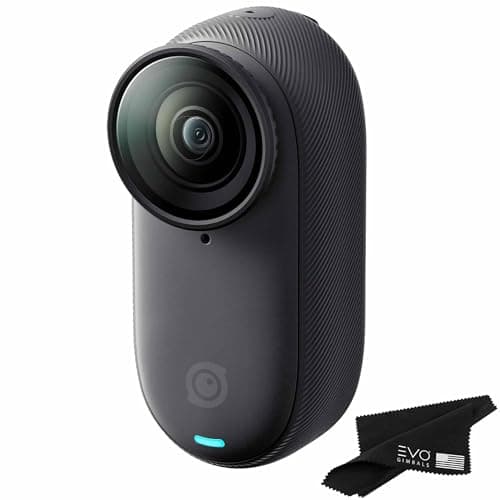
- IPX8 to 33ft (10m), camera only
- 39.1g camera / 96.3g Action Pod
- 38 min alone / 140 min with the Action Pod
- 7.0
- 7.5
- 6.0
- 7.5
- 6.5
Insta360 GO 3S
Insta360
39 grams, IPX8 to 33ft on the camera alone, and fixed storage — the cheapest way into the clip-on format if you can live without a card slot.
A second angle you clip to a hat brim or a PFD strap and forget
- 39.1g on Insta360's published figure — light enough to wear on clothing with no harness
- IPX8 to 33ft (10m) for the camera itself, the same bare depth Insta360 publishes for the GO Ultra
- Magnetic pendant and clip mounting that goes where a two-prong cage cannot
- Sits below the GO Ultra on price while doing the same hands-free job
- A 1/2.3" sensor against the GO Ultra's 1/1.28" — low light is where the gap shows
- Fixed 64GB or 128GB storage with no card slot, so the capacity you buy is the capacity you keep
- 38 minutes on the camera alone; the long runtime needs the Action Pod
- The Action Pod is IPX4 splash-resistant only — it is not a part you take swimming
Specs from Insta360 GO series published hardware specifications.
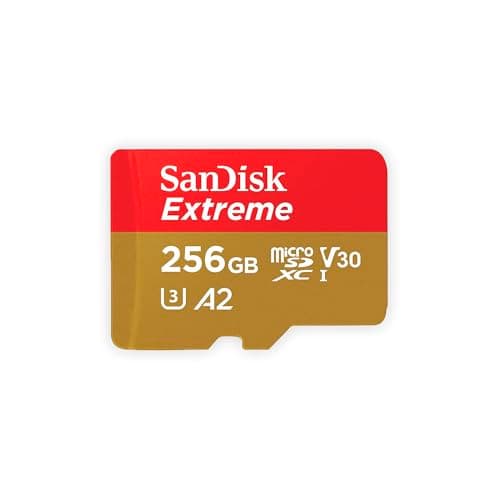
- U3 · V30 · A2 · Class 10
- Up to 190MB/s read, 130MB/s write
- Shock, temperature, water and X-ray proof
- 8.5
- 9.5
- 9.0
- 9.0
- 8.0
SanDisk Extreme microSDXC UHS-I
SanDisk
The card that appears on every manufacturer compatibility list, rated V30 and built to survive being wet, cold and dropped.
Anyone who does not want to think about cards again
- V30 guarantees a 30MB/s minimum sustained write, which is what high-bitrate video actually needs
- SanDisk publishes shockproof, temperature-proof, waterproof and X-ray-proof ratings
- Appears on GoPro, DJI and Insta360 tested-card lists more often than any other card
- Capacities up to 1TB, so a long trip does not need a card swap
- Write speeds vary by capacity — the 64GB tops out at 80MB/s write, the 128GB at 90MB/s
- Counterfeits are common; buy from a seller you trust
- V30 is the floor, not the ceiling — 8K on some cameras wants more headroom
Specs from SanDisk Extreme microSDXC UHS-I product page.
02
How we picked
We do not lab-test, bench-test or dive-test cameras, and we do not own test units. What we do instead is read the manufacturer's published specifications, read the independent reviews that genuinely do test, read owner reports for the failure modes specs never mention — fogging, salt corrosion, cold battery collapse, mount slippage — and then weight all of it for action cameras used on lake and trail. Where a number is not published, the page says “not published” rather than filling the cell.
The full method, including what we refuse to do, is on the editorial policy page.
- 30%Water survival
- Rated depth without a case, door design, and what the manufacturer actually publishes.
- 25%Stabilization in chop
- A kayak deck and a rooty trail shake in ways a handheld walk test never shows.
- 20%Battery in the cold
- Published runtime, spare-battery cost, and whether it charges while recording.
- 15%Mount ecosystem
- Finger mount, threaded, magnetic — and how much of it you have to re-buy.
- 10%Footage you will keep
- Lens replaceability, low-light behavior, and how much cutting the footage needs.
03
Questions people actually ask
01Is the Insta360 GO Ultra worth it over the GO 3S?
For most buyers, yes. The GO Ultra has roughly four times the sensor area (1/1.28" against 1/2.3"), a microSD slot instead of fixed storage, a larger battery and roughly twice the charging speed. The GO 3S wins on weight — 39.1g against 52.9g — and on price.
02Does the Insta360 GO 3S take a memory card?
No. The GO 3S has 64GB or 128GB of built-in storage and no card slot, so the capacity you buy is fixed for the life of the camera. The GO Ultra has no built-in storage and takes a microSD card up to 2TB.
03Are the GO Ultra and GO 3S waterproof to the same depth?
Yes. Insta360 publishes IPX8 and 33ft (10m) standalone for both cameras, IPX4 splash-resistance for both Action Pods, and 196ft (60m) for the camera and pod in the Dive Case. The water specifications are identical.
04Can you take the Action Pod swimming?
No — on either camera. The Action Pod is rated IPX4, which is splash resistance, not submersion. Take the camera out of the pod before it goes in water. Docking the camera in the pod and swimming with the assembled unit is the standard way these cameras get destroyed.
05Which is lighter, the GO Ultra or the GO 3S?
The GO 3S, at approximately 39.1g against the GO Ultra's 52.9g. The newer camera is the heavier one — it spent the difference on the sensor, the battery and the card slot.
06How long does each camera record for?
On Insta360's published figures: the GO Ultra camera alone, 70 minutes at 1080p24 in Endurance Mode, or 200 minutes with the Action Pod; the GO 3S camera alone, 38 minutes at 1080p30, or 140 minutes with the pod. The two were measured at different settings, so read them as a ranking rather than a direct comparison.
04
Read this next
Insta360 GO Ultra review
The winner here on its own, with both water ratings explained properly.
How to choose an action camera
The decision above this one: whether a wearable belongs in your kit at all.
The best SD cards for action cameras
Only relevant to one of these two cameras, which is itself the point.
The best GoPro for family vacations
The conventional alternative, rated as one sealed unit with no pod to flood.
The easiest action cameras to use
If simplicity rather than size is the real requirement.
05
Sources
- Insta360 GO series published hardware specifications (GO Ultra, GO 3S, GO 3)
- Insta360 GO 3S published hardware specifications
- Insta360 GO Ultra published specifications (4K60 top video mode)
- Tom's Guide, Insta360 GO 3S review (4K30 top video mode)
- Insta360 GO Ultra published specifications
- SanDisk Extreme microSDXC UHS-I product page
Specifications are quoted from the manufacturer pages above as they read on the dates shown. Where a figure is not published, this site says so rather than estimating one. We have not tested these products.