How deep can an action camera actually go?
Every published rating in one table, and the difference between what the camera is rated to and what the box says.
Part of On the Water.
We earn a commission if you buy through our links, at no extra cost to you. It never changes what we recommend or the order we rank it in — how this works.
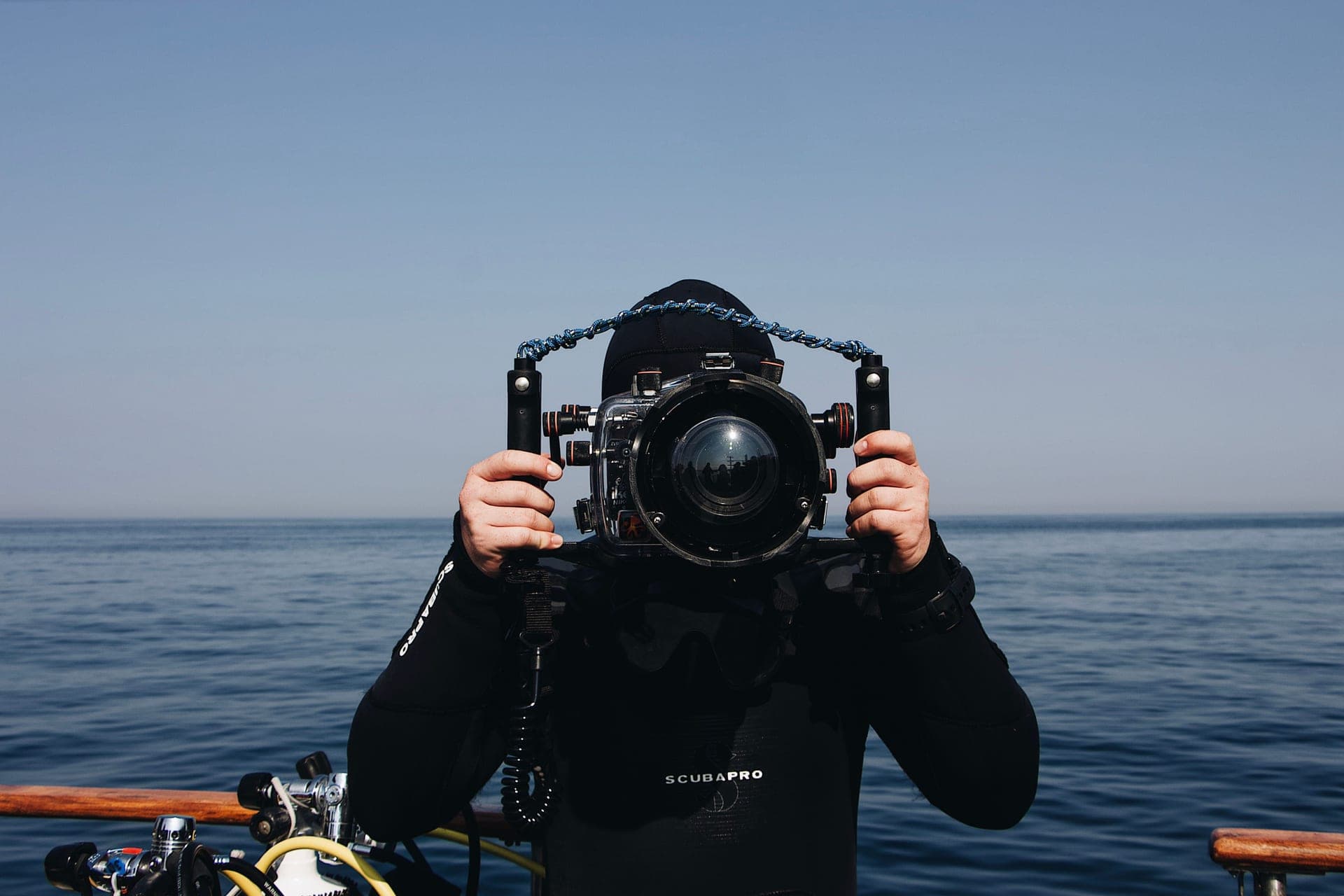
Between 5m and 20m, depending on the model — and up to 60m in the manufacturer's dive housing. DJI rates the Osmo Action 5 Pro to 20m bare and the Action 4 to 18m. Insta360 rates the X5 to 15m (IP68) and the Ace Pro 2 to 12m. GoPro rates the HERO13 Black to 10m (33ft) and the small HERO (2024) to 5m. GoPro's Protective Housing takes a HERO13, 12, 11 or 10 Black to 196ft (60m), and DJI and Insta360 publish 60m figures for their own dive cases.
The full table
| Camera | Without a housing | With the maker's case | How it is stated |
|---|---|---|---|
| DJI Osmo Action 5 Pro | 20m | 60m | Depth rating |
| DJI Osmo Action 4 | 18m | 60m | Depth rating |
| Insta360 X5 | 15m (49ft) | Not published for the X5 case | IP68 plus depth |
| Insta360 Ace Pro 2 | 12m (39ft) | 60m (197ft) | Depth rating |
| Insta360 X4 | 10m (33ft) | 50m (164ft) | Depth rating |
| GoPro HERO13 Black | 10m (33ft) | 60m (196ft) | Depth rating |
| AKASO Brave 8 Lite | 10m (33ft), IPX8 | 60m (198ft) | IPX8 plus depth |
| Insta360 GO Ultra | 10m (33ft), IPX8 — camera only | Not published | IPX8 plus depth |
| GoPro HERO (2024) | 5m (16ft) | Not published | Depth rating |
Note the Insta360 GO Ultra row carefully: the 10m rating is for the camera itself. The Action Pod it docks into is a separate product with a separate rating, and treating them as one thing is how people flood a GO.
What a depth rating actually promises
Less than most people assume, and the gap is where cameras die.
A manufacturer's depth rating describes a new, undamaged camera with its doors correctly closed and its seals clean, submerged in still water. It is a laboratory statement about a specific physical configuration.
It does not promise anything about a camera whose door gasket has a grain of sand on it. It does not promise anything about a gasket that has been compressed five hundred times over three seasons. It does not account for the pressure spike of hitting the water hard from a jump, or for thermal shock going from a hot deck straight into cold water. And it says nothing about time — most ratings assume a dive, not a camera left submerged all afternoon.
IP ratings versus depth ratings
You will see both, and they are not the same claim.
A depth rating is a direct statement: this camera is rated to this depth.
An IP rating — IP68 or IPX8 — comes from an international ingress-protection standard. The first digit is dust (6 is the top; X means not rated). The second is water, and 8 means continuous submersion under conditions the manufacturer specifies. That last part is the catch: the standard deliberately leaves depth and duration to the manufacturer, so IPX8 alone tells you almost nothing.
This is why the good listings state both — Insta360 says IP68 and 15m; AKASO says IPX8 and 10m. If you find a product claiming only an IP rating with no depth attached, go and find the depth before you get in the water with it.
When a housing is the right answer
Three situations, and only three.
You are going deeper than the bare rating. Scuba diving, primarily. GoPro's Protective Housing is rated to 196ft (60m), which covers recreational diving with margin.
You want impact protection. A housing is also armor, which matters around rock, boats and boards.
Your camera is older or heavily used. Seals age. A housing on a four-year-old camera is a reasonable precaution.
Outside those, a housing costs you more than it gives: muffled audio, harder buttons with cold hands, an O-ring to inspect, and the fogging problem — sealed warm air plus cold water equals condensation on the inside of the glass, which no setting can touch.
What actually floods a camera
In rough order of how often it happens:
- A door that was not fully latched. Every camera here has a two-stage latch and a partially closed door looks closed. Check it every time.
- Grit on the seal. Sand on a gasket is the classic. Rinse and dry the camera before opening it, not after.
- A damaged or perished gasket. Look at it in good light occasionally. Salt, sunscreen and UV all age rubber.
- A housing O-ring with a hair on it. One hair is enough. This is the main reason a housing is not automatically safer than a bare camera.
- Opening it wet. Water sitting in the door recess runs straight into the battery bay.
None of these are depth failures. Which is the real point of this page: the rating is rarely what lets you down.
01
What to buy for the depth you actually go to
Two routes to depth: a camera rated deep enough on its own, or a housing. The housing wins below about 20m and costs you audio and a fogging risk above it.
- 196ft (60m)
- HERO13, 12, 11, 10 Black
- Flat glass front
- 9.5
- 8.5
- 8.0
- 7.0
- 6.0
GoPro Protective Housing
GoPro
196ft (60m) rated, with a flat glass lens — the piece that turns a 33ft camera into a diving camera.
Anything below about 30ft, and any camera going anywhere near a tank
- 60m is six times the HERO13 Black's bare rating
- Flat glass lens rather than plastic, so the image holds up
- Includes a skeleton backdoor for better audio when you are not underwater
- Also the best impact protection the camera can wear
- Muffles audio badly with the sealed door — that is physics, not a defect
- Sealed air plus a temperature change is exactly how fogging happens; budget for inserts
- Buttons are harder to work with gloves on
Specs from GoPro Protective Housing product page.
- 20m bare / 60m with case
- 1950mAh · 240 min at 1080p24
- -20° to 45°C
- 9.5
- 9.0
- 9.5
- 8.0
- 9.0
DJI Osmo Action 5 Pro
DJI
Goes to 20m with no housing at all and publishes a 240-minute runtime — the two numbers that decide a long, wet, cold day.
Long paddles, cold water, and anyone tired of buying a housing to get past 10m
- 20m without the Waterproof Case — double the bare-camera depth of the HERO13 Black
- DJI publishes 240 minutes of recording at 1080p/24 with screens off, the longest figure in this set
- Rated to -20°C, which matters more on an October lake than any resolution number
- 1/1.3-inch sensor holds detail when the light goes flat
- Mount ecosystem is smaller than GoPro's, and magnetic quick-release adapters are their own purchase
- 146g — the heaviest of the flagship three
- Fewer third-party mounts and filters exist for it
Specs from DJI Osmo Action 5 Pro published specifications.

- IP68 to 49ft (15m)
- 2400mAh · ~88 min at 8K30
- User-replaceable
- 9.5
- 9.5
- 9.0
- 8.5
- 7.5
Insta360 X5
Insta360
15m rated, replaceable lenses, and the one camera that means you never have to aim while you are paddling.
Anyone filming themselves on the water who cannot stop to frame a shot
- 15m IP68 is the deepest bare rating of any camera on this site
- User-replaceable lenses — the single biggest fix for the 360 format's worst failure mode
- 185 minutes in Endurance mode at 5.7K24, which is a whole day of clips
- Invisible-selfie-stick reframing means you point the camera at nothing and pick the angle later
- Exposed lenses still scratch; lens guards are a purchase, not an option
- Every clip needs a reframing pass before anyone else can watch it
- 8K30 files are large and the edit is slower than flat footage
Specs from CineD, Insta360 X5 announcement with published specifications.
02
How we picked
We do not lab-test, bench-test or dive-test cameras, and we do not own test units. What we do instead is read the manufacturer's published specifications, read the independent reviews that genuinely do test, read owner reports for the failure modes specs never mention — fogging, salt corrosion, cold battery collapse, mount slippage — and then weight all of it for cases and housings used on lake and trail. Where a number is not published, the page says “not published” rather than filling the cell.
The full method, including what we refuse to do, is on the editorial policy page.
- 35%Rated depth
- The number the manufacturer publishes, with the model it was rated on.
- 25%Seal design
- O-ring serviceability is the difference between a flood and a rinse.
- 18%Optical clarity
- A flat port costs sharpness underwater; some housings cost more than others.
- 12%Button access
- What you can change without surfacing.
- 10%Fog risk
- Sealed air plus temperature change is how a dive ends up unusable.
03
Questions people actually ask
01How deep can a GoPro go without a housing?
The HERO13 Black is rated to 33ft (10m). The smaller HERO (2024) is rated to 16ft (5m). Both figures come from GoPro's own specification pages and describe the camera with its door correctly closed.
02How deep can a GoPro go with the dive housing?
GoPro's Protective Housing is published as waterproof to 196ft (60m) and is listed as compatible with the HERO13, HERO12, HERO11 and HERO10 Black. That covers recreational scuba with margin.
03Which action camera goes deepest without a case?
Of the cameras on this site, the DJI Osmo Action 5 Pro at 20m, followed by the Osmo Action 4 at 18m and the Insta360 X5 at 15m. That is the single strongest argument for the DJI bodies if you spend time under the surface rather than on it.
04Can I take an action camera scuba diving?
Not on its bare rating — recreational diving goes well past every figure in the table. Use the manufacturer's dive housing, fit fresh anti-fog inserts, and inspect the O-ring before every dive.
05Does the depth rating change in salt water?
The pressure rating itself does not meaningfully change, but salt attacks seals, threads and buttons over time in a way fresh water does not — so a salt-used camera drifts away from its as-new rating faster. The rinse routine matters: salt water care and rinsing.
06What does IPX8 mean for depth?
It means continuous submersion at a depth and duration the manufacturer declares — the standard does not fix a number. Always look for the depth figure stated alongside it, and be skeptical of any product that only gives you the IP rating.
04
Read this next
Best waterproof action cameras
The same ratings, turned into a ranked buying decision.
Cases and dive housings
What a 60m housing costs you above the surface.
Anti-fog inserts that work
The consumable that comes with every housing decision.
Salt water care and rinsing
How a rated camera slowly stops being one.
Floats and tethers
Depth rating is irrelevant if it is on the bottom.
05
Sources
- DJI Osmo Action 5 Pro specifications
- DJI Osmo Action 4 specifications
- GoPro HERO13 Black published specifications
- GoPro HERO (2024) published specifications
- Insta360 X4 product page
- AKASO Brave 8 Lite specifications
- GoPro Protective Housing product page
- CineD, Insta360 X5 announcement with published specifications
Specifications are quoted from the manufacturer pages above as they read on the dates shown. Where a figure is not published, this site says so rather than estimating one. We have not tested these products.