Insta360 X5 vs X4
One difference on this page is worth more than all the others combined, and it is not the sensor or the resolution.
Part of Cameras.
We earn a commission if you buy through our links, at no extra cost to you. It never changes what we recommend or the order we rank it in — how this works.

Buy the Insta360 X5 if the camera goes anywhere abrasive — water, rock, sand, a beach. Its lenses are user-replaceable, which turns the 360 format's worst and most likely failure into a part you order, and it is rated IP68 to 15m against the X4's 10m. Buy the X4 if the camera lives on a bike, a helmet or dry trail and the money saved matters: it shoots the same 8K30, does the same invisible selfie stick trick, and has removable lens guards that protect the glass it cannot replace.
The specification table
| Insta360 X5 | Insta360 X4 | |
|---|---|---|
| Waterproof, no case | IP68 to 49ft (15m) | 33ft (10m) |
| With the dive case | Not published for the X5 case | 50m (164ft) |
| Lenses | User-replaceable | Not user-replaceable; removable lens guards |
| Capture | 8K30 360 | 8K30 360 |
| Battery | 2400mAh | 2290mAh |
| Published runtime | ~88 min at 8K30 / 185 min Endurance at 5.7K24 | 135 min at 5.7K30 |
| Weight | Not published here | 203g |
Why the lens question dominates everything else
A 360 camera works by pointing two hemispherical lenses in opposite directions and stitching the results together. That design means the glass bulges outward, unprotected, on both sides — there is no flat recessed front element the way there is on a conventional action camera. It is the format's defining compromise and it is the reason most dead 360 cameras are dead.
Sand does it. A rock on a riverbank does it. Reef does it. So does setting the camera down lens-first on a gravel path once, which is the version that catches most people. And a scratch on a 360 lens is worse than a scratch on a flat camera, because the stitch line runs through the middle of the frame — damage shows up as a smear that no software removes and that sits in every single shot.
On the X4, a deep scratch is a service job: the lenses are not user-replaceable, so you are looking at sending it away or living with it. On the X5, the lenses are a part you unscrew and replace at the kitchen table. Same failure, entirely different outcome.
Which is why the honest version of this comparison is a question about your habits, not your budget. If this camera is going to spend its life on a kayak deck, in salt water or on a beach, the X5 is cheaper over three seasons even though it costs more today. If it is going to live on a handlebar on dry trail and come home in a case, the X4's lens guards are genuinely adequate and the X5's advantage is theoretical.
The 5 meters of depth, in practice
15m against 10m sounds like a specification argument and is mostly a margin argument. Almost nobody snorkels at 12 meters. What the extra 5m actually buys is slack: a depth rating describes a new camera with clean, correctly closed seals in still water, and it makes no promise about a three-season-old gasket or the pressure spike of being thrown into a wave. Being rated to 15m and used at 4m means the rating is nowhere near the limit, which is the right place for it to be. The full argument is on how deep an action camera can actually go.
One asymmetry worth knowing: Insta360 publishes a 50m figure for the X4's Invisible Dive Case and does not publish an equivalent for an X5 case. If you specifically plan to dive with a 360 camera, check current case availability for the body you are buying before you commit, because on published figures today the X4 is the one with a documented deep-water route.
What is the same, and it is most of the camera
Both bodies capture 8K30 360 video. Both do the invisible selfie stick trick, which is the actual reason anyone buys one of these: the pole disappears from the footage, so you get a floating third-person shot of yourself paddling, riding or walking with nobody holding a camera. Both let you point the camera at nothing and choose the angle afterwards, which is the capability that has no equivalent on a flat camera.
Both also charge you the same tax for it. Every clip needs a reframing pass before another person can watch it, the files are large, and the edit is slower than flat footage. That is the real trade in owning a 360 camera and it does not change between these two models — if you have not decided whether you want to pay it, read 360 camera vs action camera before you pick between X5 and X4.
Battery, read carefully
The published numbers are not directly comparable and it is worth saying why. Insta360 quotes roughly 88 minutes at 8K30 for the X5 and 185 minutes in Endurance mode at 5.7K24; the X4 is quoted at 135 minutes at 5.7K30. Those are three different settings, so the useful reading is: both last a normal day of clips, neither lasts a day of continuous 8K, and the X5 has the larger cell and the explicit low-power mode.
In cold weather both will come in under their figures, as everything does. If that is your use case, the same rules apply as anywhere else — see action camera battery life compared.
Which one we would actually buy
For this site's buyer — lake, kayak, paddleboard, coast — the X5, without much hesitation. The use case is wet, gritty and hard on exposed glass, and both of the X5's advantages point precisely at that. It is the body we rank first on the best 360 cameras for kayaking.
For a trail rider, a skier or anyone whose 360 camera lives on a helmet and comes home in a bag, the X4 is the better value and the compromise is one you will probably never meet. It is still the camera on the 360 mountain biking page worth considering on price.
01
The two cameras, and the accessory both need
Both are genuinely good 360 cameras with the same core trick. The pole is not optional on either — the invisible-selfie-stick effect is the entire reason to own one of these.
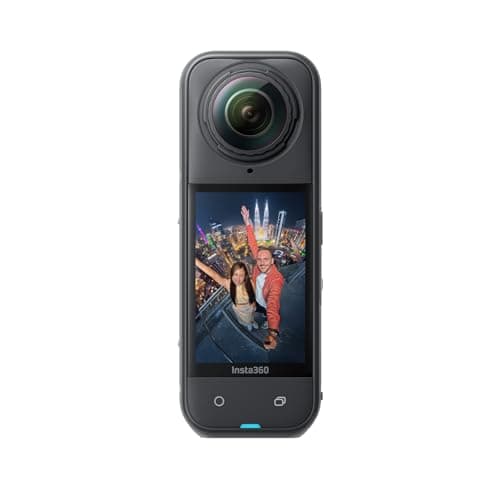
- IP68 to 49ft (15m)
- 2400mAh · ~88 min at 8K30
- User-replaceable
- 9.5
- 9.5
- 9.0
- 8.5
- 7.5
Insta360 X5
Insta360
15m rated, replaceable lenses, and the one camera that means you never have to aim while you are paddling.
Anyone filming themselves on the water who cannot stop to frame a shot
- 15m IP68 is the deepest bare rating of any camera on this site
- User-replaceable lenses — the single biggest fix for the 360 format's worst failure mode
- 185 minutes in Endurance mode at 5.7K24, which is a whole day of clips
- Invisible-selfie-stick reframing means you point the camera at nothing and pick the angle later
- Exposed lenses still scratch; lens guards are a purchase, not an option
- Every clip needs a reframing pass before anyone else can watch it
- 8K30 files are large and the edit is slower than flat footage
Specs from CineD, Insta360 X5 announcement with published specifications.
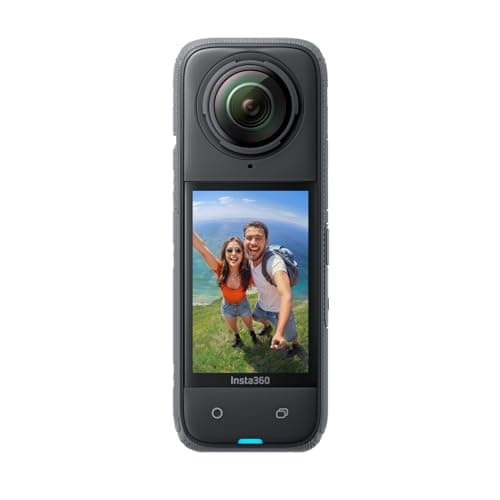
- 33ft (10m) / 50m with dive case
- 2290mAh · 135 min at 5.7K30
- 203g
- 8.5
- 9.0
- 8.5
- 8.5
- 7.5
Insta360 X4
Insta360
The previous X-series flagship: same 8K reframing trick, 10m rated, and usually a good deal less money.
A first 360 camera when the X5's deeper rating is not worth the difference
- 8K30 360 capture and the same invisible-selfie-stick effect as the X5
- Removable lens guards, so the lenses are protectable
- 135 minutes at 5.7K30 is a real day on the water
- Invisible Dive Case takes it to 50m when you need it
- 10m bare against the X5's 15m
- Lenses are not user-replaceable the way the X5's are — a deep scratch is a service job
- 203g on a pole is noticeable after an hour
Specs from Insta360 X4 published specifications.
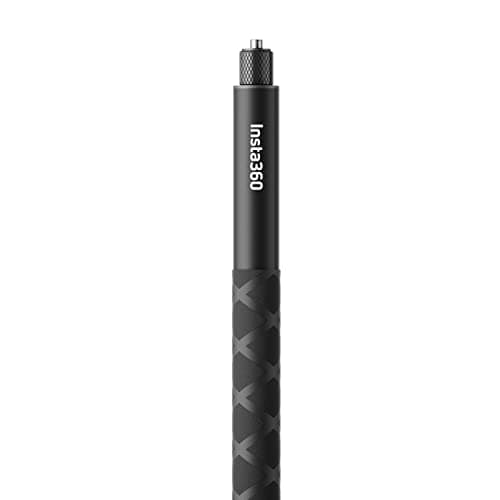
- 23.3cm to 114.1cm
- Aluminum
- 1/4-20 screw
- 6.5
- 9.0
- 7.0
- 9.0
- 7.0
Insta360 114cm Invisible Selfie Stick
Insta360
The pole that disappears in a 360 shot — the single accessory that makes a 360 camera worth owning on the water.
Third-person paddling shots from an X-series camera
- Vanishes from 360 footage, which is the whole reason the format works for self-filming
- Collapses to 23cm and stows in a deck bag
- Standard 1/4-20, so it takes more than just Insta360 cameras
- Light enough to hold out one-handed while the other hand paddles
- Insta360 says plainly it is not designed for high-speed adventures
- Aluminum sections seize if you put them away wet and salty
- It does not float, and a dropped pole with a camera on it sinks fast
Specs from Insta360 114cm Invisible Selfie Stick product page.
02
How we picked
We do not lab-test, bench-test or dive-test cameras, and we do not own test units. What we do instead is read the manufacturer's published specifications, read the independent reviews that genuinely do test, read owner reports for the failure modes specs never mention — fogging, salt corrosion, cold battery collapse, mount slippage — and then weight all of it for 360 cameras used on lake and trail. Where a number is not published, the page says “not published” rather than filling the cell.
The full method, including what we refuse to do, is on the editorial policy page.
- 30%Water survival
- Exposed lenses change the rules — rated depth and lens-guard availability both count.
- 25%Reframing payoff
- A 360 camera is only worth it if the reframing genuinely saves shots you would have missed.
- 20%Battery in the cold
- Stitching two sensors costs power; cold costs more.
- 15%Mount ecosystem
- Invisible-selfie-stick geometry is the whole trick, and it depends on the mount.
- 10%Edit time
- Every 360 clip needs a pass before anyone can watch it.
03
Questions people actually ask
01Is the Insta360 X5 worth upgrading to from an X4?
If you shoot in water or around sand and rock, yes — the user-replaceable lenses change what a scratch costs you, and 15m gives real margin over 10m. If your X4 lives on dry trail with lens guards fitted, the upgrade buys you very little.
02What is the main difference between the X5 and X4?
Two things: the X5's lenses are user-replaceable and the X4's are not, and the X5 is rated IP68 to 15m against the X4's 10m. Both capture 8K30 and do the same invisible-selfie-stick reframing.
03Do the X5 and X4 shoot the same resolution?
Yes — both are 8K30 in 360 mode. Resolution is not the reason to pick between them, which is unusual for a generational comparison and worth knowing before you pay for the newer body.
04Can you dive with an Insta360 X5 or X4?
Insta360 publishes a 50m figure for the X4's Invisible Dive Case and does not publish an equivalent for an X5 case. If diving is the plan, check current case availability for the specific body before buying — on published figures the X4 is the one with a documented deep route.
05Do I need lens guards for a 360 camera?
Yes, on either body. The lenses bulge outward with nothing protecting them, a scratch sits in the middle of every frame through the stitch line, and guards cost a fraction of a lens. On the X4 they are the only protection available.
04
Read this next
Insta360 X5: the specs that matter
The winner here, on its own, with the replaceable lenses assessed properly.
The best 360 cameras for kayaking
Where this comparison lands for a paddler specifically.
360 camera vs action camera
The decision above this one: whether you want the reframing workflow at all.
360 cameras for mountain biking
The dry-land case, where the X4 is the value answer.
Paddle and pole mounts
The invisible stick is the whole trick. This is how to hold it.
05
Sources
- CineD, Insta360 X5 announcement with published specifications
- Insta360 X4 published specifications
- Insta360 114cm Invisible Selfie Stick product page
Specifications are quoted from the manufacturer pages above as they read on the dates shown. Where a figure is not published, this site says so rather than estimating one. We have not tested these products.