Insta360 Ace Pro 2: the official specs, and which ones matter
The best-looking image of the three flagships, and the only one with a screen that lets you frame a shot you are standing in front of.
Part of Cameras.
We earn a commission if you buy through our links, at no extra cost to you. It never changes what we recommend or the order we rank it in — how this works.
The Insta360 Ace Pro 2 shoots 8K30 on a 1/1.3-inch sensor with a Leica lens, is rated waterproof to 39ft (12m) bare and 60m in its dive case, publishes 180 minutes of battery life with 80% charge in 18 minutes, and has a flip-up screen. It is the image-quality pick of the current flagships and the only one where you can frame a shot you are standing in front of rather than guessing at it, which makes it the camera for family trips and for anything you narrate to camera. What it gives up is depth — 12m is less than both DJI bodies — and the mount ecosystem, which is smaller than GoPro's.
The published specification table
Figures below are quoted from Insta360's own Ace Pro 2 product page, read on 2026-09-23. Where Insta360 does not publish a number, the row says so.
| Specification | Published figure |
|---|---|
| Waterproof | 39ft (12m), no case |
| With the dive case | 60m (197ft) |
| Sensor | 1/1.3" with a Leica lens |
| Video ceiling | 8K30 |
| Battery | 1800mAh, user-removable |
| Published runtime | 180 min |
| Fast charge | 80% in 18 minutes |
| Screen | Flip-up rear screen |
| Stabilization | FlowState |
| Operating temperature | Not published |
The flip screen is the reason to buy it
This is unusual for a flagship action camera, because normally the headline specification is a resolution number. Here the feature that changes your footage is a hinge.
Every other camera in this class gives you, at best, a small front-facing display that confirms a frame exists. It tells you roughly where you are pointing. It does not show you the shot. The result is the same three mistakes forever: your head is cropped at the top, the horizon is tilted, and the thing behind you that justified the shot is out of frame — all of which you discover at home.
A screen that flips up solves it completely. You see your own frame while you are in it. For anything self-filmed — a piece to camera, a family shot where you are in the picture, a chest-mounted angle you are setting up — that is the difference between usable and nearly usable. It is why this body leads the travel vlogging roundup and ranks high on family travel.
It is also why we rank it first on snorkelling: being able to frame a shot of the person you are swimming with, rather than pointing and hoping, is worth more underwater than anywhere else.
The sensor, and where it actually shows
A 1/1.3-inch sensor is large for this class, and it is one of the few spec-sheet figures that translates into something visible — but not in the situation people expect.
In bright midday sun, every camera on this site produces a perfectly good image and sensor size barely matters. Where it matters is when the light goes flat or short: an overcast afternoon, the hour before sunset, under tree cover on a trail, and especially underwater, where the available light is both dimmer and missing a chunk of its spectrum. In those conditions the larger sensor holds detail and keeps noise down where a smaller one starts to smear.
The 8K30 figure is a different thing and worth reading carefully. It is genuinely useful if you crop or reframe in an edit — it gives you pixels to spend. It is of no use at all if the footage goes to a phone as shot, where it costs you battery, card space and export time for detail nobody sees. Shoot 4K/30 for normal use and reach for 8K when you know you will crop.
12 meters, and whether it is enough
For most of what this site covers, comfortably. Snorkelling happens in the top five meters almost all of the time, swimming in the top two, and a capsize is a submersion rather than a descent. 12m bare clears all of that with margin, and margin is the right way to read a depth rating — it describes a new camera with clean, correctly closed seals in still water and promises nothing about an aged gasket or a hard entry.
Where 12m is a genuine limitation is next to the competition. DJI publishes 20m for the Osmo Action 5 Pro and 18m for the Action 4, so if you free-dive, or you simply want the largest possible cushion, the DJI bodies give you more for the same money class. Insta360 publishes 60m (197ft) for the Ace Pro 2's dive case if you need to go deeper. Every rating in the category is tabulated on how deep can an action camera go.
Where it loses
Mounts. GoPro's two-prong interface has been the category standard for over a decade, so the selection of engineered brackets is wider for GoPro than for Insta360, and switching ecosystems costs you adapters. See are action camera mounts universal?
Stabilization in the worst conditions. FlowState is very good. On the published evidence, HyperSmooth 6.0 with AutoBoost is ahead when the motion is violent — whitewater, rough singletrack. On flat water and gravel you will not see a difference: HyperSmooth vs RockSteady vs FlowState.
Depth, as above. And the dive case is a separate purchase for anything past 12m.
Filter availability. Depth-rated color-correction filter selection tracks market share, so GoPro is best served. If underwater color is a priority this asymmetry is real — filters and dome ports for water.
Who should buy it instead of a GoPro or a DJI
Buy the Ace Pro 2 if the footage has people in it and you care how it looks. Family trips, travel where you narrate to camera, anything shot in poor light. The flip screen and the sensor both point at exactly that buyer.
Buy a DJI if your days are long, cold or deep — that is a runtime and depth argument and DJI wins it. Buy a GoPro if you ride rough trail, already own mounts, or want the steadiest possible footage. The three-way comparison is in GoPro vs Insta360 vs DJI.
How we assessed this
We do not lab-test or dive-test cameras and we do not own test units. Every figure above is quoted from Insta360's published specification page, linked below, read on the date stated. Which specifications we treat as decisive is an editorial judgment weighted for lake-and-trail use and is kept separate from the published numbers. The full method is on the editorial policy page.
01
What we would actually buy with it
The camera, a fast card because 8K is a real bitrate, and the GO Ultra if you want a second angle that clips to a strap.
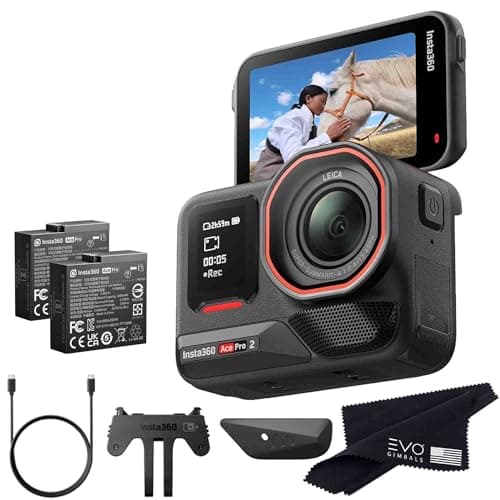
- 39ft (12m) / 60m with dive case
- 1800mAh · 180 min published
- 1/1.3" with Leica lens
- 8.5
- 8.5
- 9.0
- 7.5
- 9.5
Insta360 Ace Pro 2
Insta360
The best-looking image of the three flagships, with a flip screen that finally makes a chest-mounted shot something you can frame.
Family trips where you want the footage to look like more than dashcam clips
- 8K30 with a 1/1.3-inch sensor — the most detail in the group
- 12m bare, which clears every snorkel depth without a housing
- 180-minute published battery life and 80% charge in 18 minutes
- Flip screen means you can frame a shot you are standing in front of
- 12m is still short of the DJI's 20m
- The dive case is a separate purchase for anything past 12m
- Fewer mount options than GoPro, and an adapter tax if you switch
Specs from Insta360 Ace Pro 2 published specifications.
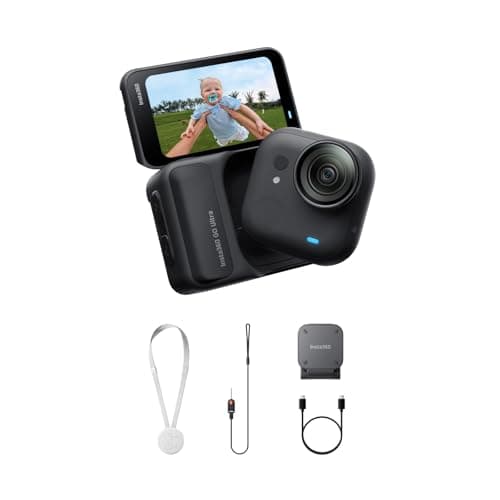
- IPX8 to 33ft (10m), camera only
- 53g
- Up to 170 min with the Action Pod
- 7.0
- 8.0
- 7.5
- 8.0
- 8.0
Insta360 GO Ultra
Insta360
53 grams and IPX8 to 10m on its own — the camera you actually clip on for a paddle instead of leaving in the dry bag.
Hands-free clips where a full-size camera would never leave the bag
- 53g means it goes on a hat brim, a PFD strap or a chest magnet and you forget it is there
- IPX8 to 10m for the camera itself, with a 1/1.28" sensor that is far larger than the size suggests
- Action Pod adds a flip screen and the long runtime when you want it
- Removable microSD, so you are not stuck with fixed onboard storage
- The Action Pod is not rated to the same depth as the camera — read the two ratings separately
- Magnetic mounting is convenient but is not a mechanical lock in real chop
- No interchangeable lens cover, so a scratch is permanent
Specs from Insta360 GO Ultra published specifications.
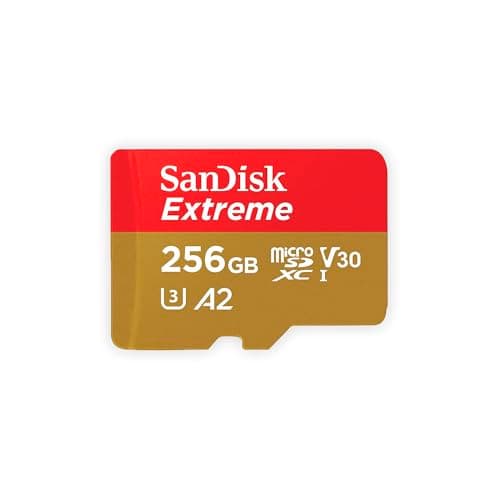
- U3 · V30 · A2 · Class 10
- Up to 190MB/s read, 130MB/s write
- Shock, temperature, water and X-ray proof
- 8.5
- 9.5
- 9.0
- 9.0
- 8.0
SanDisk Extreme microSDXC UHS-I
SanDisk
The card that appears on every manufacturer compatibility list, rated V30 and built to survive being wet, cold and dropped.
Anyone who does not want to think about cards again
- V30 guarantees a 30MB/s minimum sustained write, which is what high-bitrate video actually needs
- SanDisk publishes shockproof, temperature-proof, waterproof and X-ray-proof ratings
- Appears on GoPro, DJI and Insta360 tested-card lists more often than any other card
- Capacities up to 1TB, so a long trip does not need a card swap
- Write speeds vary by capacity — the 64GB tops out at 80MB/s write, the 128GB at 90MB/s
- Counterfeits are common; buy from a seller you trust
- V30 is the floor, not the ceiling — 8K on some cameras wants more headroom
Specs from SanDisk Extreme microSDXC UHS-I product page.
02
How we picked
We do not lab-test, bench-test or dive-test cameras, and we do not own test units. What we do instead is read the manufacturer's published specifications, read the independent reviews that genuinely do test, read owner reports for the failure modes specs never mention — fogging, salt corrosion, cold battery collapse, mount slippage — and then weight all of it for action cameras used on lake and trail. Where a number is not published, the page says “not published” rather than filling the cell.
The full method, including what we refuse to do, is on the editorial policy page.
- 30%Water survival
- Rated depth without a case, door design, and what the manufacturer actually publishes.
- 25%Stabilization in chop
- A kayak deck and a rooty trail shake in ways a handheld walk test never shows.
- 20%Battery in the cold
- Published runtime, spare-battery cost, and whether it charges while recording.
- 15%Mount ecosystem
- Finger mount, threaded, magnetic — and how much of it you have to re-buy.
- 10%Footage you will keep
- Lens replaceability, low-light behavior, and how much cutting the footage needs.
03
Questions people actually ask
01How deep is the Insta360 Ace Pro 2 waterproof?
39ft (12m) with no case, and 60m (197ft) in Insta360's dive case. That clears every snorkelling depth bare, and it is shallower than DJI's 20m and 18m bare ratings.
02Is the Ace Pro 2 better than a GoPro HERO13 Black?
On image quality and self-framing, yes — the larger sensor and the flip screen have no GoPro equivalent. On stabilization in violent motion, mounts and filter availability, the GoPro is ahead. It depends entirely on whether you are in the frame.
03Does the Insta360 Ace Pro 2 have a flip screen?
Yes, and it is the main reason to buy it. It is the only real self-framing preview among the current flagships — everything else gives you a small front display that confirms a frame exists rather than showing you the shot.
04Do I need to shoot 8K on the Ace Pro 2?
Only if you plan to crop or reframe in an edit. For footage going to a phone or a television as shot, 4K/30 looks the same and costs much less battery, card space and export time.
05How long does the Ace Pro 2 battery last?
Insta360 publishes 180 minutes, with 80% charge in 18 minutes on the 1800mAh removable battery. As with every camera, real use at the highest settings with the screen on comes in under the published figure.
04
Read this next
GoPro vs Insta360 vs DJI
All three ecosystems against each other, not just the bodies.
The best action cameras for travel vlogging
Where the flip screen takes this camera to first place.
Insta360 X5: the official specs
The other Insta360 flagship, and a completely different workflow.
The best action cameras for snorkeling
The use case where the sensor and the screen both earn their keep.
The best SD cards for action cameras
8K30 needs a card that can sustain it. This is which ones do.
05
Sources
- Insta360 Ace Pro 2 published specifications
- Insta360 GO Ultra published specifications
- SanDisk Extreme microSDXC UHS-I product page
Specifications are quoted from the manufacturer pages above as they read on the dates shown. Where a figure is not published, this site says so rather than estimating one. We have not tested these products.