The best action camera mounts
Nobody needs nine mounts. You need the one that fits the thing you are attaching to, and it holds the angle you set. Seven picks, one per attachment method.
Part of Mounts.
We earn a commission if you buy through our links, at no extra cost to you. It never changes what we recommend or the order we rank it in — how this works.
The RAM Tough-Claw clamp with an action camera adapter is the best action camera mount for most people, because it needs no drilling, fits round, square and odd-shaped tubes from 0.625in to 1.14in, and uses a ball-and-socket arm that holds an angle instead of creeping. But mounts are not really a ranked category - they are a compatibility problem. Work out what you are attaching to first: a tube or rail takes the clamp, your body takes the GoPro Chesty, a helmet shell takes the Helmet Front + Side Mount, a kayak with accessory track takes the YakAttack PanFish Pro, a board or hull with nothing to grip takes adhesive pads, a smooth boat hull takes the Suction Cup Mount, and a handlebar or paddle shaft takes the 9-35mm tube mount. Buy the one that matches, not a kit of nine.
01
Quick picks
| # | Product | Best for | Score | Price |
|---|---|---|---|---|
| 01 | 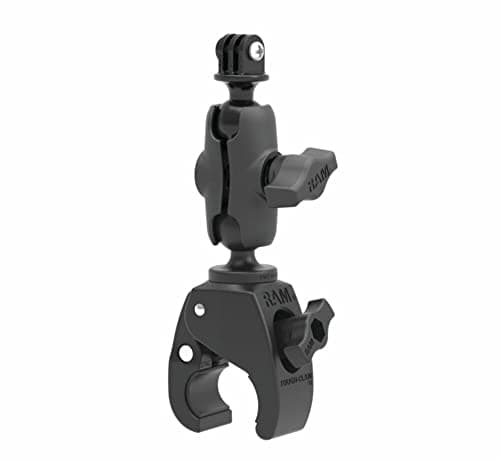 RAM Tough-Claw Clamp Mount with Action Camera Adapter Clamps to anything between 0.625in and 1.14in and does not care whether it is round, square or odd — the mount that solves the boats with no track. | Rails, bars, seat frames and anything you cannot or will not drill | 8.4/ 10 | |
| 02 | 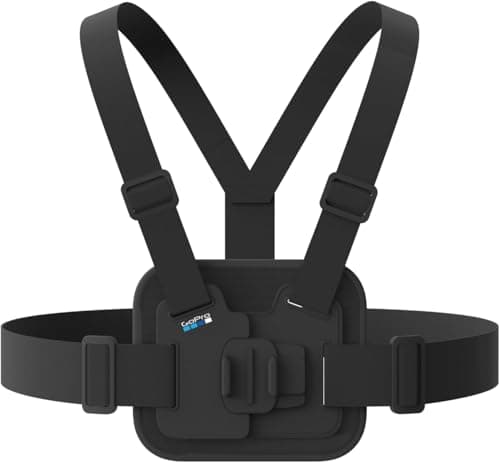 GoPro Chesty Performance Chest Mount The mount that shows your hands — which on a kayak means the paddle, and on a bike means the trail arriving. | Paddling and riding footage where the hands are the story | 8.1/ 10 | |
| 03 | 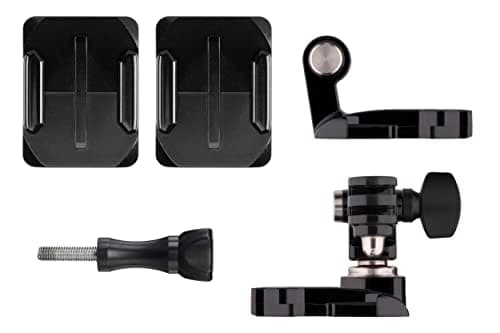 GoPro Helmet Front + Side Mount A swivel assembly and two curved adhesive pads — the only official way to get a side-of-helmet angle that is not a chin bar. | Bike and ski helmets where a top mount is too tall and a chest mount sees too little | 8.2/ 10 | |
| 04 | 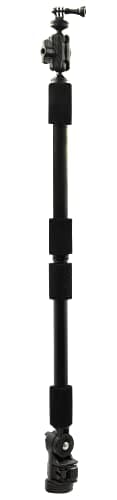 YakAttack PanFish Pro Camera Mount Aluminum, 33 inches tall, mounts to almost every kayak track system, and floats if you drop it in. | Kayak fishing, where the camera has to see the rod tip and the water | 8.8/ 10 | |
| 05 | 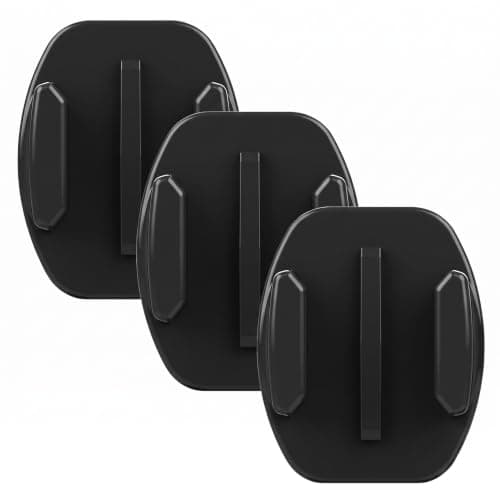 GoPro Curved + Flat Adhesive Mounts Industrial-strength waterproof adhesive pads — the cheapest permanent mount, and the one you have to get right the first time. | Boards, hulls, helmets and anywhere a clamp has nothing to grip | 7.9/ 10 | |
| 06 | 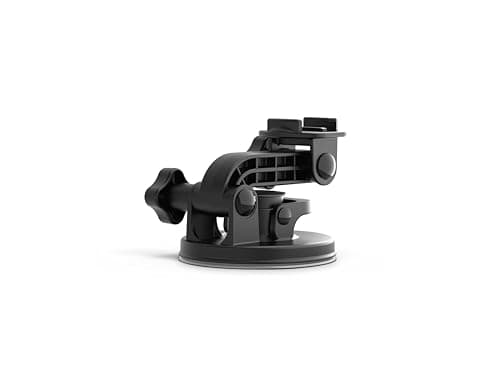 GoPro Suction Cup Mount Proven at 150+ mph on a car, which means it will hold on a boat hull — as long as the surface is genuinely smooth and genuinely clean. | Powerboats, pontoons and any smooth hull you will not drill | 8.0/ 10 | |
| 07 | 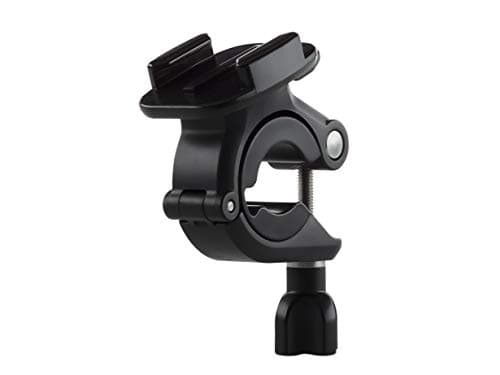 GoPro Handlebar / Seatpost / Pole Mount Fits 9mm to 35mm tubes, which covers handlebars, seatposts, ski poles and — the reason it is here — most paddle shafts. | Bike bars, and the paddle-shaft shot nobody sells a dedicated mount for | 7.8/ 10 |
Scores are our editorial judgment from published specs and named independent reviews, weighted for lake and trail use — not measurements. We have not tested these units and do not own them.
02
How we picked
We do not lab-test, bench-test or dive-test cameras, and we do not own test units. What we do instead is read the manufacturer's published specifications, read the independent reviews that genuinely do test, read owner reports for the failure modes specs never mention — fogging, salt corrosion, cold battery collapse, mount slippage — and then weight all of it for mounts used on lake and trail. Where a number is not published, the page says “not published” rather than filling the cell.
The full method, including what we refuse to do, is on the editorial policy page.
- 35%Hold under load
- Vibration, chop and a wet hull are what actually break a mount.
- 25%Fit range
- Rail width, bar diameter, helmet curve — the spec that decides whether it fits at all.
- 20%Water and salt tolerance
- Stainless vs plated hardware, and what happens after a season of rinses.
- 12%Adjustability
- Getting the angle right on the water, with cold hands.
- 8%Tether point
- A mount with nowhere to clip a leash is a mount that loses cameras.
Start with what you are attaching to, not with the mount
Mounts are the one category on this site where the ranking matters less than the fit. A brilliant mount that does not close around your rail is worth nothing, and a plain adhesive pad in the right position beats an expensive boom in the wrong one. So the useful order is: look at the thing you want the camera on, identify which of five attachment methods it supports, then buy the best mount within that group.
Track or rail. If your kayak has accessory track, use it. Track mounts are rigid, repositionable along the rail, and need no drilling because the drilling was already done at the factory.
Clamp. Anything tubular within the jaw range - bars, rails, seat frames, bimini tubes, paddle shafts. Measure the outer diameter first, because clamp ranges are narrower than people expect.
Harness. Your body is a mounting surface, and it is the one that produces point-of-view footage. A chest harness is steadier than a helmet; a helmet sees where you look.
Suction. Smooth, clean, non-porous surfaces and nowhere else. Texture, grit and temperature swings are the failure modes, not wind.
Adhesive. Permanent, lowest-profile, cheapest per mounting point, and you get one attempt. Right for a helmet or a board, wrong anywhere you are still experimenting with angles. The compatibility guide covers what fits what, including the two-prong interface question.
The five criteria we ranked on
Mounts publish far fewer numbers than cameras do, so the criteria are mostly about failure modes. These are the five, in the order they decide a purchase.
Hold under load, first. Not static weight - vibration and repeated shock. A mount that holds a camera on a bench can still let go on a trail or a wake, and the two common failures are a clamp that walks loose and an adhesive pad that lifts at one edge.
Fit range, second. The published jaw or tube range is the single specification that decides whether a mount is a purchase or a return. The RAM Tough-Claw covers 0.625in to 1.14in; the GoPro tube mount covers 9mm to 35mm. Those are both narrower than “fits handlebars” suggests.
Adjustability that holds, third. There is a real difference between a joint that moves and a joint that stays. Ball-and-socket arms and locking friction joints hold an angle through hours of vibration; a plain pivot creeps, and the horizon slowly leaves the frame without you noticing.
Water and salt tolerance, fourth. A mount has no waterproof rating to read, so you are judging material and hardware instead. Stainless hardware versus plated is the difference between a mount that survives three salt seasons and one that seizes after one. Waterproof mounting options sets out which family survives which sport, and salt water care covers the rinse that keeps them moving.
A tether point, fifth, and non-negotiable near water. Every mount on this page can fail: suction releases, adhesive lifts, thumb screws back out. A mount with somewhere to attach a leash turns each of those from a lost camera into an inconvenience.
| Mount | Attaches to | Published fit figure | Adjustment | Reposition? |
|---|---|---|---|---|
| RAM Tough-Claw + adapter | Round, square or odd tubes and rails | 0.625" to 1.14" outer diameter | Ball and double socket arm | Yes, tool-free |
| GoPro Chesty | Your torso, over layers | Adjustable harness, fits over a winter jacket | Vertical buckle + thumb screw | Yes |
| GoPro Helmet Front + Side | Curved helmet shells | Swivel mount + 2 curved adhesive pads | Swivel assembly | No - adhesive is one-shot |
| YakAttack PanFish Pro | Kayak accessory track | 33in tall (4.25" W x 36.5" H x 2.0" D) | LockNLoad base, 360-degree | Yes, along the track |
| GoPro Curved + Flat Adhesive | Boards, hulls, helmets, hard shells | Both curvatures in the pack | None - fixed angle | No - new pad required |
| GoPro Suction Cup | Smooth, clean, non-porous surfaces | Proven at 150+ mph | Swivel arm, 360-degree | Yes, in seconds |
| GoPro Handlebar / Seatpost / Pole | Bars, posts, ski poles, paddle shafts | 0.35" to 1.4" (9 to 35mm) tubes | 360-degree rotation | Yes, tool-free |
What to buy for each trip
A kayak with accessory track: the PanFish Pro, or a boom if you want the camera further out than up. The kayak mounting guide covers placement, which matters more than the hardware.
A kayak with no track: the RAM Tough-Claw on a carry handle or seat frame, with a leash. Do not drill a boat to solve a problem a clamp solves.
A bike: the tube mount for a quick setup, the Tough-Claw if your trails are rough enough that plastic flex shows. The mountain biking picks explain why stabilization and mount stiffness outrank resolution on a trail.
A helmet: the Helmet Front + Side Mount, and check your helmet's certification guidance before you press the pad down.
Your own point of view, on anything: the Chesty. It is the mount people underestimate and then use most.
A motorboat or pontoon: the Suction Cup Mount on clean gelcoat, tethered. If the surface is textured, it is a clamp job instead.
A paddleboard or a surfboard: adhesive pads, placed after a couple of trips with a clamp so you know where the shot is.
What we would skip
The 50-piece accessory kit. They are mostly filler: a tripod you will not use, three sizes of strap, a bag of plastic buckles and a chest harness that does not adjust properly. You end up buying the real mount anyway, and it costs more in total than buying it first.
Any mount with no tether point near water. Not because the mount is bad, but because the mount is not the last line of defense. The leash is.
Suction on a textured surface. This is the single most common way a camera ends up in a lake. If your thumbnail catches on the gelcoat, the cup will not hold properly.
Adhesive on a surface you have not cleaned and dried, or in the cold. The pad needs a clean, above-freezing surface and about a day to cure. Rushing that is how a camera leaves a board at speed.
One thing that matters more than any of these
Position. Low and forward on a kayak deck is the easiest place to reach and the worst place for the lens: spray every few strokes, and a viewpoint two feet above the waterline that makes flat water look flatter. Higher and further back is almost always better. On a bike, a bar mount shows the trail and a chest mount shows the trail plus your hands, and the second one is usually the clip you keep. The cheapest upgrade available to anybody reading this page is moving the mount they already own six inches, not buying another one.
By activity, and by budget
This page picks one mount per attachment method. Two newer pages start from the activity instead - the fishing mounts, ranked on published height and reach, and the hiking mounts, which start from the fact that a trail gives you nothing to clamp to. Two more start from a price ceiling checked against a live listing: mounts under $50 and kayak mounts under $100. And if the helmet mount is the part that is not working, the helmet mount alternatives cover what else gets the same shot.
03
Every pick, in detail
- 0.625" to 1.14" outer diameter
- High-strength composite, stainless hardware
- Ball adapter, double socket arm, clamp base
- 8.5
- 7.5
- 8.5
- 9.5
- 7.0
RAM Tough-Claw Clamp Mount with Action Camera Adapter
RAM Mounts
Clamps to anything between 0.625in and 1.14in and does not care whether it is round, square or odd — the mount that solves the boats with no track.
Rails, bars, seat frames and anything you cannot or will not drill
Top pick, because it is the mount that solves the most common problem on this site: a boat, bar or rail with nothing designed to take a camera. The jaw closes on anything with an outer diameter between 0.625in and 1.14in and does not care whether that tube is round, square or an odd extrusion - which covers kayak carry handles, bimini frames, seat rails, roll bars, bike bars and most paddle shafts.
The part that makes it the top pick rather than just a cheap clamp is the RAM ball-and-socket arm. A friction hinge creeps under two hours of vibration and you find out when you review the footage and the horizon has slowly walked out of frame; a ball locked into a double socket does not. The hardware is stainless, which is the right call for anything that gets rinsed with salt water, and the whole thing is a no-drill install, so it moves between a boat, a bike and a rail in the same weekend.
Honest cons: 0.625in to 1.14in is a narrow band and you should measure before you buy, because a clamp that will not close is a clamp that does nothing. The composite version is not the stiffest option in the RAM range - the aluminum arms hold better and weigh more. And it is three separate pieces, so it is three things to lose in the bottom of a dry bag. Suction and clamp mounts covers where each family holds and where it does not.
- Fits round, square and odd-shaped rails in the same jaw
- Stainless hardware is the right call for anything that gets rinsed
- The RAM ball-and-socket arm holds an angle far better than a friction hinge
- No drilling, so it moves between boats, bikes and rails
- 0.625in to 1.14in is a narrow band — measure before you buy
- The composite version is not the stiffest option in the RAM range
- Three separate pieces means three things to lose
Specs from RAM Mounts Tough-Claw with Action Camera Adapter specifications.
- Adjustable, fits over heavy winter jackets
- Quick-release buckle, usable with gloves
- Harness, vertical buckle, thumb screw
- 8.0
- 9.0
- 7.0
- 8.5
- 8.0
GoPro Chesty Performance Chest Mount
GoPro
The mount that shows your hands — which on a kayak means the paddle, and on a bike means the trail arriving.
Paddling and riding footage where the hands are the story
The pick when the shot you want is your own point of view, and the one most people should buy second. A chest mount sits lower and steadier than a helmet mount, which means less head-turn in the footage and less nausea for whoever watches it - and it shows your hands. On a kayak that means the paddle stroke; on a bike it means the trail arriving. That is the shot most people are actually trying to get when they buy a camera.
GoPro builds this one to be worn over layers: the harness is padded and breathable, genuinely adjustable across body types, and it fits over a heavy winter jacket. The quick-release buckle works with gloves on, which sounds minor until you are trying to unclip a camera with cold hands on a November lake.
The cons are about fit rather than build. A PFD worn over the top changes the angle completely, so set it up wearing exactly what you will wear on the water. It sits low, and on a sit-inside kayak with high deck sides it can end up framing mostly deck. And nothing about it is waterproof - it gets wet and stays wet all day. Chest mount against helmet mount is the full decision, and the chest mount picks go deeper on fit.
- Padded and breathable, and genuinely adjustable across body types and layers
- The quick-release buckle works with gloves on, which matters in cold water
- Lower and steadier than a helmet mount — less head-turn, less nausea in the edit
- Shows the paddle stroke, which is the shot most people are actually trying to get
- A PFD over the top changes the angle, so set it up wearing what you will actually wear
- Sits low; on a sit-inside kayak it can end up framing mostly deck
- Nothing about it is waterproof — it gets wet and stays wet
Specs from GoPro Chesty product page.
- Swivel mount, 2 curved adhesive mounts
- Vertical mounting buckle and thumb screw
- Curved helmet shells
- 8.5
- 8.0
- 8.0
- 9.0
- 6.5
GoPro Helmet Front + Side Mount
GoPro
A swivel assembly and two curved adhesive pads — the only official way to get a side-of-helmet angle that is not a chin bar.
Bike and ski helmets where a top mount is too tall and a chest mount sees too little
The best helmet mount here, and the only official way to get a side-of-helmet angle without a chin bar. It is a swivel assembly plus two curved adhesive pads, and the swivel is the reason to choose it: you set the angle once with the camera on your head, lock it, and ride. A plain adhesive pad gives you whatever angle the helmet shell happens to present, which on a modern vented lid is rarely the one you wanted.
Side mounting also keeps the camera lower and more out of the airflow than a top mount, which helps with both wind noise and the top-heavy feeling of a camera on a stalk. The adhesive is the same industrial-strength waterproof family GoPro uses on its curved and flat pads, designed for curved helmet shells rather than flat panels.
Cons, and they matter: the adhesive is a one-shot decision, so get the position right before you press. Removing it means heating the pad with a hair dryer. And a side-mounted camera adds a profile that some helmet certifications specifically discourage - check what yours says before you commit, especially on a climbing or whitewater lid. The helmet mounting guide walks the placement, and the helmet mount picks cover the strap alternatives if you switch helmets often.
- The swivel assembly means you set the angle once and ride, instead of guessing
- Curved adhesive pads are made for helmet shells rather than flat panels
- Side mounting keeps the camera out of the wind better than a top mount
- Industrial-strength waterproof adhesive from the same family as the curved and flat mounts
- Adhesive is a one-shot decision — get the position right before you press
- Removing it means heating the adhesive with a hair dryer
- Adds a side profile that some helmet certifications discourage; check yours
Specs from GoPro Helmet Front + Side Mount product page.
- 33in (4.25" W x 36.5" H x 2.0" D)
- LockNLoad, 360-degree rotation
- GoPro interface + 1/4-20 adapter
- 9.0
- 8.5
- 9.0
- 9.0
- 8.5
YakAttack PanFish Pro Camera Mount
YakAttack
Aluminum, 33 inches tall, mounts to almost every kayak track system, and floats if you drop it in.
Kayak fishing, where the camera has to see the rod tip and the water
The pick if your kayak has an accessory track, which most fishing kayaks and a growing number of touring boats do. This is 33 inches of aluminum mast on a LockNLoad base, and the two reasons to buy it are rigidity and height. Aluminum rather than plastic means the mast is not adding its own wobble to the footage, and the height gets the lens above the deck line, which is what separates a shot of your hull from a shot of the water you are on.
It rotates a full 360 degrees while staying locked to the track, takes a GoPro-fitting camera directly or anything with a 1/4-20 thread via the adapter, and fits YakAttack MightyMounts and GearTrac plus most Scotty, RAM and YakGear tracks. It is made from marine-grade materials and it floats if it goes over the side, which is a specification worth more than it sounds.
Honest cons: FeelFree, 3 Waters and Jonny Boat kayaks need a separate adapter, so check yours. Thirty three inches is a lot of mast in a crosswind, and you will feel it. And it costs noticeably more than a plain track mount. If your boat has no track at all this is the wrong pick and the clamp at the top of this page is the right one. The kayak mount roundup ranks this category properly, and track against clamp against suction compares the three ways onto a boat.
- Rigid aluminum construction specifically to reduce camera shake
- LockNLoad base gives full 360-degree rotation while staying locked to the track
- Compatible with YakAttack MightyMounts and GearTrac plus most Scotty, RAM and YakGear tracks
- Made from marine-grade materials, and it floats if it goes over
- FeelFree, 3 Waters and Jonny Boat kayaks need a separate adapter
- 33 inches is a lot of mast in a crosswind
- Costs noticeably more than a plain track mount
Specs from YakAttack PanFish Pro published specifications.
- Curved and flat pads
- Industrial-strength, waterproof
- Heat with a hair dryer, then peel
- 8.5
- 8.0
- 8.5
- 5.0
- 7.5
GoPro Curved + Flat Adhesive Mounts
GoPro
Industrial-strength waterproof adhesive pads — the cheapest permanent mount, and the one you have to get right the first time.
Boards, hulls, helmets and anywhere a clamp has nothing to grip
The budget pick, and the answer when there is genuinely nothing to clamp to. A board, a smooth hull panel, a helmet, a hard shell pannier - adhesive pads create a mounting point where none existed, and they do it with the lowest profile of anything on this page, which means nothing to catch a line, a branch or a paddle blade. The pack includes both curvatures, so you are not guessing which one fits a curved surface.
The adhesive itself is the point: industrial-strength and waterproof, designed for exactly this job rather than borrowed from a general-purpose tape. Cheap enough that leaving a pad semi-permanently on two or three different boats is a reasonable plan, and then one camera moves between them.
The cons are the honest cost of permanence. You get one shot at placement; repositioning means a new pad. It needs a clean, dry, above-freezing surface and about 24 hours to cure properly - which rules out the car park on a cold morning. And removal takes heat and can mark some finishes. The rule that saves people here: clamp first, work out where the shot actually is over a couple of trips, and only then adhere.
- Waterproof adhesive designed for exactly this job
- The lowest profile of any mount here — nothing to catch a line or a branch
- Both curvatures in the pack, so you are not guessing which one fits
- Cheap enough to leave pads semi-permanently on several boats
- One shot at placement; repositioning means a new pad
- Needs a clean, dry, above-freezing surface and 24 hours to cure properly
- Removal takes heat, and can mark some finishes
Specs from GoPro Curved + Flat Adhesive Mounts product page.
- Proven at speeds of 150+ mph
- Smooth, non-porous, clean
- Swivel arm, 360-degree positioning
- 8.0
- 7.0
- 8.0
- 9.5
- 7.5
GoPro Suction Cup Mount
GoPro
Proven at 150+ mph on a car, which means it will hold on a boat hull — as long as the surface is genuinely smooth and genuinely clean.
Powerboats, pontoons and any smooth hull you will not drill
The pick for a smooth hull you are not going to drill - a powerboat, a pontoon, a RIB console, a kayak with a big flat gelcoat deck. GoPro publishes a figure of 150+ mph proven on a car, so wind load is not the failure mode here, and it repositions in seconds, which is how you find the angle that actually works rather than the one you guessed in the driveway.
It packs flat, moves between boats, and makes no permanent change to anything. For anyone filming from a motorboat a few times a year rather than every weekend, it is the sensible amount of hardware to own.
Cons, stated plainly, because this is the mount that loses the most cameras. Gelcoat texture, decals and any grit trapped under the cup all reduce the hold. Temperature swings over a long day in the sun can break the seal on their own. And it will eventually let go - that is not a defect, it is what suction does. This is the mount that most needs a tether, every single time, and on open water a float as well. Floats and tethers makes that case with the arithmetic.
- No drilling, no permanent change to the boat
- GoPro publishes a 150+ mph figure, so wind load is not the failure mode
- Repositionable in seconds, which is how you find the angle that works
- Packs flat and moves between boats
- Gelcoat texture, decals and any grit under the cup all reduce the hold
- Temperature swings can break the seal over a long day in the sun
- It will eventually let go — this is the mount that most needs a tether
Specs from GoPro Suction Cup product page.
- 0.35" to 1.4" (9 to 35mm) tubes
- 360-degree positioning
- Thumb screw, no tools needed
- 7.0
- 9.0
- 8.0
- 8.5
- 7.0
GoPro Handlebar / Seatpost / Pole Mount
GoPro
Fits 9mm to 35mm tubes, which covers handlebars, seatposts, ski poles and — the reason it is here — most paddle shafts.
Bike bars, and the paddle-shaft shot nobody sells a dedicated mount for
The cheap, useful one, and the mount that solves a problem nobody sells a dedicated product for. It fits tubes from 0.35in to 1.4in (9 to 35mm), which covers handlebars, seatposts, ski poles and - the reason it earns a place here - most paddle shafts. A camera on a paddle shaft gives you a swinging low-angle shot of the blade entering the water that no deck mount can produce.
It is tool-free, so you can move it mid-ride or mid-paddle, rotates a full 360 degrees, and is cheap enough to own two and leave one permanently on the bike.
The con is the clamp material. It is plastic, and on genuinely rough ground it flexes in a way an aluminum clamp does not - which shows up as wobble that no stabilization system fully removes. Bars over 35mm are out of range entirely. And on a paddle shaft it adds swing weight you will notice by the end of a long day. Bike and handlebar mounts covers the stiffer options, and paddle and pole mounts covers the shaft shot in detail.
- The 9-35mm range is wide enough to cover bars, posts, poles and paddle shafts
- Tool-free, so you can move it mid-ride or mid-paddle
- Cheap enough to own two and leave one on the bike
- Rotates a full 360 degrees for the angle you actually want
- Plastic clamp — it will flex on a rough trail in a way an aluminum mount does not
- Oversized bars over 35mm are out of range
- On a paddle shaft it adds swing weight you will feel by the end of the day
Specs from GoPro Handlebar / Seatpost / Pole Mount product page.
04
What decides this category
Measure the tube before you buy a clamp
Published jaw ranges are narrow - 0.625in to 1.14in on the Tough-Claw, 9 to 35mm on the GoPro tube mount - and “handlebar” covers diameters well outside both. Two minutes with a tape measure prevents the most common mount return.
Buy one mount for the trip you actually take
Not a kit. The person with one clamp and one chest harness films more than the person with a drawer of plastic, because the two they own fit the boat and the body they actually have.
Clamp first, adhere later
Adhesive is permanent and the right position is rarely the first one you try. Use a clamp for two or three trips, find the angle in the footage, then commit a pad to it.
Tether everything that goes near water
Every mount can fail and most of them eventually will. A leash to a deck loop costs very little and converts a total loss into a story. Add a float on open water.
Stainless hardware if there is salt involved
Plated hardware seizes. If your water is salt water, the mount that survives is the one with stainless screws and marine-grade plastic, and the rinse afterwards matters as much as the purchase.
05
Questions people actually ask
01What is the best action camera mount overall?
The RAM Tough-Claw clamp with an action camera adapter, for most people: it fits round, square and odd-shaped tubes between 0.625in and 1.14in, needs no drilling, uses stainless hardware, and its ball-and-socket arm holds an angle through hours of vibration rather than creeping. If you are attaching to a helmet, a kayak track or your own chest, a purpose-built mount for that surface will beat it.
02Are action camera mounts universal?
Mostly, with one adapter. GoPro's two-prong folding-finger interface has become the de facto standard that most mount makers either copy or adapt to, and a 1/4-20 thread covers the rest. That does not mean every accessory fits every camera - DJI bodies use a magnetic quick-release and need an adapter for two-prong mounts, which is one of the reasons buyers weigh Osmo Action alternatives in the first place. The compatibility guide works through it properly.
03Do I need a chest mount or a helmet mount?
A chest mount if you want to see what you are doing with your hands - the paddle stroke, the bars, the rod. A helmet mount if you want to see where you are looking. Chest footage is steadier and easier to watch; helmet footage follows your attention but adds head-turn. Chest against helmet is the full comparison.
04Will a suction cup mount hold on a boat?
On genuinely smooth, clean, non-porous gelcoat, yes - GoPro publishes a 150+ mph figure proven on a car, so wind is not the problem. Texture, decals, grit under the cup and temperature swings over a long sunny day are. Treat it as a mount that will let go eventually and tether it every time.
05What is the cheapest way to mount an action camera?
Adhesive pads. A pack of curved and flat mounts creates permanent mounting points on boards, hulls, helmets and hard shells for less than any hardware mount, and the profile is low enough that nothing catches on it. The cost is permanence: one attempt at placement, a clean dry above-freezing surface, and about 24 hours to cure.
06Can I mount an action camera on a paddle?
Yes, with a tube clamp - the GoPro Handlebar / Seatpost / Pole Mount fits 9 to 35mm shafts, which covers most paddles. It produces a low swinging angle of the blade entering the water that no deck mount can get. Expect to notice the swing weight after an hour, and tether it. Paddle and pole mounts covers the shot in detail.
07Do I need the 50-piece mount kit that comes up on Amazon?
No. Those kits are mostly plastic filler - straps in sizes you will not use, a tripod, buckles - and the one mount your trip actually needs is usually not in there. Buying the right single mount first is cheaper than buying a kit and then the right mount.
06
Read this next
Are action camera mounts universal?
What the two-prong standard actually covers, and where it quietly does not.
Best kayak camera mounts
The boat version of this page, ranked for track, clamp and hull.
Best helmet mounts
Adhesive, strap and chin-bar options compared for bike and ski lids.
Best chest mounts
Fit over layers and PFDs, and what the angle actually frames.
Floats, tethers and not losing your camera
The cheap insurance every mount on this page needs near water.
07
Sources
- RAM Mounts Tough-Claw with Action Camera Adapter specifications
- GoPro Chesty product page
- GoPro Helmet Front + Side Mount product page
- YakAttack PanFish Pro published specifications
- GoPro Curved + Flat Adhesive Mounts product page
- GoPro Suction Cup product page
- GoPro Handlebar / Seatpost / Pole Mount product page
Specifications are quoted from the manufacturer pages above as they read on the dates shown. Where a figure is not published, this site says so rather than estimating one. We have not tested these products.