The best kayak camera mounts
Start with what your boat actually has: a track, a rail, a smooth hull, or nothing. That decides the mount before anything else does.
Part of Mounts.
We earn a commission if you buy through our links, at no extra cost to you. It never changes what we recommend or the order we rank it in — how this works.
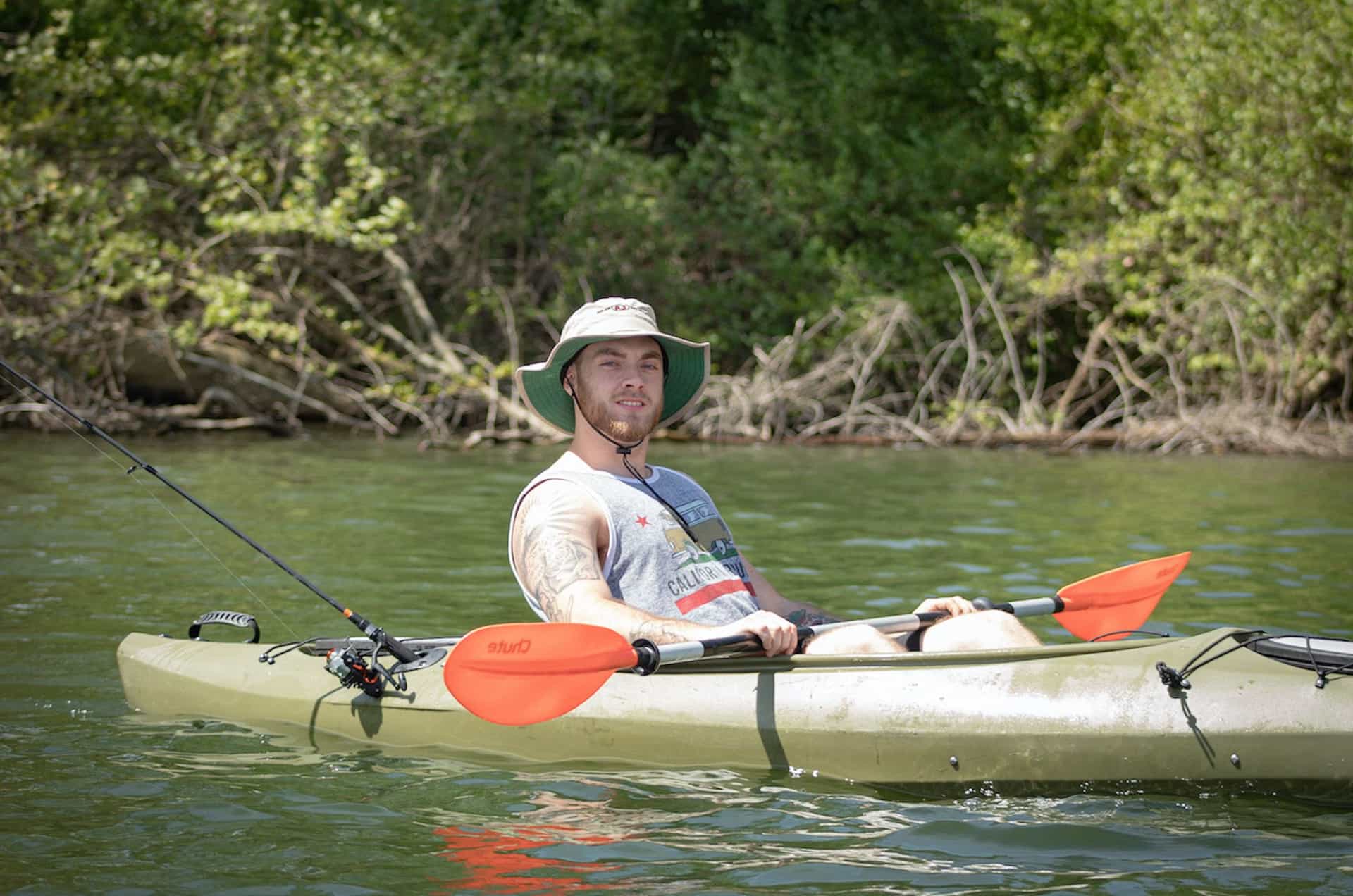
01
Quick picks
| # | Product | Best for | Score | Price |
|---|---|---|---|---|
| 01 | YakAttack PanFish Pro Camera Mount Aluminum, 33 inches tall, mounts to almost every kayak track system, and floats if you drop it in. | Kayak fishing, where the camera has to see the rod tip and the water | 8.8/ 10 | |
| 02 | 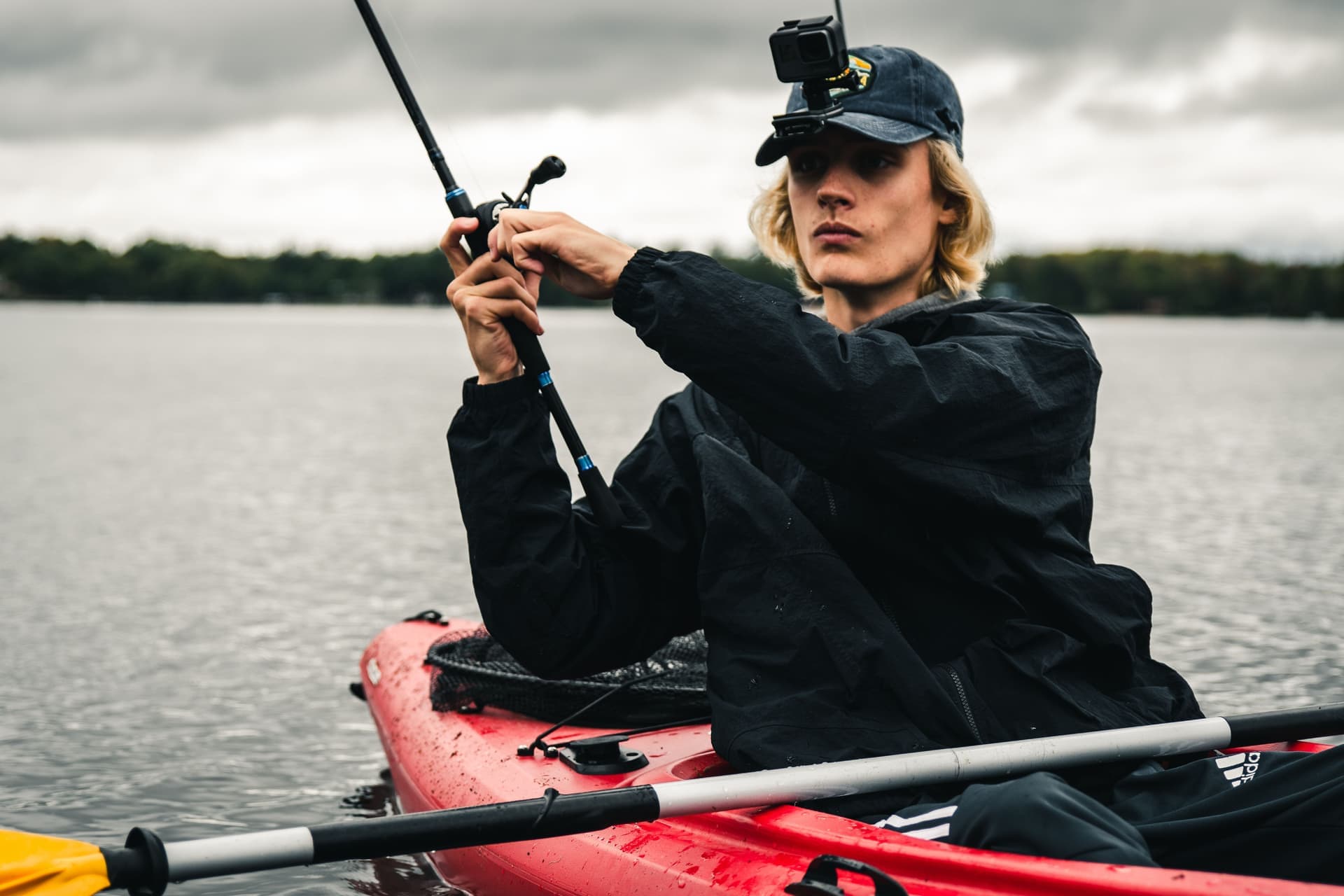 RAILBLAZA Camera Boom 600 R-Lock A 750mm boom that gets the camera off the hull and far enough out to show the boat, the paddle and the water at once. | Wide over-the-shoulder shots from a sit-on-top or fishing kayak | 8.5/ 10 | |
| 03 |  RAM Tough-Claw Clamp Mount with Action Camera Adapter Clamps to anything between 0.625in and 1.14in and does not care whether it is round, square or odd — the mount that solves the boats with no track. | Rails, bars, seat frames and anything you cannot or will not drill | 8.4/ 10 | |
| 04 |  GoPro Suction Cup Mount Proven at 150+ mph on a car, which means it will hold on a boat hull — as long as the surface is genuinely smooth and genuinely clean. | Powerboats, pontoons and any smooth hull you will not drill | 8.0/ 10 | |
| 05 |  GoPro Curved + Flat Adhesive Mounts Industrial-strength waterproof adhesive pads — the cheapest permanent mount, and the one you have to get right the first time. | Boards, hulls, helmets and anywhere a clamp has nothing to grip | 7.9/ 10 |
Scores are our editorial judgment from published specs and named independent reviews, weighted for lake and trail use — not measurements. We have not tested these units and do not own them.
02
How we picked
We do not lab-test, bench-test or dive-test cameras, and we do not own test units. What we do instead is read the manufacturer's published specifications, read the independent reviews that genuinely do test, read owner reports for the failure modes specs never mention — fogging, salt corrosion, cold battery collapse, mount slippage — and then weight all of it for mounts used on lake and trail. Where a number is not published, the page says “not published” rather than filling the cell.
The full method, including what we refuse to do, is on the editorial policy page.
- 35%Hold under load
- Vibration, chop and a wet hull are what actually break a mount.
- 25%Fit range
- Rail width, bar diameter, helmet curve — the spec that decides whether it fits at all.
- 20%Water and salt tolerance
- Stainless vs plated hardware, and what happens after a season of rinses.
- 12%Adjustability
- Getting the angle right on the water, with cold hands.
- 8%Tether point
- A mount with nowhere to clip a leash is a mount that loses cameras.
Step one: what does your kayak actually have?
Four cases, and they lead to different halves of this page.
Accessory track (a rail running along the gunwale or in front of the seat). Common on fishing kayaks and increasingly on recreational ones. This is the best case: a track mount is rigid, repositionable, needs no drilling, and supports a tall mast. Buy the PanFish Pro.
Rails, handles or a rod holder but no track. A clamp is your answer. Measure the diameter — the RAM Tough-Claw covers 0.625in to 1.14in and the GoPro tube mount covers 9mm to 35mm, which between them cover most but not all kayak hardware.
A smooth hard deck section. Suction or adhesive. Check for molded texture, which is everywhere on modern sit-on-tops and is exactly what defeats a suction cup.
Nothing usable. Adhesive, a StarPort (which means drilling), or a mount that attaches to your body instead — a chest harness is a genuinely good kayak solution that people overlook because it is not attached to the boat.
| Method | Needs | Rigidity | Reversible? |
|---|---|---|---|
| Track mount | An accessory track | Excellent — supports a tall mast | Yes, slides off |
| Clamp | A tube or rail in the jaw range | Good | Yes |
| Suction | Smooth, clean, non-porous surface | Moderate | Yes |
| Adhesive | Clean dry surface, 24h cure | Excellent, lowest profile | No — heat to remove |
| StarPort / hard point | Drilling the deck | Excellent | No |
Step two: height, which is where the footage comes from
This is the part most people get wrong, and it is free to get right.
A camera mounted low and forward on the deck — the easiest place to reach — produces two problems. The lens collects spray every few strokes, and the viewpoint sits about two feet above the waterline, which makes flat water look flatter and hides everything happening in the boat.
Higher and further back solves both. A 33-inch mast behind the seat sees you, the deck, the paddle and the water. A boom swung out to the side sees the boat in its surroundings. Both are more hardware than a deck mount, and both are why some people's kayak footage looks like kayaking and everyone else's looks like a wet deck.
The kayak mounting guide works through each position with what it shows.
Salt, and why hardware material matters
If you paddle salt, the mount will die before the camera does, and it will die at the threads.
Salt crystallizes in a thumb screw, a quick-release base or an aluminum pole joint and then grinds every time the part moves. A seized thumb screw is the single most common salt casualty in this whole category, and a seized pole section is permanent.
Two consequences for buying. Prefer stainless hardware over plated — it is most of the difference between the RAM Tough-Claw and a cheaper clamp. And soak the mount, not just the camera, after every salt day: the rinse routine is five minutes and it is the whole difference.
03
Every pick, in detail
- 33in (4.25" W x 36.5" H x 2.0" D)
- LockNLoad, 360-degree rotation
- GoPro interface + 1/4-20 adapter
- 9.0
- 8.5
- 9.0
- 9.0
- 8.5
YakAttack PanFish Pro Camera Mount
YakAttack
Aluminum, 33 inches tall, mounts to almost every kayak track system, and floats if you drop it in.
Kayak fishing, where the camera has to see the rod tip and the water
The best answer if your kayak has accessory track, which most fishing kayaks do. 33 inches of rigid aluminum gets the camera above deck level — which is the single biggest improvement available to kayak footage — and the LockNLoad base rotates 360 degrees while staying locked to the rail. It floats if it goes over, which on a $100+ mount is not a small detail.
- Rigid aluminum construction specifically to reduce camera shake
- LockNLoad base gives full 360-degree rotation while staying locked to the track
- Compatible with YakAttack MightyMounts and GearTrac plus most Scotty, RAM and YakGear tracks
- Made from marine-grade materials, and it floats if it goes over
- FeelFree, 3 Waters and Jonny Boat kayaks need a separate adapter
- 33 inches is a lot of mast in a crosswind
- Costs noticeably more than a plain track mount
Specs from YakAttack PanFish Pro published specifications.
- 31in (750mm)
- Any RAILBLAZA StarPort
- GoPro and 1/4-20 thread
- 8.5
- 7.5
- 9.5
- 9.0
- 8.0
RAILBLAZA Camera Boom 600 R-Lock
RAILBLAZA
A 750mm boom that gets the camera off the hull and far enough out to show the boat, the paddle and the water at once.
Wide over-the-shoulder shots from a sit-on-top or fishing kayak
A different shape of answer: 750mm of boom that swings out from a StarPort so the camera can look back at you and the boat together. R-Lock friction joints hold an angle rather than creeping. The catch is the StarPort — fitting one usually means drilling the deck, which is a decision rather than a purchase.
- R-Lock friction joints and a 360-degree rotating platform hold an angle instead of creeping
- UV-stabilized fiberglass-reinforced plastic, which is the right material for a boat that lives outside
- Mounts to any StarPort in seconds and breaks down just as fast for stowing
- Takes GoPro-fitting cameras and anything with a standard 1/4-20 thread
- You need a StarPort installed, which usually means drilling the deck
- 750mm of leverage in wind is real — it moves in a way a deck mount does not
- Long enough to catch a paddle stroke if you place it badly
Specs from RAILBLAZA Camera Boom 600 R-Lock published specifications.
- 0.625" to 1.14" outer diameter
- High-strength composite, stainless hardware
- Ball adapter, double socket arm, clamp base
- 8.5
- 7.5
- 8.5
- 9.5
- 7.0
RAM Tough-Claw Clamp Mount with Action Camera Adapter
RAM Mounts
Clamps to anything between 0.625in and 1.14in and does not care whether it is round, square or odd — the mount that solves the boats with no track.
Rails, bars, seat frames and anything you cannot or will not drill
The no-track answer. Clamps to anything round, square or odd-shaped between 0.625in and 1.14in — rails, seat frames, rod holders — with stainless hardware and a ball-and-socket arm that genuinely holds. That jaw range is narrow, so measure before ordering.
- Fits round, square and odd-shaped rails in the same jaw
- Stainless hardware is the right call for anything that gets rinsed
- The RAM ball-and-socket arm holds an angle far better than a friction hinge
- No drilling, so it moves between boats, bikes and rails
- 0.625in to 1.14in is a narrow band — measure before you buy
- The composite version is not the stiffest option in the RAM range
- Three separate pieces means three things to lose
Specs from RAM Mounts Tough-Claw with Action Camera Adapter specifications.
- Proven at speeds of 150+ mph
- Smooth, non-porous, clean
- Swivel arm, 360-degree positioning
- 8.0
- 7.0
- 8.0
- 9.5
- 7.5
GoPro Suction Cup Mount
GoPro
Proven at 150+ mph on a car, which means it will hold on a boat hull — as long as the surface is genuinely smooth and genuinely clean.
Powerboats, pontoons and any smooth hull you will not drill
For smooth, clean hull sections and hard decks. GoPro publishes a 150+ mph figure, so airflow is not the failure mode — texture, grit and heat are. On a kayak this is a secondary option rather than a primary one, because most kayak decks have molded texture exactly where you want to stick it.
- No drilling, no permanent change to the boat
- GoPro publishes a 150+ mph figure, so wind load is not the failure mode
- Repositionable in seconds, which is how you find the angle that works
- Packs flat and moves between boats
- Gelcoat texture, decals and any grit under the cup all reduce the hold
- Temperature swings can break the seal over a long day in the sun
- It will eventually let go — this is the mount that most needs a tether
Specs from GoPro Suction Cup product page.
- Curved and flat pads
- Industrial-strength, waterproof
- Heat with a hair dryer, then peel
- 8.5
- 8.0
- 8.5
- 5.0
- 7.5
GoPro Curved + Flat Adhesive Mounts
GoPro
Industrial-strength waterproof adhesive pads — the cheapest permanent mount, and the one you have to get right the first time.
Boards, hulls, helmets and anywhere a clamp has nothing to grip
The lowest-profile permanent option, and the cheapest. Industrial waterproof adhesive designed for exactly this, with both curvatures in the pack. You get one attempt at placement, and the surface must be clean, dry and given 24 hours to cure.
- Waterproof adhesive designed for exactly this job
- The lowest profile of any mount here — nothing to catch a line or a branch
- Both curvatures in the pack, so you are not guessing which one fits
- Cheap enough to leave pads semi-permanently on several boats
- One shot at placement; repositioning means a new pad
- Needs a clean, dry, above-freezing surface and 24 hours to cure properly
- Removal takes heat, and can mark some finishes
Specs from GoPro Curved + Flat Adhesive Mounts product page.
04
What decides this category
Measure before you order
Clamp jaw ranges are narrow and stated precisely: 0.625in to 1.14in for the RAM Tough-Claw, 9mm to 35mm for the GoPro tube mount. A clamp that does not close is a clamp that does nothing.
Rigidity, because stabilization cannot fix a moving mount
Electronic stabilization removes vibration. It cannot remove a camera slowly rotating on a loose friction joint, and it cannot invent a horizon back once the mount has walked. A ball-and-socket that locks beats a knurled friction hinge every time.
Stainless hardware for salt
The difference between a mount that survives three seasons and one that seizes after one. This is where the price difference between a cheap clamp and a good one actually goes.
A tether point
A mount with nowhere to clip a leash is a mount that loses cameras. Check for a hole, a loop or a bar before buying.
What we would skip
Suction as a primary kayak mount. Most sit-on-top decks have molded texture exactly where you want to stick it, and a suction cup on texture is a camera in the lake. It is an excellent mount on a powerboat windscreen and a poor one on a plastic kayak.
05
Questions people actually ask
01What is the best way to mount a camera on a kayak?
If your kayak has accessory track, a track-mounted mast — it is rigid, repositionable, needs no drilling and gets the camera above deck level. Without track, a clamp on a rail or rod holder is the next best thing.
02Can I mount a GoPro on a kayak without drilling?
Yes, in three ways: a track mount if you have track, a clamp on a rail or handle, or an adhesive pad on a smooth deck section. Drilling is only required for a StarPort or a permanent hard point.
03Will a suction cup mount work on a kayak?
Often not. Most modern sit-on-top decks have molded texture, and suction needs a smooth, clean, non-porous surface. Test it before you trust it, and tether it regardless.
04How high should the camera be on a kayak?
Higher than feels necessary. Low and forward collects spray on the lens and gives a flat, uninteresting viewpoint. A mast behind the seat or a boom out to the side transforms the footage.
05Do I need a tether if the mount is secure?
Yes. Every mount can fail — suction releases, adhesive lifts, screws back out. A short leash to a deck loop costs almost nothing and turns a lost camera into a dropped one.
06Does a kayak camera mount need to be stainless?
In salt water, yes — the threads are where mounts die, and plated hardware seizes. In fresh water the difference is much smaller, though a rinse still matters after a sandy launch.
06
Read this next
How to mount a camera on a kayak
The step-by-step, position by position.
Track vs clamp vs suction
The three methods compared directly, with the failure modes.
Best action cameras for kayaking
The camera that goes on the mount you just chose.
Floats and tethers
Because every mount on this page can fail.
Best action camera for kayak fishing
Where a tall mast stops being optional.
07
Sources
- YakAttack PanFish Pro Camera Mount specifications
- RAILBLAZA Camera Boom 600 R-Lock specifications
- RAM Mounts Tough-Claw with Action Camera Adapter specifications
- GoPro Suction Cup product page
- GoPro Curved + Flat Adhesive Mounts product page
Specifications are quoted from the manufacturer pages above as they read on the dates shown. Where a figure is not published, this site says so rather than estimating one. We have not tested these products.