DJI Osmo Action 6 review: a variable aperture, and what it is actually for
Two things on this camera are genuinely new to the category. One of them will change your water footage; the other is a number you will never see on a phone screen.
Part of Cameras.
We earn a commission if you buy through our links, at no extra cost to you. It never changes what we recommend or the order we rank it in — how this works.
The DJI Osmo Action 6 pairs a 1/1.1-inch sensor with an f/2.0 to f/4.0 variable aperture — the first on a mainstream action camera — and keeps the 20m bare waterproof rating, the 1950mAh removable battery and the 240-minute published runtime of the Osmo Action 5 Pro. It records 8K at up to 30fps and 4K at up to 120fps, carries 64GB of internal storage (50GB usable), weighs 149g and is rated from -20° to 45°C. For lake and trail use the aperture is the upgrade that matters: it lets the camera cut glare off bright water without screwing a filter onto the front. The 8K is the upgrade that mostly does not matter, because it costs card space and battery for detail no phone screen resolves. If you already own an Action 5 Pro, the aperture is the only real reason to move.
The published specification table
Every figure below is quoted from DJI's own Osmo Action 6 specification page, read on 2026-10-23. This site owns no test units and runs no lab, so what follows is DJI's published data plus our reading of what each number does on a kayak, a bike or a dock. Where DJI does not publish a figure, the row says so rather than guessing.
| Specification | Published figure |
|---|---|
| Sensor | 1/1.1" CMOS, approx. 38MP |
| Aperture | f/2.0-f/4.0, variable |
| Field of view | 155 degrees |
| Max video | 8K (7680x4320) at 24/25/30fps |
| Max 4K frame rate | 4K at up to 120fps |
| Max video bitrate | 120 Mbps |
| Max photo | 7168x5376 (approx. 38MP), JPEG + RAW |
| Waterproof | 20m with no housing / 60m with the Waterproof Case |
| Battery | 1950mAh, user-removable |
| Published runtime | 240 min at 1080p/24 with screens off |
| Operating temperature | -20° to 45°C (-4° to 113°F) |
| Weight | 149g |
| Screens | Front 1.46" (342x342), rear 2.5" (400x712) |
| Internal storage | 64GB, 50GB usable |
| Card support | microSD up to 1TB |
| Stabilization | RockSteady 3.0 / 3.0+, HorizonBalancing, HorizonSteady |
| Microphones | 3 |
| Low light | SuperNight mode: 4K / 2.7K / 1080p at 24-60fps, ISO to 51200 in that mode only |
| Charging time | Not published |
The variable aperture is the real story
Every action camera before this one has a fixed aperture. That single design choice sits behind a whole category of annoyance anyone who films on water already knows: at noon on a lake there is simply too much light. A fixed-aperture camera has only shutter speed and ISO to work with, so it closes the shutter down to 1/2000 of a second or faster — and a very fast shutter is what makes moving water look like shattered glass instead of water. The standard fix is a neutral-density filter screwed onto the front: one more thing to buy, one more thing to drop in the lake, one more thing to swap when a cloud arrives.
An aperture that closes to f/4.0 does that job inside the lens. You lose two stops of light without touching the shutter, which is exactly what you want when the sun is overhead and the surface is a mirror. The same mechanism opens back to f/2.0 for the end of the day, under tree cover, or below the surface, where every action camera has always been starved of light.
Two honest caveats. First, two stops is useful but it is not a full ND set — hard midday sun on white water can still want more than f/4.0 gives you, so filters and dome ports still have a job. Second, a variable aperture is a moving part in a body that gets dunked, sanded and frozen. DJI rates the camera to 20m and to -20°C with the mechanism in it and we have no reason to doubt the rating, but it is one more mechanism than the Action 5 Pro has. Long-term reliability is not something a specification page can tell you, and we will not pretend otherwise.
What stayed the same, and why that is the good news
The specification sheet is unusually conservative where it counts. The bare waterproof rating is still 20m. The battery is still 1950mAh and still removable. The published runtime is still 240 minutes at 1080p/24 with the screens off, and the operating range is still -20° to 45°C.
Those four figures are the ones that decide a long day out, and they were already the best in the category on the Action 5 Pro. 20m bare means a swamped kayak is a wet camera rather than a dead one, with no housing in the way and no housing to fog — how deep an action camera can actually go covers what those ratings do and do not promise. 240 published minutes is the figure that still gets you footage on the third day of a trip. And a genuine sub-zero rating matters far more on an October morning than any resolution number on this page.
One quiet addition is worth more than it sounds: 64GB of internal storage, 50GB of it usable. It is not a substitute for a card, but it is the difference between a wasted morning and a slightly shorter one on the day the card is still sitting in the laptop at home.
The 8K question
8K at 30fps makes the headline and will not change your footage. Three reasons, in order of how much they matter.
The frame rate is wrong for the use. Action footage wants 60fps for anything that moves and 120fps for anything you intend to slow down. 8K here is 24, 25 or 30fps — a cinematography frame rate on a camera bolted to a bike. The genuinely useful high-resolution mode on this body is 4K at 120fps, which is slow motion you will actually cut with.
The bitrate has to stretch further. DJI publishes a 120 Mbps maximum for the whole camera. That same ceiling has to cover four times the pixels of 4K, so an 8K frame works with roughly a quarter of the data per pixel. More pixels at the same bitrate is a trade, not a free upgrade.
Nothing you watch it on resolves it. A phone, a laptop and almost every television in a normal house are 4K at most, and most are less. 8K earns its keep in exactly one place: cropping. Shoot wide on a chest mount, push in on the part that mattered, and still deliver 4K. That is a real workflow, and it is the only reason to turn the mode on. The arithmetic is in 4K vs 5.3K vs 8K: what resolution you actually need.
Who this camera is for
Buy it if you film on bright water. Lakes, flat ocean, snow, white hulls, midday sun: this is the camera that handles those without a filter on the front. If your footage has always looked harsh and brittle at noon and you never worked out why, the aperture is the fix.
Buy it if you want the best low-light footage from a flat body. The 1/1.1-inch sensor is the largest here, f/2.0 is a bright lens, and SuperNight mode runs to ISO 51200 in 4K. Dawn launches and the hour after sunset are where that combination shows up — the best action cameras for low light ranks the rest of the field on the same question.
Skip it if you already own an Osmo Action 5 Pro. Depth rating, battery, published runtime, cold rating and mount system are identical. You would be paying a flagship premium for two stops of aperture and a sensor upgrade. The Action 5 Pro review remains the better value page to read.
Skip it if your bag is full of GoPro mounts. DJI's magnetic quick-release system is excellent and it is not GoPro's. Adapters exist, they work, and they are still another purchase and another part to lose. Mount compatibility is the page to read before switching brands, and Osmo Action 6 vs GoPro HERO13 Black puts the two ecosystems side by side.
Skip it if weight is the constraint. 149g is the heaviest body in this group. On a kayak hull or a handlebar that is irrelevant; on the side of a helmet every gram is a lever arm, and the smaller bodies in the helmet-camera roundup are the better answer.
What we cannot tell you
We have not had this camera on a boat. Nobody here has frozen one, dropped one off a dock or run a season of salt water through its door seal, and a specification page cannot answer any of those questions. What a published figure can do is tell you what DJI will stand behind: 20m, 240 minutes, -20°C, 120 Mbps, 149g. Those are commitments, and the table above is every one we could verify, with the page we read them on linked in the sources below.
Our scores are editorial judgments built from those published figures and weighted for lake and trail use, exactly as our editorial policy describes. They are not measurements, and they will not be until somebody here buys one.
01
What we would actually buy with it
The camera, the previous model if the saving matters more than the aperture, and a card fast enough for the bitrate this body can produce.
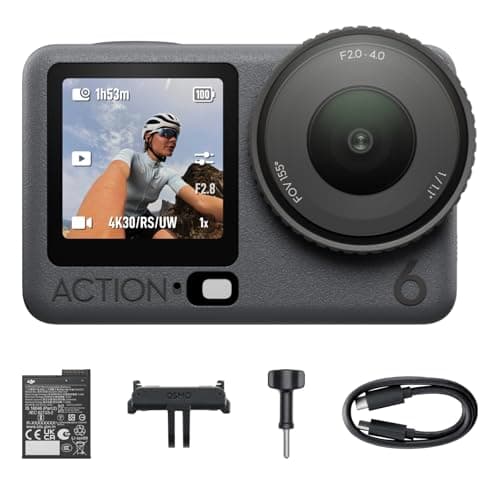
- 20m bare / 60m with case
- 1950mAh · 240 min at 1080p24
- 1/1.1" with f/2.0-f/4.0 aperture
- 9.5
- 9.0
- 9.5
- 8.0
- 9.5
DJI Osmo Action 6
DJI
The first action camera with a variable aperture, on the largest sensor in the class — and it keeps the 20m bare rating and the 240-minute runtime that made the Action 5 Pro the long-day pick.
Bright water and flat light in the same afternoon, on trips measured in days rather than hours
- 1/1.1-inch sensor — the largest in any flat action camera we track, and it shows in flat light
- Variable f/2.0-f/4.0 aperture: it can stop down for glare off the water instead of needing an ND filter
- Keeps the 20m bare rating, the 1950mAh removable battery and the 240-minute published runtime
- -20° to 45°C operating range, and 64GB built in (50GB usable) for the day you forget the card
- 4K at up to 120fps for slow motion, 8K/30 for cropping in the edit
- 149g, the heaviest flagship here — noticeable on a helmet, irrelevant on a hull
- 8K stops at 30fps and costs card space and battery for detail a phone screen never shows
- Mount ecosystem is still smaller than GoPro's, and the magnetic quick-release adapters are a separate purchase
- Sits at the top of the category price bracket — the Action 5 Pro does most of this for less
Specs from DJI Osmo Action 6 published specifications.
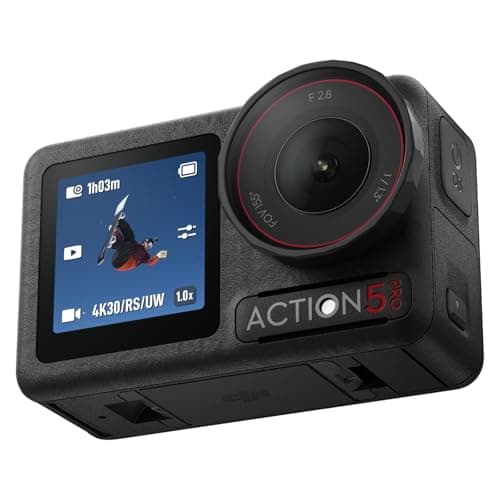
- 20m bare / 60m with case
- 1950mAh · 240 min at 1080p24
- -20° to 45°C
- 9.5
- 9.0
- 9.5
- 8.0
- 9.0
DJI Osmo Action 5 Pro
DJI
Goes to 20m with no housing at all and publishes a 240-minute runtime — the two numbers that decide a long, wet, cold day.
Long paddles, cold water, and anyone tired of buying a housing to get past 10m
- 20m without the Waterproof Case — double the bare-camera depth of the HERO13 Black
- DJI publishes 240 minutes of recording at 1080p/24 with screens off, the longest figure in this set
- Rated to -20°C, which matters more on an October lake than any resolution number
- 1/1.3-inch sensor holds detail when the light goes flat
- Mount ecosystem is smaller than GoPro's, and magnetic quick-release adapters are their own purchase
- 146g — the heaviest of the flagship three
- Fewer third-party mounts and filters exist for it
Specs from DJI Osmo Action 5 Pro published specifications.
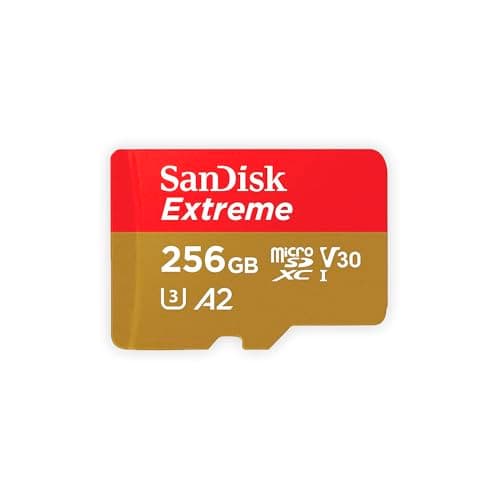
- U3 · V30 · A2 · Class 10
- Up to 190MB/s read, 130MB/s write
- Shock, temperature, water and X-ray proof
- 8.5
- 9.5
- 9.0
- 9.0
- 8.0
SanDisk Extreme microSDXC UHS-I
SanDisk
The card that appears on every manufacturer compatibility list, rated V30 and built to survive being wet, cold and dropped.
Anyone who does not want to think about cards again
- V30 guarantees a 30MB/s minimum sustained write, which is what high-bitrate video actually needs
- SanDisk publishes shockproof, temperature-proof, waterproof and X-ray-proof ratings
- Appears on GoPro, DJI and Insta360 tested-card lists more often than any other card
- Capacities up to 1TB, so a long trip does not need a card swap
- Write speeds vary by capacity — the 64GB tops out at 80MB/s write, the 128GB at 90MB/s
- Counterfeits are common; buy from a seller you trust
- V30 is the floor, not the ceiling — 8K on some cameras wants more headroom
Specs from SanDisk Extreme microSDXC UHS-I product page.
02
How we picked
We do not lab-test, bench-test or dive-test cameras, and we do not own test units. What we do instead is read the manufacturer's published specifications, read the independent reviews that genuinely do test, read owner reports for the failure modes specs never mention — fogging, salt corrosion, cold battery collapse, mount slippage — and then weight all of it for action cameras used on lake and trail. Where a number is not published, the page says “not published” rather than filling the cell.
The full method, including what we refuse to do, is on the editorial policy page.
- 30%Water survival
- Rated depth without a case, door design, and what the manufacturer actually publishes.
- 25%Stabilization in chop
- A kayak deck and a rooty trail shake in ways a handheld walk test never shows.
- 20%Battery in the cold
- Published runtime, spare-battery cost, and whether it charges while recording.
- 15%Mount ecosystem
- Finger mount, threaded, magnetic — and how much of it you have to re-buy.
- 10%Footage you will keep
- Lens replaceability, low-light behavior, and how much cutting the footage needs.
03
Questions people actually ask
01Is the DJI Osmo Action 6 waterproof without a case?
Yes. DJI publishes 20m with no housing, and 60m with the Waterproof Case. That is the same bare rating as the Osmo Action 5 Pro, and double what any current GoPro manages without a housing.
02What does a variable aperture do on an action camera?
It cuts incoming light inside the lens — f/4.0 for glare off bright water, f/2.0 for dusk or below the surface. Without it, a camera in harsh light has to use a very fast shutter speed, which makes moving water look brittle, or you screw a neutral-density filter onto the front instead.
03Should I upgrade from the Osmo Action 5 Pro to the Action 6?
Only for the aperture and the larger sensor. Depth rating, battery, published runtime, cold rating and the mount system are unchanged, so the upgrade buys better bright-light and low-light images and nothing else that affects a long day out.
04Does the Osmo Action 6 really shoot 8K?
It records 7680x4320 at 24, 25 or 30fps, inside a published 120 Mbps ceiling for the whole camera. That is useful if you plan to crop into a wide shot and still deliver 4K. As a delivery format it costs card space and battery for detail phones and most televisions cannot display.
05How long does the Osmo Action 6 battery last?
DJI publishes 240 minutes at 1080p/24 with RockSteady on and the screens off, from a removable 1950mAh battery. Real figures fall well below that at higher resolutions, with the screen on, or in the cold — the published number is a best case measured at 25°C.
06Is there an Osmo Action 6 Pro?
No. DJI sells this camera as the Osmo Action 6. The "Action 6 Pro" name circulating in searches comes from pre-release rumors that expected DJI to keep the "Pro" suffix it used on the Osmo Action 5 Pro. If you are searching for an Action 6 Pro, this is the camera you mean.
04
Read this next
Osmo Action 6 vs GoPro HERO13 Black
The aperture and the depth rating against the mount ecosystem.
DJI Osmo Action 5 Pro review
The same depth, the same runtime, a fixed aperture and a lower price.
4K vs 5.3K vs 8K: what resolution you need
Why the 8K mode on this camera is a cropping tool, not a delivery format.
Best action cameras for low light
Where a big sensor and a bright lens actually show up.
Best waterproof action cameras
Every bare depth rating in the category, ranked.
05
Sources
- DJI Osmo Action 6 published specifications
- DJI Osmo Action 5 Pro published specifications
- SanDisk Extreme microSDXC UHS-I product page
Specifications are quoted from the manufacturer pages above as they read on the dates shown. Where a figure is not published, this site says so rather than estimating one. We have not tested these products.