DJI Osmo Action 6 vs GoPro HERO13 Black
DJI changed the lens. GoPro still owns everything you bolt the camera to. That is genuinely the whole decision.
Part of Cameras.
We earn a commission if you buy through our links, at no extra cost to you. It never changes what we recommend or the order we rank it in — how this works.
The specifications
Every figure below is quoted from the manufacturer's own specification page, read on 2026-10-23. Where a manufacturer does not publish a number, the cell says so instead of guessing at it.
| DJI Osmo Action 6 | GoPro HERO13 Black | |
|---|---|---|
| Bare waterproof | 20m | 33ft (10m) |
| With the maker's case | 60m | 196ft (60m) |
| Sensor | 1/1.1" CMOS, approx. 38MP | Not published on the page we read (HERO12: 1/1.9") |
| Aperture | f/2.0-f/4.0, variable | Fixed; ND filters are a separate purchase |
| Max video | 8K (7680x4320) at 24/25/30fps | 5.3K60 |
| Max 4K frame rate | 4K at up to 120fps | 4K120 (also 2.7K120, 1080p240) |
| Max bitrate | 120 Mbps | Not on GoPro's own page; 120 Mbps on High per retailer spec sheets |
| Battery | 1950mAh, removable | 1900mAh Enduro, removable |
| Published runtime | 240 min at 1080p/24, screens off | Over 2.5h at 1080p30, over 1.5h at 4K30 and 5.3K30 |
| Stabilization | RockSteady 3.0 / 3.0+, HorizonBalancing, HorizonSteady | HyperSmooth 6.0 with AutoBoost |
| Operating temperature | -20° to 45°C (-4° to 113°F) | Enduro battery: full function to 14°F (-10°C) |
| Weight | 149g | Not published on the page we read |
| Mounting | Magnetic quick-release; adapters to two-prong | Built-in fingers plus 1/4-20 thread |
| Internal storage | 64GB, 50GB usable | None; card only |
| Lens protection | Replaceable lens cover | Replaceable lens cover; HB-Series lenses available |
| Microphones | 3 | Not published on the page we read |
The runtime row needs reading carefully, because the two companies measure differently. DJI's 240 minutes is 1080p/24 with RockSteady on, Wi-Fi off and both screens off, at 25°C. GoPro publishes over 2.5 hours at 1080p30 and over 1.5 hours at 4K30 and 5.3K30. Those are much closer than 240 against anything, and neither company publishes a figure for its top mode, so the honest answer is that both run a long paddle and neither runs a long paddle in 8K.
Where the DJI wins
The aperture, and it is not a small thing. The Osmo Action 6 is the first mainstream action camera that can stop its lens down, from f/2.0 to f/4.0. On a lake at noon that is the difference between water that moves and water that looks like broken glass: a fixed-aperture camera in that light has to run a very fast shutter, and fast shutter ruins moving water. The HERO13 gets there too, but it gets there with an ND filter screwed onto the front, which is another purchase, another thing to drop over the side, and another thing to swap when the sun goes behind a cloud.
Depth, by a factor of two. 20m bare against 33ft. This is less about diving than about ordinary use never coming near the limit — a capsize, a rescue drill, a free-dive to look at something, a camera knocked off a dock. All unremarkable on the DJI, all in the back half of the GoPro's range. How deep an action camera can go explains what those ratings actually promise.
Sensor size. 1/1.1 inch is the largest in any current flat action camera. GoPro does not publish a sensor size for the HERO13 Black on the page we read; the HERO12 Black listing states 1/1.9 inch, which is the best indication available and is clearly smaller. Sensor area shows up on gray mornings and under the surface, which on this site is most of the year.
Cold, as a camera claim. DJI states -20° to 45°C for the camera. GoPro's published cold figure is narrower in scope: the Enduro battery maintaining full camera functionality down to 14°F (-10°C). Both cameras work on a frozen morning; DJI is committing to more of one.
Internal storage. 64GB built in, 50GB usable, against nothing at all on the HERO13. It is a once-a-year feature and once a year it saves the morning.
Where the GoPro wins
Mounting, decisively. Built-in folding fingers plus a 1/4-20 thread mean the HERO13 fits every two-prong mount, clamp, boom, mast, chest harness and tripod ever made for this category, with nothing bought in between. DJI's magnetic quick-release is faster to use and genuinely clever, but it is a magnetic latch rather than a mechanical lock, and getting to a two-prong fitting means an adapter: more height, more flex, one more part. On a kayak track that is a shrug. On a helmet or a tall mast it is the whole argument. Mount compatibility is the page to read before you change brands.
Stabilization in impact. HyperSmooth 6.0 with AutoBoost remains the steadiest published system in the category. RockSteady 3.0 is very good and the gap does not show in smooth motion — it shows in sharp repetitive impact, a wheel over roots or a hull slapping chop. HyperSmooth vs FlowState vs RockSteady has the detail on all three.
The accessory catalog as a whole. Lens mods, ND sets, dive housings, media mods, floats, third-party clamps: everything in this category is designed around GoPro first and everything else second. Even DJI owners end up buying GoPro-pattern parts with an adapter on the back.
Frame rates where it counts. 5.3K60 is a more useful top mode than 8K30, because 60fps is what action footage needs. Both cameras do 4K120, and the HERO13 adds 2.7K120 and 1080p240 for slow-motion work.
Weight, probably. The DJI is 149g. GoPro does not publish a weight on the page we read, so we are not going to state a comparison we cannot source — but the HERO13 is the smaller body, and on the side of a helmet that matters.
Scenario by scenario
Kayak, canoe and paddle board. DJI. The depth rating, the aperture for glare off flat water and the runtime all point the same way, and a hull gives you room for an adapter if you need one. See the kayaking roundup for the mounts that follow from that choice.
Mountain bike and rough trail. GoPro. HyperSmooth in repetitive impact plus a mechanical mount lock is the right answer when the camera is being hit a thousand times an hour. The mountain biking roundup ranks the field on exactly that.
Helmet, any sport. GoPro, on mounting and size. A magnetic latch plus an adapter stack is the wrong structure on the side of your head.
Snorkeling and shallow diving. DJI, on 20m bare and the brighter lens below the surface, where light is the whole problem. The snorkeling picks cover the filters either camera still wants at depth.
Family trips and general use. Either, honestly. If you own nothing yet, the DJI is the more capable camera. If there is already a GoPro in the house, buying the second GoPro means every mount, battery and case in the drawer keeps working, and that is worth real money. Best for family travel takes the question from the other end.
Cold-weather anything. DJI, narrowly, because the -20°C figure is a camera claim rather than a battery claim. Carry spares either way; cold costs every cell capacity.
What we are not telling you
We have not had either of these cameras in a lake. This page is published specifications from DJI and GoPro plus our reading of what those figures mean for lake and trail use, which is what our editorial policy says we do. Nobody here has measured a bitrate, a runtime or a depth rating, and where a manufacturer leaves a cell blank we leave it blank too.
One more honest note on price: both sit at the top of the category and both move constantly. The buy links on this page go to the live listing, which is the only number worth quoting.
01
The two cameras
Both are flagships and both are good. The choice is about which compromise you can live with for the next three years.
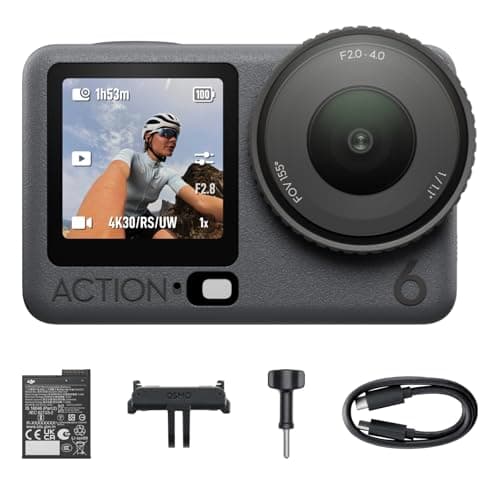
- 20m bare / 60m with case
- 1950mAh · 240 min at 1080p24
- 1/1.1" with f/2.0-f/4.0 aperture
- 9.5
- 9.0
- 9.5
- 8.0
- 9.5
DJI Osmo Action 6
DJI
The first action camera with a variable aperture, on the largest sensor in the class — and it keeps the 20m bare rating and the 240-minute runtime that made the Action 5 Pro the long-day pick.
Bright water and flat light in the same afternoon, on trips measured in days rather than hours
- 1/1.1-inch sensor — the largest in any flat action camera we track, and it shows in flat light
- Variable f/2.0-f/4.0 aperture: it can stop down for glare off the water instead of needing an ND filter
- Keeps the 20m bare rating, the 1950mAh removable battery and the 240-minute published runtime
- -20° to 45°C operating range, and 64GB built in (50GB usable) for the day you forget the card
- 4K at up to 120fps for slow motion, 8K/30 for cropping in the edit
- 149g, the heaviest flagship here — noticeable on a helmet, irrelevant on a hull
- 8K stops at 30fps and costs card space and battery for detail a phone screen never shows
- Mount ecosystem is still smaller than GoPro's, and the magnetic quick-release adapters are a separate purchase
- Sits at the top of the category price bracket — the Action 5 Pro does most of this for less
Specs from DJI Osmo Action 6 published specifications.
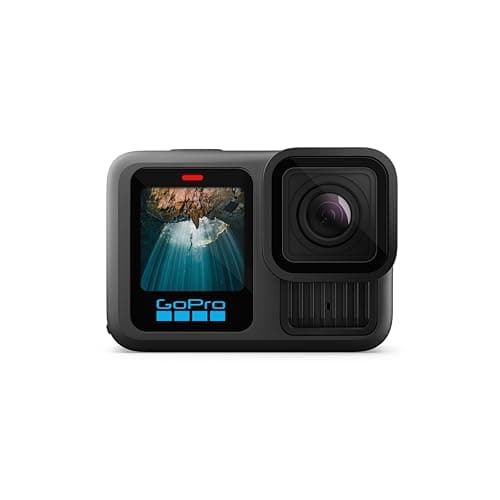
- 33ft (10m), no housing
- 1900mAh Enduro
- 1.5h at 5.3K30 / 2.5h at 1080p30
- 8.0
- 9.5
- 8.5
- 9.5
- 9.0
GoPro HERO13 Black
GoPro
The safest default for lake and trail: 33ft without a housing, the steadiest footage in the category, and a mount for literally everything.
Anyone who wants one camera to handle the kayak, the bike and the family trip
- HyperSmooth 6.0 with AutoBoost is the steadiest stabilization we can find published figures for
- Built-in mounting fingers plus 1/4-20 threads — it fits the GoPro ecosystem and a normal tripod
- Enduro battery is rated to keep full camera functionality down to 14°F (-10°C)
- Replaceable lens cover, so a scratched lens is a $20 problem and not a $400 one
- 33ft is shallower than the DJI and it is the shallowest of the three flagships
- Anything past 33ft needs the separate Protective Housing
- HB-Series lenses and ND filters are all extra purchases
Specs from GoPro HERO13 Black published specifications.
02
How we picked
We do not lab-test, bench-test or dive-test cameras, and we do not own test units. What we do instead is read the manufacturer's published specifications, read the independent reviews that genuinely do test, read owner reports for the failure modes specs never mention — fogging, salt corrosion, cold battery collapse, mount slippage — and then weight all of it for action cameras used on lake and trail. Where a number is not published, the page says “not published” rather than filling the cell.
The full method, including what we refuse to do, is on the editorial policy page.
- 30%Water survival
- Rated depth without a case, door design, and what the manufacturer actually publishes.
- 25%Stabilization in chop
- A kayak deck and a rooty trail shake in ways a handheld walk test never shows.
- 20%Battery in the cold
- Published runtime, spare-battery cost, and whether it charges while recording.
- 15%Mount ecosystem
- Finger mount, threaded, magnetic — and how much of it you have to re-buy.
- 10%Footage you will keep
- Lens replaceability, low-light behavior, and how much cutting the footage needs.
03
Questions people actually ask
01Is the DJI Osmo Action 6 better than the GoPro HERO13 Black?
On the camera itself, mostly yes: a larger sensor, a variable f/2.0-f/4.0 aperture, double the bare depth rating and internal storage. On everything around the camera, no: GoPro's built-in two-prong fingers, 1/4-20 thread and accessory catalog are still the best in the category, and HyperSmooth 6.0 is still the steadiest published stabilization.
02Which is better for kayaking, the Osmo Action 6 or the HERO13 Black?
The Osmo Action 6. 20m bare against 33ft, a lens that can stop down for glare off flat water, and 240 published minutes are the three things a day on the water leans on. A hull also has room for a two-prong adapter if a mount needs one.
03Which one has better stabilization?
GoPro, on published systems: HyperSmooth 6.0 with AutoBoost against RockSteady 3.0 and 3.0+. The difference shows in sharp repetitive impact rather than smooth motion, so it matters far more on a rooty trail than on flat water.
04Can I use my GoPro mounts with the DJI Osmo Action 6?
With an adapter, yes. DJI uses a magnetic quick-release and sells adapters to the standard two-prong fitting. The adapter adds height and a flex point, which is fine on a hull or a handlebar and less fine on a helmet or a tall mast.
05Does 8K on the DJI make it the better camera for image quality?
Not on its own. DJI publishes a 120 Mbps maximum bitrate for the camera, so 8K spreads that data across four times the pixels of 4K and caps out at 30fps. The sensor size and the aperture are the real image-quality advantages here; 8K is a cropping tool.
04
Read this next
DJI Osmo Action 6 review
Every published figure on the DJI, and what the aperture is actually for.
GoPro HERO13 Black review
The same treatment for the GoPro, including the lens-mod story.
Osmo Action 5 Pro vs HERO13 Black
The cheaper version of this same argument, without the aperture.
4K vs 5.3K vs 8K: what resolution you need
Why 8K30 does not settle an image-quality argument.
Action camera mount compatibility
What an adapter costs you in height and flex before you switch brands.
05
Sources
- DJI Osmo Action 6 published specifications
- GoPro HERO13 Black published specifications
- Adorama HERO13 Black listing (120 Mb/s maximum video bitrate)
Specifications are quoted from the manufacturer pages above as they read on the dates shown. Where a figure is not published, this site says so rather than estimating one. We have not tested these products.