The best action cameras for whitewater kayaking
Runtime is irrelevant on a rapid that lasts forty seconds. What matters is stabilization, replaceable glass, and a mount that does not come off in a hole.
Part of On the Water.
We earn a commission if you buy through our links, at no extra cost to you. It never changes what we recommend or the order we rank it in — how this works.
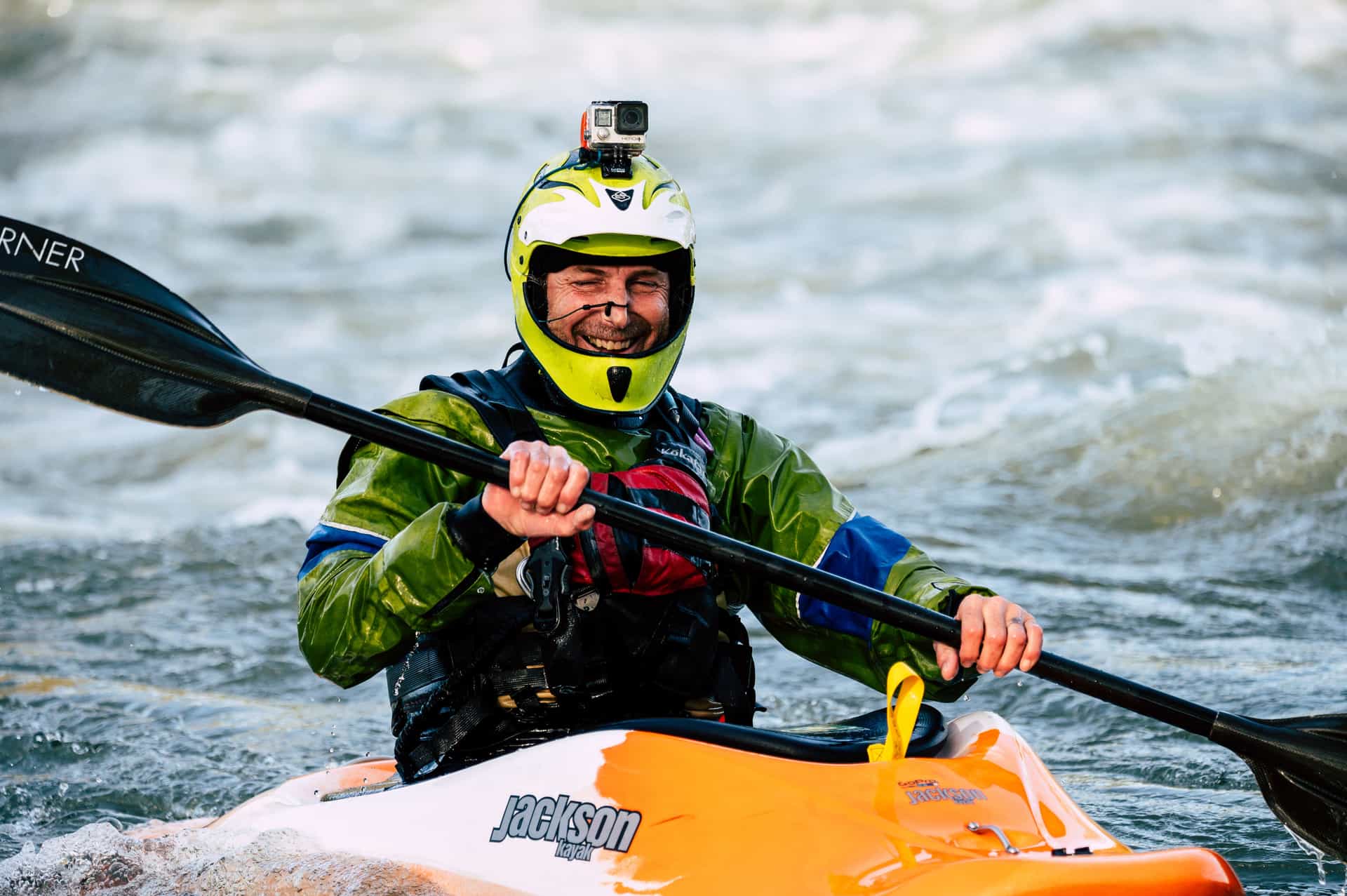
The GoPro HERO13 Black is the best action camera for whitewater kayaking. Whitewater is decided by stabilization and by what breaks: HyperSmooth 6.0 with AutoBoost is the steadiest stabilization with published figures, the lens cover is user-replaceable so a rock strike is a $20 part, and the mount ecosystem is the largest in the category — which matters because on a rapid, the mount is the thing that fails, not the camera. Take the DJI Osmo Action 5 Pro if you want more depth margin for a swim, and the Insta360 X5 if you want to stop aiming entirely and reframe at home.
01
Quick picks
| # | Product | Best for | Score | Price |
|---|---|---|---|---|
| 01 | 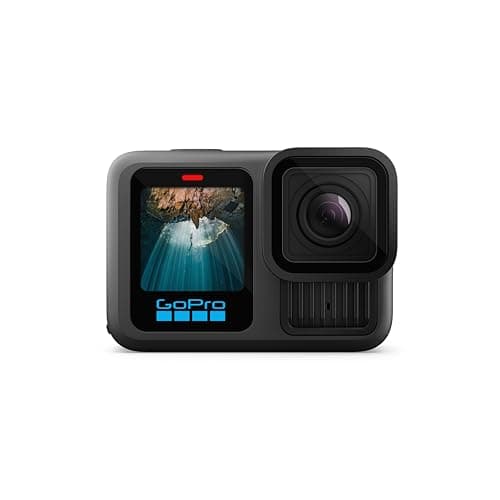 GoPro HERO13 Black The safest default for lake and trail: 33ft without a housing, the steadiest footage in the category, and a mount for literally everything. | Anyone who wants one camera to handle the kayak, the bike and the family trip | 8.8/ 10 | |
| 02 | 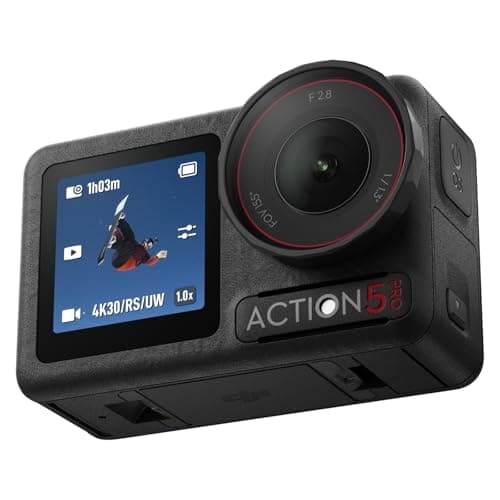 DJI Osmo Action 5 Pro Goes to 20m with no housing at all and publishes a 240-minute runtime — the two numbers that decide a long, wet, cold day. | Long paddles, cold water, and anyone tired of buying a housing to get past 10m | 9.1/ 10 | |
| 03 | 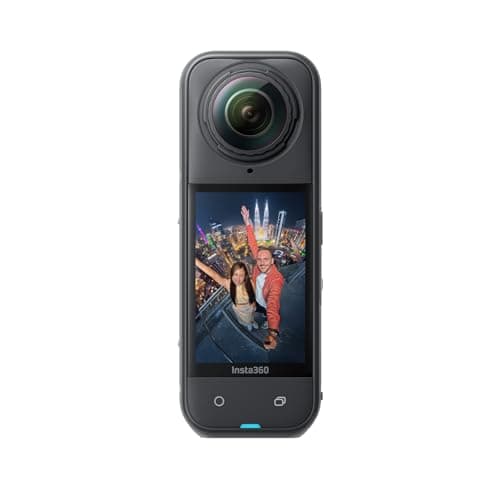 Insta360 X5 15m rated, replaceable lenses, and the one camera that means you never have to aim while you are paddling. | Anyone filming themselves on the water who cannot stop to frame a shot | 9.1/ 10 | |
| 04 | 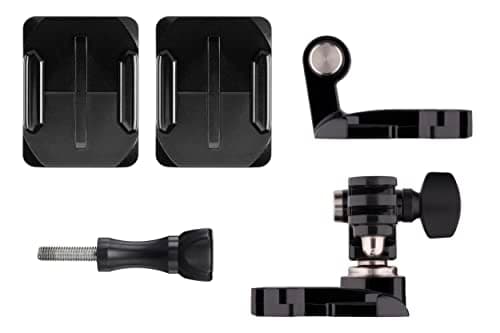 GoPro Helmet Front + Side Mount A swivel assembly and two curved adhesive pads — the only official way to get a side-of-helmet angle that is not a chin bar. | Bike and ski helmets where a top mount is too tall and a chest mount sees too little | 8.2/ 10 | |
| 05 | 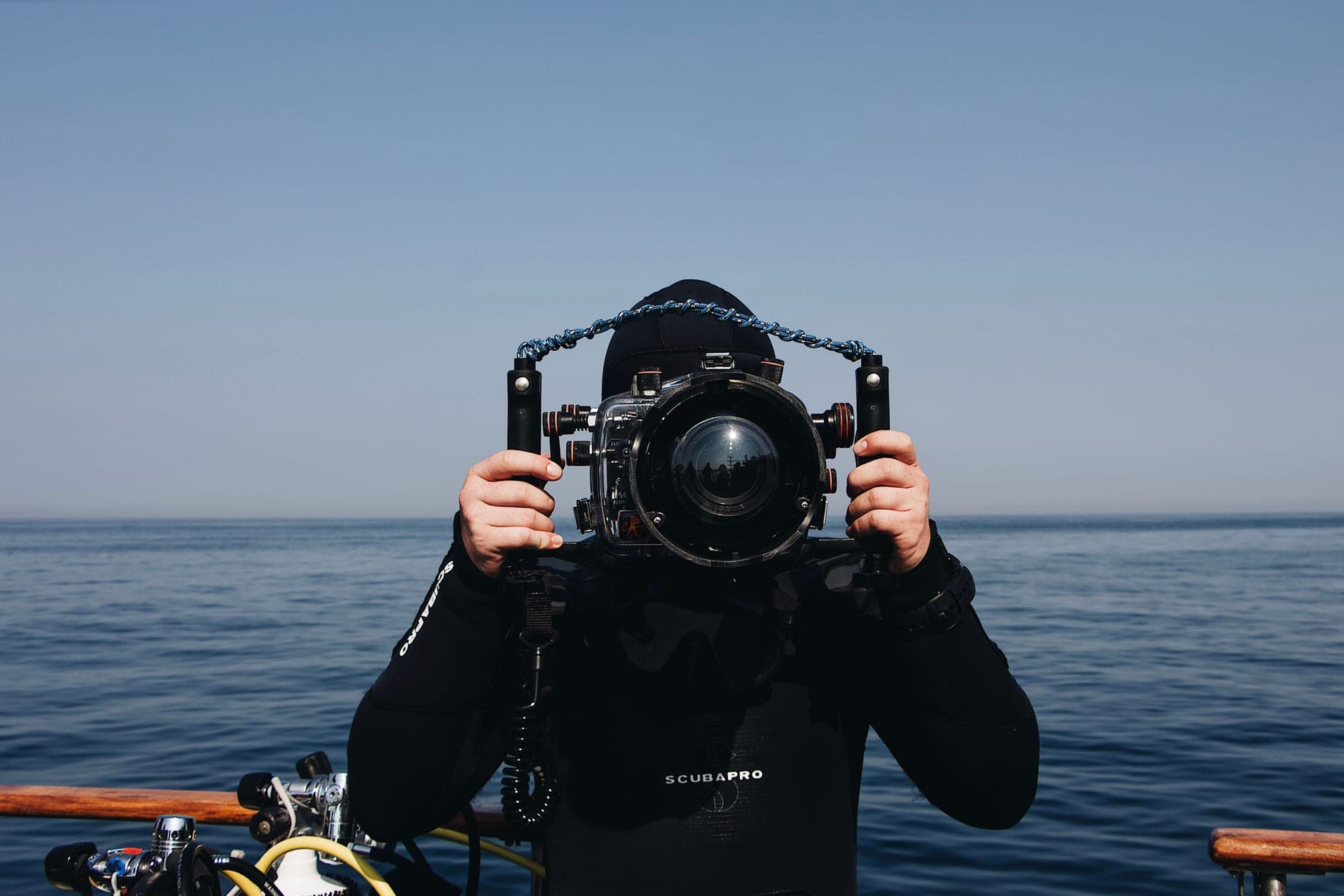 GoPro Protective Housing 196ft (60m) rated, with a flat glass lens — the piece that turns a 33ft camera into a diving camera. | Anything below about 30ft, and any camera going anywhere near a tank | 8.4/ 10 |
Scores are our editorial judgment from published specs and named independent reviews, weighted for lake and trail use — not measurements. We have not tested these units and do not own them.
02
How we picked
We do not lab-test, bench-test or dive-test cameras, and we do not own test units. What we do instead is read the manufacturer's published specifications, read the independent reviews that genuinely do test, read owner reports for the failure modes specs never mention — fogging, salt corrosion, cold battery collapse, mount slippage — and then weight all of it for action cameras used on lake and trail. Where a number is not published, the page says “not published” rather than filling the cell.
The full method, including what we refuse to do, is on the editorial policy page.
- 30%Water survival
- Rated depth without a case, door design, and what the manufacturer actually publishes.
- 25%Stabilization in chop
- A kayak deck and a rooty trail shake in ways a handheld walk test never shows.
- 20%Battery in the cold
- Published runtime, spare-battery cost, and whether it charges while recording.
- 15%Mount ecosystem
- Finger mount, threaded, magnetic — and how much of it you have to re-buy.
- 10%Footage you will keep
- Lens replaceability, low-light behavior, and how much cutting the footage needs.
Whitewater inverts the usual ranking
Every other water page on this site ranks heavily on depth rating and runtime. On whitewater both drop down the list, and the reason is simply the shape of the day.
Runtime barely matters. A rapid lasts thirty seconds to two minutes. You are recording in bursts between eddies, and even a camera with ninety published minutes will outlast a day of actual recording. A camera chosen for its 240-minute figure has optimized for something you are not doing.
Depth matters differently. You will not be at 10 meters. You may well be held under in aerated water for ten or fifteen seconds, which is a submersion-with-force question rather than a depth question — and the honest answer is that margin over the rating is what protects you, not the number itself.
Impact is the real threat. This is the discipline where cameras get smashed rather than flooded. Rock, bows, paddles, the riverbed. The specification that matters is whether the part that breaks is a part you can buy.
Stabilization decides whether anyone watches. Whitewater footage is violent in every axis simultaneously. Weak stabilization turns a good line into a blur nobody sits through, and this is the one category where the difference between the best and second-best stabilization is visible to a casual viewer.
The mount is the weakest link, always. We have never seen a camera fail on a river that the mount did not fail first.
| Camera | Stabilization | Replaceable glass | Bare depth | Housing available |
|---|---|---|---|---|
| GoPro HERO13 Black | HyperSmooth 6.0 with AutoBoost | Yes — lens cover | 10m (33ft) | Yes, 196ft (60m) |
| DJI Osmo Action 5 Pro | RockSteady | No | 20m | Yes, 60m |
| Insta360 X5 | FlowState | Yes — user-replaceable lenses | 15m (IP68) | Not published for the X5 case |
| Insta360 Ace Pro 2 | FlowState | No | 12m (39ft) | Yes, 60m |
| AKASO Brave 8 Lite | SuperSmooth — a step behind | No | 10m (IPX8) | Yes, 60m |
Mounting, which is most of the decision
A camera is as secure as the cheapest component between it and the boat, and on whitewater the forces are unlike anything else in this category — a few hundred newtons of aerated water arriving sideways.
Helmet, front or side, never the top. A top mount has the most leverage, the most snag potential and sits on the most likely impact point. A low front or side position survives better and looks better, because it is closer to your eye line. Never drill a helmet, and use a mount that will shear away rather than transfer load into the shell.
Give adhesive 24 hours. The pads reach full bond strength overnight. This single fact is responsible for more lost cameras than any other on this page.
Tether everything. A short leash from the camera to the helmet or to your PFD. A camera rated to 20m that is sitting on a riverbed is still gone. There is more on this in floats, tethers and not losing your camera.
Bow mounts beat helmet mounts for the actual whitewater shot. A helmet camera shows what you looked at. An adhesive or suction mount on the foredeck pointing back at you shows the wave arriving and your face dealing with it, which is the footage people watch. The deck options are in the best kayak camera mounts, and the adhesive-versus-clamp question specifically is in track vs clamp vs suction.
What not to use: suction cups on a plastic creek boat. The hull texture is wrong, they release under load, and they will release at the worst moment. Adhesive or a mechanical fitting only.
Settings for a river
Shoot 2.7K or 4K at 60fps, not 30. This is the one place on this site where we recommend a high frame rate as the default. Whitewater has fast motion in frame and 60fps both looks cleaner and gives you the option to slow a drop down by half in an edit. 1080p/120 for the big drop specifically.
Leave stabilization on and do not use the widest lens setting. Maximum field of view gives the stabilizer less margin to crop into, which is exactly backwards for violent motion. One step in from the widest is the sweet spot.
Lock the shutter if the camera lets you. White water is the brightest subject in nature and auto-exposure chases it, so a wave arriving makes the whole frame dim and then bright again. The water settings page covers this: best settings for water.
Wipe the lens before every run. A droplet on the front element ruins the whole descent and you will not notice until you are home. This is the most common reason good whitewater footage is unusable.
03
Every pick, in detail
- 33ft (10m), no housing
- 1900mAh Enduro
- 1.5h at 5.3K30 / 2.5h at 1080p30
- 8.0
- 9.5
- 8.5
- 9.5
- 9.0
GoPro HERO13 Black
GoPro
The safest default for lake and trail: 33ft without a housing, the steadiest footage in the category, and a mount for literally everything.
Anyone who wants one camera to handle the kayak, the bike and the family trip
The right camera here for three reasons, none of which is the headline spec. HyperSmooth 6.0 with AutoBoost is the best-documented stabilization in the category, and whitewater is the condition that exposes stabilization most brutally — a boat punching through a wave train generates motion in every axis at once, and a camera that cannot hold it produces footage nobody can watch for more than thirty seconds.
The replaceable lens cover is the second reason, and it is more important on a river than anywhere else. Rock, gravel and the rolled-up riverbed in a flood all find the front of a camera. A scratched front element on a sealed body is a dead camera; here it is a part you unscrew.
Third, the mount ecosystem. On whitewater you are mounting to a helmet, a bow or a thigh brace and the load is violent — that is a question about properly engineered brackets, and GoPro's two-prong standard has by far the widest selection behind it. The honest con is the shallowest bare rating of the three flagships at 33ft (10m), which matters for a long swim rather than a roll.
- HyperSmooth 6.0 with AutoBoost is the steadiest stabilization we can find published figures for
- Built-in mounting fingers plus 1/4-20 threads — it fits the GoPro ecosystem and a normal tripod
- Enduro battery is rated to keep full camera functionality down to 14°F (-10°C)
- Replaceable lens cover, so a scratched lens is a $20 problem and not a $400 one
- 33ft is shallower than the DJI and it is the shallowest of the three flagships
- Anything past 33ft needs the separate Protective Housing
- HB-Series lenses and ND filters are all extra purchases
Specs from GoPro HERO13 Black published specifications.
- 20m bare / 60m with case
- 1950mAh · 240 min at 1080p24
- -20° to 45°C
- 9.5
- 9.0
- 9.5
- 8.0
- 9.0
DJI Osmo Action 5 Pro
DJI
Goes to 20m with no housing at all and publishes a 240-minute runtime — the two numbers that decide a long, wet, cold day.
Long paddles, cold water, and anyone tired of buying a housing to get past 10m
Second, and the pick if you swim more than you would like to admit. 20m bare is double the GoPro's rating, and on a river the point is not depth — it is that the rating is nowhere near its limit while the camera is held under a stopper, pushed through a boil line and recirculated. Add the -20°C rating and this is also the right camera for a snowmelt run in March.
RockSteady stabilization is excellent and marginally behind HyperSmooth in the worst conditions, which is why this is second rather than first. The real cost on whitewater is the mount ecosystem: fewer third-party brackets, and magnetic quick-release adapters that we would not use in violent water. Use a mechanical mount. The comparison between the two bodies is in Osmo Action 5 Pro vs GoPro HERO13 Black.
- 20m without the Waterproof Case — double the bare-camera depth of the HERO13 Black
- DJI publishes 240 minutes of recording at 1080p/24 with screens off, the longest figure in this set
- Rated to -20°C, which matters more on an October lake than any resolution number
- 1/1.3-inch sensor holds detail when the light goes flat
- Mount ecosystem is smaller than GoPro's, and magnetic quick-release adapters are their own purchase
- 146g — the heaviest of the flagship three
- Fewer third-party mounts and filters exist for it
Specs from DJI Osmo Action 5 Pro published specifications.
- IP68 to 49ft (15m)
- 2400mAh · ~88 min at 8K30
- User-replaceable
- 9.5
- 9.5
- 9.0
- 8.5
- 7.5
Insta360 X5
Insta360
15m rated, replaceable lenses, and the one camera that means you never have to aim while you are paddling.
Anyone filming themselves on the water who cannot stop to frame a shot
The one camera here that changes what footage you come home with. On a rapid you have no attention available for framing — you are reading water — so a camera that records everything and lets you choose the angle afterwards captures the moment you were too busy to point at. A line you nearly blew, the person behind you going over, your own face in the hole: all from one clip.
15m IP68 is the deepest bare rating on this site and the lenses are user-replaceable, which on a river is the specification that matters most. The caveat is unavoidable: you are carrying two exposed hemispherical lenses into an environment made of rock. Lens guards are mandatory here, not optional, and you should expect to replace glass eventually. The format trade-off in full is in 360 camera vs action camera.
- 15m IP68 is the deepest bare rating of any camera on this site
- User-replaceable lenses — the single biggest fix for the 360 format's worst failure mode
- 185 minutes in Endurance mode at 5.7K24, which is a whole day of clips
- Invisible-selfie-stick reframing means you point the camera at nothing and pick the angle later
- Exposed lenses still scratch; lens guards are a purchase, not an option
- Every clip needs a reframing pass before anyone else can watch it
- 8K30 files are large and the edit is slower than flat footage
Specs from CineD, Insta360 X5 announcement with published specifications.
- Swivel mount, 2 curved adhesive mounts
- Vertical mounting buckle and thumb screw
- Curved helmet shells
- 8.5
- 8.0
- 8.0
- 9.0
- 6.5
GoPro Helmet Front + Side Mount
GoPro
A swivel assembly and two curved adhesive pads — the only official way to get a side-of-helmet angle that is not a chin bar.
Bike and ski helmets where a top mount is too tall and a chest mount sees too little
On whitewater the helmet is the mount point, and this is the right bracket for it. A front-or-side position sits far lower than a top mount, which matters twice over: less leverage for the water to tear it off, and less of a snag point in a swim or a rescue. Adhesive needs a full 24 hours to reach bond strength — fitting one the morning of a run is the single most common reason a camera parts company with a helmet. The complete method is in how to mount an action camera on a helmet.
- The swivel assembly means you set the angle once and ride, instead of guessing
- Curved adhesive pads are made for helmet shells rather than flat panels
- Side mounting keeps the camera out of the wind better than a top mount
- Industrial-strength waterproof adhesive from the same family as the curved and flat mounts
- Adhesive is a one-shot decision — get the position right before you press
- Removing it means heating the adhesive with a hair dryer
- Adds a side profile that some helmet certifications discourage; check yours
Specs from GoPro Helmet Front + Side Mount product page.
- 196ft (60m)
- HERO13, 12, 11, 10 Black
- Flat glass front
- 9.5
- 8.5
- 8.0
- 7.0
- 6.0
GoPro Protective Housing
GoPro
196ft (60m) rated, with a flat glass lens — the piece that turns a 33ft camera into a diving camera.
Anything below about 30ft, and any camera going anywhere near a tank
The one place on this site we actively recommend a housing for shallow water. On a river the camera is not going deep, it is going into things — rock, a bow, a riverbed. The housing is armor, rated to 196ft (60m) with a HERO13, 12, 11 or 10 Black inside, and it means the shell takes the strike instead of the body. The costs are real and worth stating: muffled audio, an O-ring to inspect before every run, and a fogging risk in the warm-air-to-cold-water transition a spring river gives you, which makes anti-fog inserts a required purchase alongside it.
- 60m is six times the HERO13 Black's bare rating
- Flat glass lens rather than plastic, so the image holds up
- Includes a skeleton backdoor for better audio when you are not underwater
- Also the best impact protection the camera can wear
- Muffles audio badly with the sealed door — that is physics, not a defect
- Sealed air plus a temperature change is exactly how fogging happens; budget for inserts
- Buttons are harder to work with gloves on
Specs from GoPro Protective Housing product page.
04
What decides this category
Stabilization first
It is the only specification on this page a casual viewer notices. If you are choosing between two cameras and one has better-documented stabilization, take it — there is a dedicated comparison in HyperSmooth vs RockSteady vs FlowState.
Buy a camera whose glass is a part number
Rock finds lenses. A replaceable lens cover or replaceable lens is the difference between a consumable and a write-off, and over two seasons on rivers it will be used.
Spend properly on the mount
More of the whitewater budget should go to brackets than most people allow. One engineered helmet mount and one deck mount beats a bag of plastic adapters, and it is the part that actually fails.
What we would skip
A chest mount, on whitewater specifically. It is a superb paddling angle on flat water — see chest mount vs helmet mount — and on a river your spray deck, your PFD and your forward stroke all end up in frame, and the camera sits exactly where you brace a paddle against your body.
05
Questions people actually ask
01What is the best action camera for whitewater kayaking?
The GoPro HERO13 Black. Stabilization and repairable glass are what whitewater tests, and it leads on both, with the largest selection of properly engineered mounts behind it. The DJI Osmo Action 5 Pro is the pick if you want more depth margin for being held under.
02Do I need a housing for whitewater kayaking?
Not for waterproofing — every pick here is rated well past anything a river does. A housing is worth it as armor against rock strikes, and it costs you audio, adds an O-ring to inspect and brings a fogging risk that makes anti-fog inserts necessary.
03Where is the best place to mount a camera for whitewater?
Low on the side or front of the helmet for the point-of-view shot, and an adhesive mount on the foredeck pointing back at you for the shot people actually watch. Avoid top-of-helmet and avoid suction cups on a plastic hull.
04What frame rate should I use for whitewater?
60fps at 2.7K or 4K as the default, and 1080p/120 for a big drop. Fast motion in frame looks cleaner at 60 than 30, and it gives you the option to slow a line down in the edit.
05Will a cheap action camera work on whitewater?
Usually not well. The water rating is often fine; the stabilization is where budget cameras give up, and whitewater is the condition that exposes it hardest. A budget camera on a grade III produces footage you will not keep.
06
Read this next
The best action cameras for kayaking
The general case, ranked for flat water and touring.
The best action cameras for sea kayaking
The opposite discipline: long, salty and decided by runtime.
How to mount a camera on a helmet
Position, adhesive cure time and the mistakes that lose cameras.
HyperSmooth vs RockSteady vs FlowState
The specification that decides this page, compared directly.
Cases and dive housings
When armor is worth the audio and the fogging risk.
07
Sources
- GoPro HERO13 Black published specifications
- DJI Osmo Action 5 Pro specifications
- CineD, Insta360 X5 announcement with published specifications
- GoPro Helmet Front + Side Mount product page
- GoPro Protective Housing product page
Specifications are quoted from the manufacturer pages above as they read on the dates shown. Where a figure is not published, this site says so rather than estimating one. We have not tested these products.