The best action cameras for grandparents
The deciding spec is not resolution. It is whether the camera can be switched on, pointed and put away without anyone needing to explain it.
Part of Cameras.
We earn a commission if you buy through our links, at no extra cost to you. It never changes what we recommend or the order we rank it in — how this works.
The GoPro HERO (2024) is the best action camera for most grandparents — one shutter button, a rear screen you frame on directly, 46% less mass than a HERO13 Black, and no setting that has to be understood before it records something watchable. It is the pick for filming grandchildren at the lake, on a bike path or in a pool, where the only requirement is that the camera works the first time it is picked up. Step up to the DJI Osmo Action 4 if the battery has to be swappable, and look at the Insta360 GO Ultra instead if the camera needs to clip on and be forgotten rather than held.
01
Quick picks
| # | Product | Best for | Score | Price |
|---|---|---|---|---|
| 01 | 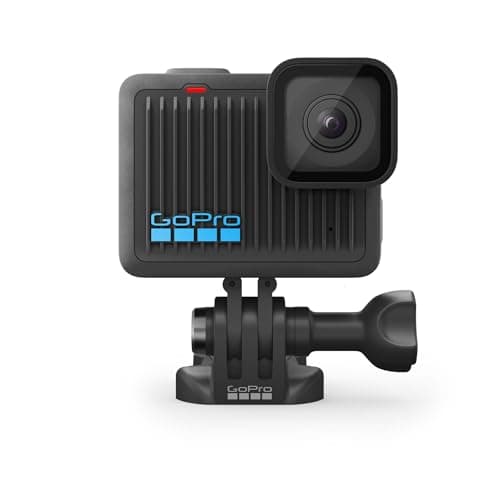 GoPro HERO (2024) The cheapest real GoPro, and the one whose 16ft rating you have to take seriously before you take it snorkeling. | A first camera, a kid's camera, or a second angle that mounts anywhere | 7.1/ 10 | |
| 02 | 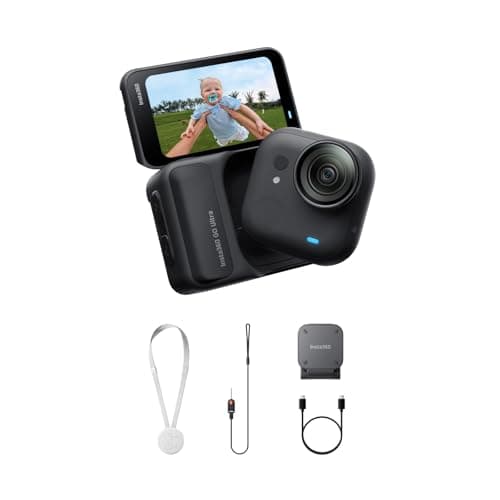 Insta360 GO Ultra 53 grams and IPX8 to 10m on its own — the camera you actually clip on for a paddle instead of leaving in the dry bag. | Hands-free clips where a full-size camera would never leave the bag | 7.6/ 10 | |
| 03 | 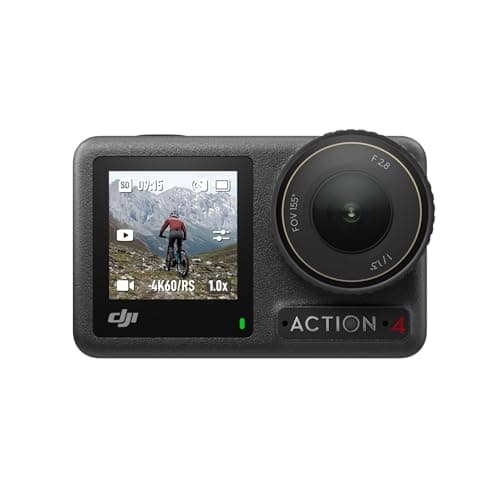 DJI Osmo Action 4 The previous DJI flagship, still 18m bare and still on shelves — the most water rating per dollar in this list. | Buyers who want deep-water capability without paying flagship money | 8.5/ 10 | |
| 04 | 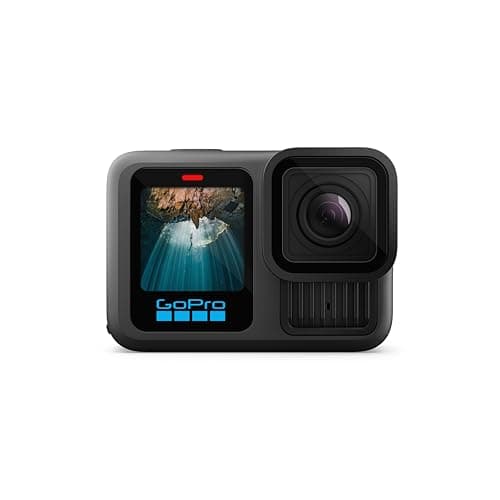 GoPro HERO13 Black The safest default for lake and trail: 33ft without a housing, the steadiest footage in the category, and a mount for literally everything. | Anyone who wants one camera to handle the kayak, the bike and the family trip | 8.8/ 10 | |
| 05 | 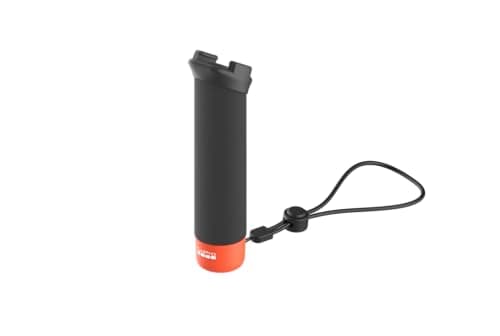 GoPro The Handler Floating Hand Grip A grip that floats bright-orange-end-up when you drop it, with a quick release so the camera moves to a mount without tools. | Handheld water shots — snorkeling, swimming, filming from the boat | 8.2/ 10 |
Scores are our editorial judgment from published specs and named independent reviews, weighted for lake and trail use — not measurements. We have not tested these units and do not own them.
02
How we picked
We do not lab-test, bench-test or dive-test cameras, and we do not own test units. What we do instead is read the manufacturer's published specifications, read the independent reviews that genuinely do test, read owner reports for the failure modes specs never mention — fogging, salt corrosion, cold battery collapse, mount slippage — and then weight all of it for action cameras used on lake and trail. Where a number is not published, the page says “not published” rather than filling the cell.
The full method, including what we refuse to do, is on the editorial policy page.
- 30%Water survival
- Rated depth without a case, door design, and what the manufacturer actually publishes.
- 25%Stabilization in chop
- A kayak deck and a rooty trail shake in ways a handheld walk test never shows.
- 20%Battery in the cold
- Published runtime, spare-battery cost, and whether it charges while recording.
- 15%Mount ecosystem
- Finger mount, threaded, magnetic — and how much of it you have to re-buy.
- 10%Footage you will keep
- Lens replaceability, low-light behavior, and how much cutting the footage needs.
What actually decides this
Almost every action camera roundup ranks on sensor size, bitrate and frame rate. None of those three decides whether a camera gets used. The questions that do are smaller and more awkward to put on a spec sheet.
Can it be operated without the phone app? This is the big one. Several cameras are designed app-first, which means pairing, Bluetooth, an account and a firmware prompt stand between picking the camera up and recording anything. Every pick above works standalone: press the button, it records; press it again, it stops.
Is there a screen on the back you can frame on? Not a status display — an actual preview. Framing by guesswork produces footage of the sky and the top of a head, and that is the most common reason a camera ends up in a drawer.
How heavy is it once it is mounted? A 154g camera on a chest harness is noticeable after an hour. A 53g camera on a hat is not. Weight is the specification that quietly decides whether the thing gets worn a second time.
What happens the day it gets dropped in water? Not a hypothetical at a lake. A float and a bare-camera depth rating turn that from a replacement into a story.
| Camera | Weight | Bare depth | Battery | Rear preview screen |
|---|---|---|---|---|
| GoPro HERO (2024) | Lightest GoPro — 46% less mass than HERO13 Black | 16ft (5m) | Built in, not removable | Yes |
| Insta360 GO Ultra | 53g camera | IPX8 to 33ft (10m), camera only | Removable via Action Pod | On the Action Pod |
| DJI Osmo Action 4 | Not published | 18m | 1770mAh removable · 160 min | Yes, plus a front screen |
| GoPro HERO13 Black | Not published | 33ft (10m) | 1900mAh Enduro, removable | Yes, plus a front screen |
Why we did not rank the cheapest camera first
There is a whole shelf of twenty-to-fifty-dollar cameras sold on exactly this use case, and we have left them off deliberately. The failure mode is consistent: they record, but the stabilization is nominal, so handheld footage of a child running is unwatchable; the screens are small and dim in sunlight, so framing goes back to guesswork; and the menus are translated badly, which is precisely the obstacle this page exists to remove.
The one budget camera we do rate is on the budget roundup, and it earns its place by shipping two batteries and seven mounts in the box rather than by being simple.
Mount it, do not hold it
The single biggest improvement to footage filmed by anyone, at any age, is to stop holding the camera. A held camera means a hand that drifts, a shot that is mostly ground, and attention spent on framing instead of on the person in front of you.
Two mounts cover nearly everything. A chest harness gives the natural you-were-there angle and leaves both hands free, which is the right answer at a playground, on a beach or pushing a stroller. A clamp or suction mount handles the boat rail, the pontoon and the garden table. Neither needs tools and neither needs explaining twice.
What to ignore
Resolution above 4K. 5.3K and 8K exist to allow cropping in an edit. If the footage is going to a phone or a television as shot, 4K/30 is already more than the screen shows, and the files are half the size.
360 cameras, for this buyer. They are genuinely excellent and they add a mandatory reframing step on a computer or phone before anyone else can watch a clip. That is a real amount of work. If that sounds appealing rather than tiring, read the 360 comparison — otherwise a flat camera skips the step entirely.
Voice control. It works in a quiet room and not on a windy dock, and a camera that sometimes responds is worse than one that never does.
03
Every pick, in detail
- 16ft (5m)
- 4K30, 2.7K60 slo-mo
- Built in, not user-removable
- 6.0
- 7.5
- 6.0
- 9.0
- 7.0
GoPro HERO (2024)
GoPro
The cheapest real GoPro, and the one whose 16ft rating you have to take seriously before you take it snorkeling.
A first camera, a kid's camera, or a second angle that mounts anywhere
Top pick because it removes the two things that make action cameras frustrating for anyone who did not grow up with them: menus and weight. There is one shutter button, a rear touchscreen that shows exactly what is being recorded, and HyperSmooth running in the background so the footage is steady whether or not anyone knows what stabilization is. GoPro lists it as working with 35+ mounts, so it fits a chest harness, a handlebar clamp or a tripod thread without a shopping expedition.
The two honest cons both matter here. The 16ft (5m) water rating is a splash-and-shallows rating, which is fine for a dock, a pool or a paddle and wrong for a snorkeling holiday. And the battery is built in and not user-removable, so you cannot hand over a charged spare mid-afternoon — you carry a power bank instead. If a swappable battery is non-negotiable, skip to the DJI below.
- Genuinely tiny — 46% less mass than HERO13 Black
- Built-in mounting fingers, and GoPro lists it as compatible with 35+ mounts
- HyperSmooth stabilization at the lowest GoPro price
- Simple enough to hand to someone who has never used one
- 16ft (5m) is a snorkel-adjacent rating, not a diving one
- The battery is built in — you cannot carry a spare, you carry a power bank
- 4K30 is the ceiling; no 4K60, no high-frame-rate 4K
Specs from GoPro HERO published specifications.
- IPX8 to 33ft (10m), camera only
- 53g
- Up to 170 min with the Action Pod
- 7.0
- 8.0
- 7.5
- 8.0
- 8.0
Insta360 GO Ultra
Insta360
53 grams and IPX8 to 10m on its own — the camera you actually clip on for a paddle instead of leaving in the dry bag.
Hands-free clips where a full-size camera would never leave the bag
A completely different answer to the same problem. At 53g this clips to a hat brim, a shirt placket or a jacket strap and then stops being a camera you are operating at all — which is the right design when the point is to be present with the grandchildren rather than filming them. It is rated IPX8 to 10m on its own, deeper than the GoPro HERO, and the sensor is far larger than the size suggests.
Read the two depth ratings separately: the camera is rated to 10m, the Action Pod it docks into is a separate product with its own rating, and treating them as one thing is how people flood a GO. Magnetic mounting is also convenient rather than mechanical — it is excellent on clothing and not something we would trust on a moving hull. See what actually fits what before buying mounts.
- 53g means it goes on a hat brim, a PFD strap or a chest magnet and you forget it is there
- IPX8 to 10m for the camera itself, with a 1/1.28" sensor that is far larger than the size suggests
- Action Pod adds a flip screen and the long runtime when you want it
- Removable microSD, so you are not stuck with fixed onboard storage
- The Action Pod is not rated to the same depth as the camera — read the two ratings separately
- Magnetic mounting is convenient but is not a mechanical lock in real chop
- No interchangeable lens cover, so a scratch is permanent
Specs from Insta360 GO Ultra published specifications.
- 18m bare / 60m with case
- 1770mAh · 160 min at 1080p24
- -20° to 45°C
- 9.0
- 8.5
- 8.5
- 8.0
- 8.0
DJI Osmo Action 4
DJI
The previous DJI flagship, still 18m bare and still on shelves — the most water rating per dollar in this list.
Buyers who want deep-water capability without paying flagship money
The pick when the day is long. 160 published minutes at 1080p/24, a removable 1770mAh battery so a flat one is a thirty-second swap rather than the end of the outing, and 18m of bare-camera depth that takes every ordinary water situation off the list of things to worry about. It is also rated to -20°C, which is the honest reason it appears on a list like this: cold hands and a cold camera are the two failures that actually ruin an October afternoon.
It is a step up in complexity from the HERO (2024) — more modes, more menu — but the front screen earns that back, because being able to see yourself while holding the camera out is the difference between a photo of a chin and a photo of two people.
- 18m without a case still beats every current GoPro by a wide margin
- Same 1/1.3-inch sensor size as the Action 5 Pro
- Rated to -20°C like its replacement
- Usually the cheapest way into serious bare-camera depth
- 160 minutes published against the Action 5 Pro's 240
- Superseded, so accessories and support will taper off first
- No front OLED — the Action 5 Pro's front screen is genuinely more useful for framing
Specs from DJI Osmo Action 4 published specifications.
- 33ft (10m), no housing
- 1900mAh Enduro
- 1.5h at 5.3K30 / 2.5h at 1080p30
- 8.0
- 9.5
- 8.5
- 9.5
- 9.0
GoPro HERO13 Black
GoPro
The safest default for lake and trail: 33ft without a housing, the steadiest footage in the category, and a mount for literally everything.
Anyone who wants one camera to handle the kayak, the bike and the family trip
Here because of the mount ecosystem rather than the specs. If there are already GoPro mounts in the house — a chest harness from a cycling phase, a suction cup from a boat — this is the body that fits all of them, and the replaceable lens cover means a scratch is a $20 problem rather than a $400 one. That last point is worth more on a camera that gets handed around than any resolution figure.
It is the most capable camera on this page and the least simple. If nobody is going to go past the default mode, the money is better spent on the HERO (2024) plus a chest mount.
- HyperSmooth 6.0 with AutoBoost is the steadiest stabilization we can find published figures for
- Built-in mounting fingers plus 1/4-20 threads — it fits the GoPro ecosystem and a normal tripod
- Enduro battery is rated to keep full camera functionality down to 14°F (-10°C)
- Replaceable lens cover, so a scratched lens is a $20 problem and not a $400 one
- 33ft is shallower than the DJI and it is the shallowest of the three flagships
- Anything past 33ft needs the separate Protective Housing
- HB-Series lenses and ND filters are all extra purchases
Specs from GoPro HERO13 Black published specifications.
- Bright orange end pops to the surface
- Quick release, switches between mounts
- Non-slip construction
- 8.0
- 8.5
- 9.0
- 7.0
GoPro The Handler Floating Hand Grip
GoPro
A grip that floats bright-orange-end-up when you drop it, with a quick release so the camera moves to a mount without tools.
Handheld water shots — snorkeling, swimming, filming from the boat
Not a camera, and the single best twenty-dollar decision on this page. It is a floating grip: the camera screws to the end, it is comfortable to hold with cold or arthritic hands, and if it goes over the side of a dock it bobs instead of sinking. Buy it with whichever camera you choose. The related reading is floats, tethers and not losing your camera.
- Floats end-up so you can actually spot it in chop
- Quick-release base means the same camera goes from hand to deck mount in seconds
- Non-slip even with wet or cold hands
- GoPro lists it specifically for surfing, kayaking and wakeboarding
- It floats the grip; a heavy housing on the end changes that calculation
- No wrist strap included in every configuration — add one
- Bulky in a PFD pocket
Specs from GoPro The Handler product page.
04
What decides this category
Standalone operation, not app-first
Buy a camera that records with no phone in the equation. The app is useful for getting clips off the camera later; it should never be required to start one.
A preview screen on the back
Framing by preview rather than by aim is the difference between keeping the footage and deleting it. A front screen as well is a genuine bonus for anything self-filmed.
A float, bought at the same time
Twenty dollars against the price of the camera. Water is where these cameras go, and sinking is what they do unaided.
What we would skip
Bundles padded with an unbranded selfie stick, a dozen plastic adapters and a bag. The mounts that come in those kits are the ones that slip. One good mount beats seven bad ones, and the first five accessories covers what is genuinely worth owning.
05
Questions people actually ask
01What is the easiest action camera for a grandparent to use?
The GoPro HERO (2024). One shutter button, a rear touchscreen to frame on, no app required to record, and stabilization that runs without being configured. Its limits are a 16ft water rating and a built-in battery you cannot swap.
02Do you need a phone to use an action camera?
Not to record. Every pick on this page starts recording from its own shutter button with no phone nearby. You will want the app eventually to move clips off the camera, but that is a separate job and it can be done by whoever is handiest with a phone.
03Is an action camera better than a phone for filming grandchildren?
For anything wet, fast or hands-free, yes — it mounts, it survives water, and it is not also the device you need for directions and calls. For a static shot in good light, a modern phone is fine. The longer answer is on action camera vs phone.
04Which action camera has the biggest screen?
Among these, the DJI Osmo Action 4 and GoPro HERO13 Black have the largest rear screens plus a front screen for self-framing. The Insta360 GO Ultra has no screen on the camera itself — the preview lives on the Action Pod it docks into.
05What happens if it gets dropped in the lake?
Without a float, it sinks — none of these are buoyant on their own. With a float or a floating grip it stays on the surface and you collect it. Buy one at the same time as the camera; it is the cheapest insurance on the whole purchase.
06
Read this next
The easiest action cameras to use
The same question without the family framing — ranked purely on operation.
The best action cameras for kids
The other end of the same trip, ranked on what survives being dropped.
The best action cameras for family travel
One camera for the whole trip, including the adults who want 5.3K.
The best chest mounts
The one accessory that changes the footage more than the camera does.
Floats, tethers and not losing your camera
Twenty dollars between a story and a replacement.
07
Sources
- GoPro HERO (2024) published specifications
- Insta360 GO Ultra published specifications
- DJI Osmo Action 4 published specifications
- GoPro HERO13 Black published specifications
- GoPro The Handler product page
Specifications are quoted from the manufacturer pages above as they read on the dates shown. Where a figure is not published, this site says so rather than estimating one. We have not tested these products.