GoPro vs Insta360, underwater
On the surface these two trade blows. Below it, the differences get sharper and one of them changes shape entirely.
Part of On the Water.
We earn a commission if you buy through our links, at no extra cost to you. It never changes what we recommend or the order we rank it in — how this works.
Depth, and where the crossover happens
| GoPro HERO13 Black | Insta360 X5 | |
|---|---|---|
| Bare rating | 33ft (10m) | 49ft (15m), IP68 |
| With the maker's housing | 196ft (60m), Protective Housing | Dive case exists; depth not published for the X5 |
| Lens exposure | Flat, recessed, replaceable cover | Two protruding lenses, user-replaceable |
| Depth-rated filter sets | Several, with published depth ranges | Fewer, and rarely with published ranges |
| Audio in a housing | Muffled, as with any housing | Muffled, plus the housing enters every frame |
Below about 15 meters the Insta360 needs a case, and a case does something to a 360 camera that it does not do to a flat one: it appears in the footage. The whole point of the format is that the camera sees everything, which means it also sees the housing around it. Insta360's dive cases are shaped to minimize this and they do a decent job, but the invisible-pole trick — the single best reason to own a 360 camera — is compromised.
That is the real crossover. Above 15m, the X5 is arguably the better underwater camera because it needs nothing. Below it, the GoPro plus its 60m housing is a cleaner system.
Color is the bigger problem, and it is a draw
Neither camera fixes the thing that actually ruins underwater footage. Water absorbs red first, and by fifteen feet your sensor is receiving light with the warm end stripped out of it. That happens before the camera is involved, so no sensor, no processor and no brand solves it.
The fix is a filter, and here the GoPro has a genuine advantage: the aftermarket is larger, and the good sets publish a depth range per filter. PolarPro, for example, states a red filter for tropical water between 15 and 75ft and a snorkel filter for 5 to 15ft. Being able to pick the right one rather than guessing is most of the value — the filter guide covers it properly.
Filters for 360 cameras are a harder problem in principle, because you have two lenses pointing in opposite directions at potentially different light. In practice this means fewer options and less published data.
Exposed lenses, underwater
The X5's protruding lenses are its defining physical risk, and underwater is where they are most exposed: reef, rock, boat ladders and sand are all abrasive, and you have less fine control of where the camera goes in three dimensions than you do on land.
Insta360's answer is genuinely good — the lenses are user-replaceable, so a deep scratch is a part rather than a service. But the correct approach is still guards on, and accepting that guards introduce a small amount of optical softness and another surface to keep clean.
The GoPro's lens sits behind a flat, recessed, replaceable cover. Less to go wrong, and it is one of the quiet reasons GoPro dominates dive shops.
Fogging: the failure that decides more dives than depth does
Any sealed housing full of warm humid air will condense on the inside of the glass when it hits cold water. That applies equally to both brands, and it is why anti-fog inserts are a consumable rather than an accessory.
The relevant difference is that the X5 does not need a housing at all above 15m, which removes the problem. If most of your water time is snorkeling, that is a real and underrated advantage.
Where each one loses
The GoPro loses on bare depth — 10m against 15m — and therefore reaches for a housing sooner, with the muffled audio, O-ring maintenance and fogging risk that come with it. It also cannot record what is behind you, which underwater is frequently where the interesting thing is.
The Insta360 loses the moment you go deep enough to need a case, because the case is in the shot. It loses on filter availability, it has more exposed glass in an abrasive environment, and every clip still needs a reframing pass afterwards — which after a day of diving is a real consideration.
01
What each side needs to work underwater
The cameras, plus the housing that is the reason the GoPro can go to 60m at all. Filters are covered separately, because they are what actually fixes the color.
- 33ft (10m), no housing
- 1900mAh Enduro
- 1.5h at 5.3K30 / 2.5h at 1080p30
- 8.0
- 9.5
- 8.5
- 9.5
- 9.0
GoPro HERO13 Black
GoPro
The safest default for lake and trail: 33ft without a housing, the steadiest footage in the category, and a mount for literally everything.
Anyone who wants one camera to handle the kayak, the bike and the family trip
- HyperSmooth 6.0 with AutoBoost is the steadiest stabilization we can find published figures for
- Built-in mounting fingers plus 1/4-20 threads — it fits the GoPro ecosystem and a normal tripod
- Enduro battery is rated to keep full camera functionality down to 14°F (-10°C)
- Replaceable lens cover, so a scratched lens is a $20 problem and not a $400 one
- 33ft is shallower than the DJI and it is the shallowest of the three flagships
- Anything past 33ft needs the separate Protective Housing
- HB-Series lenses and ND filters are all extra purchases
Specs from GoPro HERO13 Black published specifications.

- IP68 to 49ft (15m)
- 2400mAh · ~88 min at 8K30
- User-replaceable
- 9.5
- 9.5
- 9.0
- 8.5
- 7.5
Insta360 X5
Insta360
15m rated, replaceable lenses, and the one camera that means you never have to aim while you are paddling.
Anyone filming themselves on the water who cannot stop to frame a shot
- 15m IP68 is the deepest bare rating of any camera on this site
- User-replaceable lenses — the single biggest fix for the 360 format's worst failure mode
- 185 minutes in Endurance mode at 5.7K24, which is a whole day of clips
- Invisible-selfie-stick reframing means you point the camera at nothing and pick the angle later
- Exposed lenses still scratch; lens guards are a purchase, not an option
- Every clip needs a reframing pass before anyone else can watch it
- 8K30 files are large and the edit is slower than flat footage
Specs from CineD, Insta360 X5 announcement with published specifications.
- 196ft (60m)
- HERO13, 12, 11, 10 Black
- Flat glass front
- 9.5
- 8.5
- 8.0
- 7.0
- 6.0
GoPro Protective Housing
GoPro
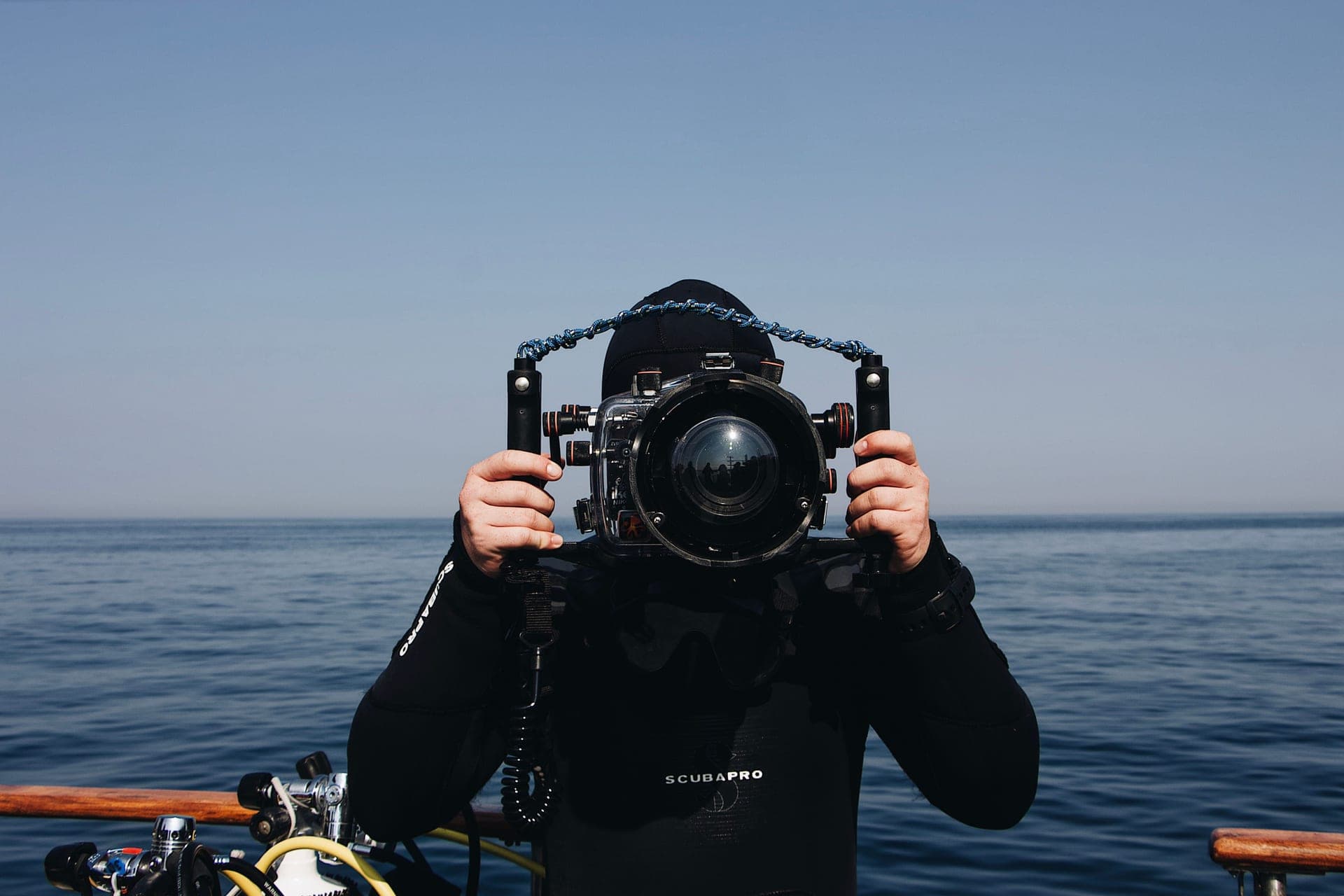
196ft (60m) rated, with a flat glass lens — the piece that turns a 33ft camera into a diving camera.
Anything below about 30ft, and any camera going anywhere near a tank
- 60m is six times the HERO13 Black's bare rating
- Flat glass lens rather than plastic, so the image holds up
- Includes a skeleton backdoor for better audio when you are not underwater
- Also the best impact protection the camera can wear
- Muffles audio badly with the sealed door — that is physics, not a defect
- Sealed air plus a temperature change is exactly how fogging happens; budget for inserts
- Buttons are harder to work with gloves on
Specs from GoPro Protective Housing product page.
02
How we picked
We do not lab-test, bench-test or dive-test cameras, and we do not own test units. What we do instead is read the manufacturer's published specifications, read the independent reviews that genuinely do test, read owner reports for the failure modes specs never mention — fogging, salt corrosion, cold battery collapse, mount slippage — and then weight all of it for action cameras used on lake and trail. Where a number is not published, the page says “not published” rather than filling the cell.
The full method, including what we refuse to do, is on the editorial policy page.
- 30%Water survival
- Rated depth without a case, door design, and what the manufacturer actually publishes.
- 25%Stabilization in chop
- A kayak deck and a rooty trail shake in ways a handheld walk test never shows.
- 20%Battery in the cold
- Published runtime, spare-battery cost, and whether it charges while recording.
- 15%Mount ecosystem
- Finger mount, threaded, magnetic — and how much of it you have to re-buy.
- 10%Footage you will keep
- Lens replaceability, low-light behavior, and how much cutting the footage needs.
03
Questions people actually ask
01Which is better underwater, GoPro or Insta360?
For diving, the GoPro — the 60m Protective Housing and the choice of depth-rated filters make it a more complete system. For snorkeling and swimming, the Insta360 X5, because 15m bare means no housing at all and no fogging risk.
02Can you use an Insta360 X5 for scuba diving?
Not on its bare 15m rating. Insta360 sells a dive case, but note that a housing appears in a 360 camera's footage in a way it never does with a flat camera, which changes what the format gives you.
03Do I need a red filter for both?
Below about five feet, yes, whichever you own — the color loss is physics, not a camera fault. Filter sets are more widely available and better documented for GoPro, which is a genuine practical advantage.
04Are the Insta360's exposed lenses a real problem underwater?
A real risk rather than a real problem, provided you use lens guards. Reef, rock and sand are abrasive and you have less precise control of the camera underwater. The X5's user-replaceable lenses make a mistake recoverable, which is why it outranks the X4 for water use.
05Which one fogs less?
Neither, inside a housing — fogging is condensation and applies to both equally. The X5 fogs less in practice only because its deeper bare rating means it spends less time in a housing at all.
04
Read this next
GoPro or Insta360 for kayaking?
The same two brands, judged on the surface instead of under it.
How deep can an action camera go?
Every published rating, and what a rating actually promises.
Filters and dome ports for water
The fix for the color problem neither camera solves.
Cases and dive housings
What a housing costs you in audio, buttons and fogging.
Best action cameras for snorkeling
Where bare ratings beat housed ratings, and why.
05
Sources
- GoPro Protective Housing, waterproof to 196ft (60m)
- PolarPro Dive Filters with published depth ranges
- GoPro HERO13 Black published specifications
- CineD, Insta360 X5 announcement with published specifications
Specifications are quoted from the manufacturer pages above as they read on the dates shown. Where a figure is not published, this site says so rather than estimating one. We have not tested these products.