Do you need a gimbal for an action camera?
This used to be a real question. Electronic stabilization answered it, and the answer is mostly no.
Part of Gear.
We earn a commission if you buy through our links, at no extra cost to you. It never changes what we recommend or the order we rank it in — how this works.
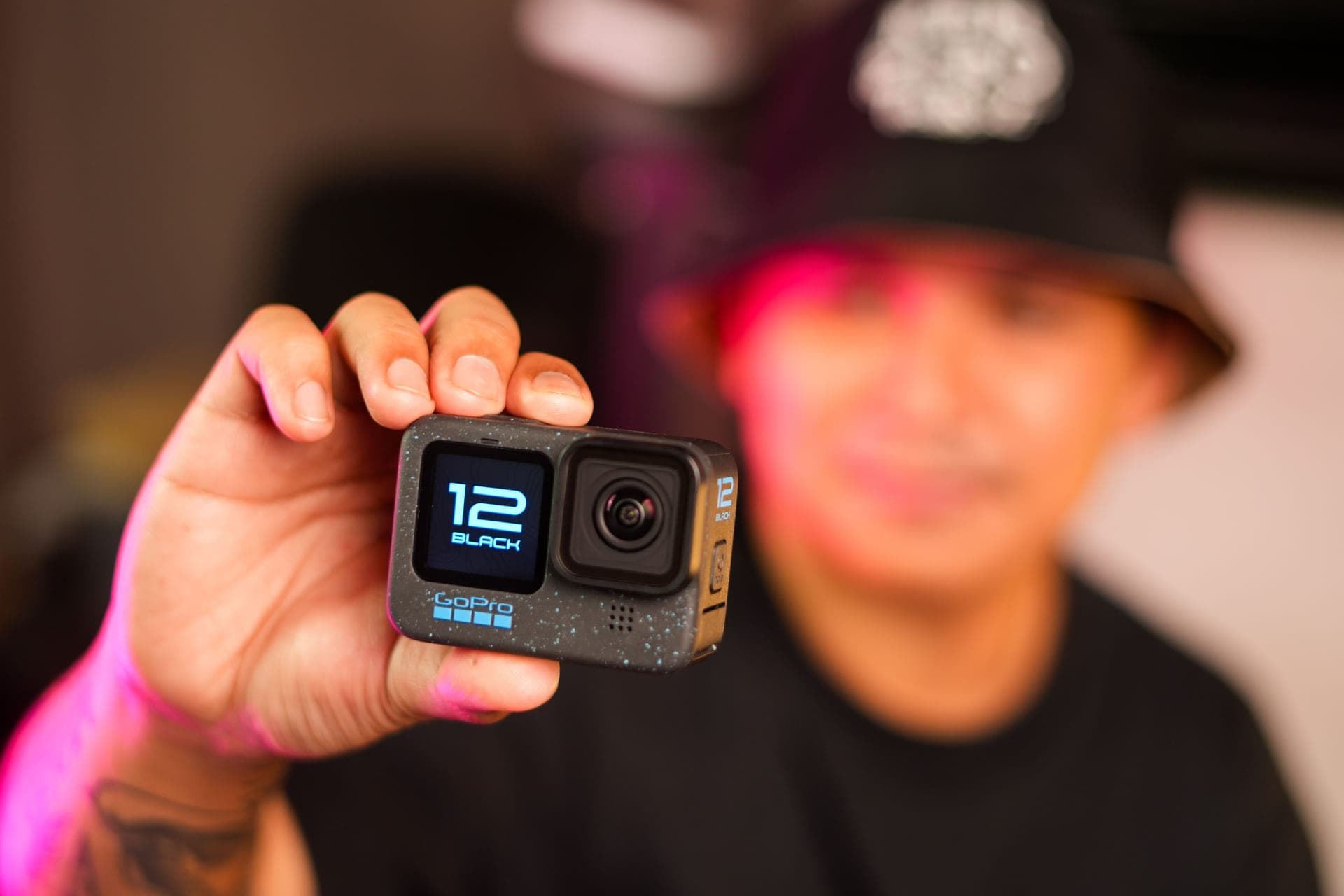
Almost certainly not. Electronic stabilization — HyperSmooth, RockSteady, FlowState — now produces results comparable to a mechanical gimbal for action camera work, with none of the bulk, battery drain, setup time or water vulnerability. On a kayak or a bike a gimbal is another thing to charge, balance and keep dry, and it is one more item that can go overboard. The narrow remaining cases are slow deliberate walking shots and cinematic work with larger cameras — neither of which is what this site is about.
What changed
A gimbal solves shake mechanically: motors counter-rotate the camera against your movement, physically keeping it level. It works extremely well and it requires a motorized cradle, a battery, and a balancing routine.
Electronic stabilization solves the same problem computationally. The camera records a wider frame than it outputs, tracks its own motion with an internal gyroscope, and crops a steadier path out of the wider image. Early versions were mediocre — soft, heavily cropped, prone to artefacts. Current ones are not.
The result is that a modern action camera produces stabilized footage straight out of the camera with no additional hardware, no charging, and no setup. For the kind of shooting this site covers, that is a complete answer. The stabilization comparison covers how the systems differ.
The comparison, honestly
| Gimbal | Electronic stabilization | |
|---|---|---|
| Result on a bike or boat | Excellent | Excellent |
| Result on slow walking shots | Slightly better | Very good |
| Setup time | Balancing, every configuration change | None |
| Battery | Its own, to charge | The camera's |
| Bulk | Significant | None |
| Water | Not rated for submersion | Whatever the camera is rated to |
| Mounting | Limited, and heavy on a lever arm | Any mount the camera fits |
| Crop | None | Some — a modest crop into the sensor |
| One more thing to lose | Yes | No |
The only column where the gimbal genuinely wins is slow, deliberate movement — and the columns where it loses are all the ones that matter on water.
The narrow cases where a gimbal still makes sense
Slow, deliberate walking shots on dry land. Following someone down a path, moving through a room, a controlled tracking shot. Mechanical stabilization handles slow low-frequency movement slightly better than a crop-and-compute approach, and the difference is visible in careful side-by-side comparison.
Larger cameras. Mirrorless bodies and phones have far weaker in-body stabilization for video than action cameras do, and a gimbal remains genuinely valuable there. That is a different purchase and a different site.
When you need zero crop. Electronic stabilization takes a modest bite out of the field of view. If you need the absolute widest frame the sensor offers and a rock-steady result, only a gimbal gives you both.
None of those describe a kayak deck, a bike bar or a helmet.
What to spend the money on instead
In order of how much each improves footage.
A better mount, in a better position. A stiff mount on your chest beats a flexing clamp on a bar by more than any stabilization difference — chest versus helmet.
A pole. The shot that includes you in the environment is worth more than the shot that is marginally steadier — paddle and pole mounts.
A second camera. Two angles to cut between improves an edit more than either angle being better.
A spare battery and a proper card. Unglamorous, and they prevent the failures that cost you footage entirely.
What stabilization still cannot fix
Worth saying plainly, because it is where people blame the camera.
A mount that moves. Stabilization removes vibration; it cannot remove a camera slowly rotating on a loose thumb screw, and it cannot restore a horizon the mount walked away from.
Water on the lens. No amount of processing recovers a bead of spray.
Bad framing. A steady shot of the wrong thing is still the wrong thing.
All three are cheaper to fix than a gimbal, and all three matter more.
01
What to buy instead
The money that would have gone on a gimbal is better spent on a camera whose stabilization is already excellent.
- 33ft (10m), no housing
- 1900mAh Enduro
- 1.5h at 5.3K30 / 2.5h at 1080p30
- 8.0
- 9.5
- 8.5
- 9.5
- 9.0
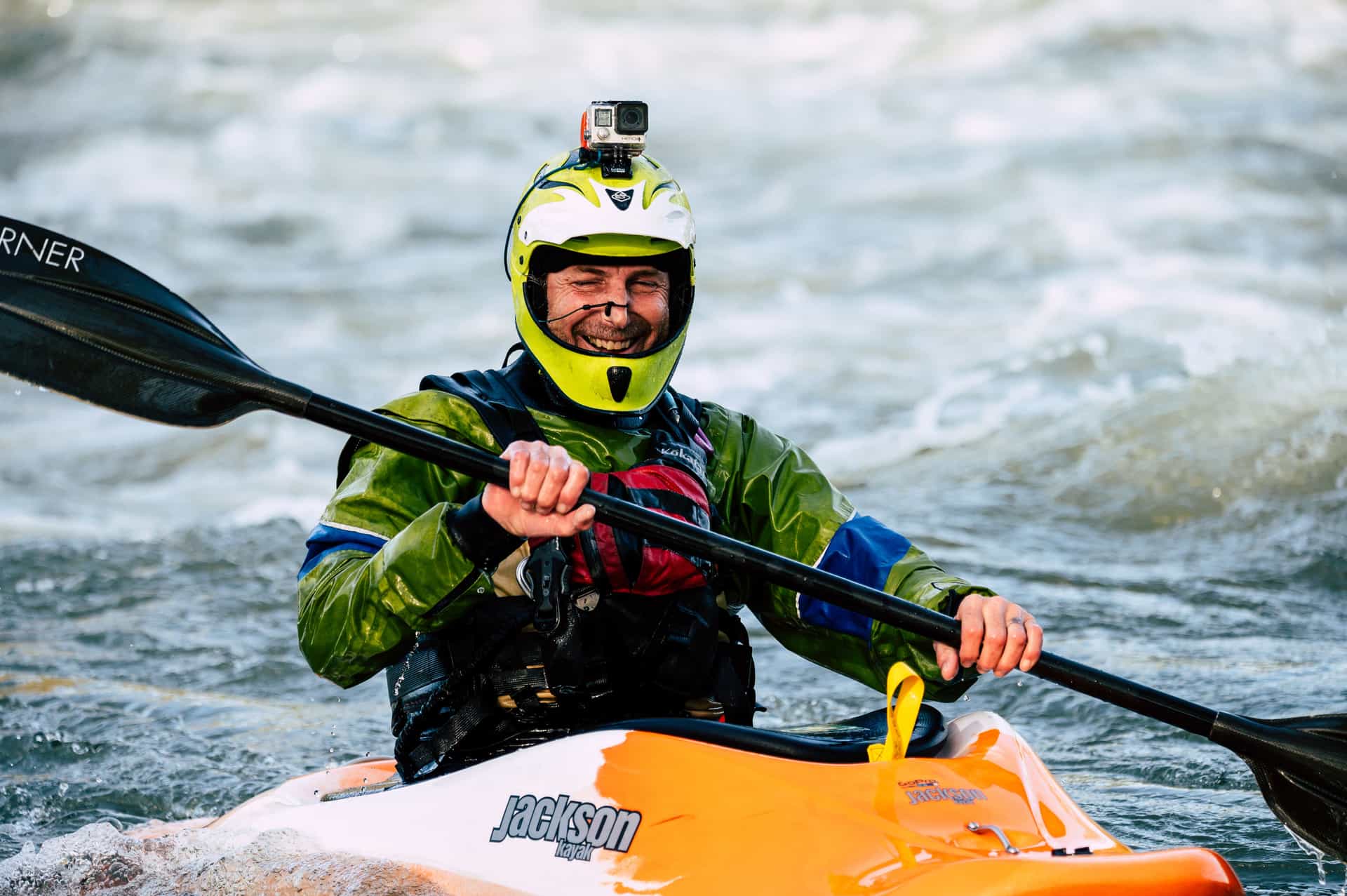
GoPro HERO13 Black
GoPro
The safest default for lake and trail: 33ft without a housing, the steadiest footage in the category, and a mount for literally everything.
Anyone who wants one camera to handle the kayak, the bike and the family trip
- HyperSmooth 6.0 with AutoBoost is the steadiest stabilization we can find published figures for
- Built-in mounting fingers plus 1/4-20 threads — it fits the GoPro ecosystem and a normal tripod
- Enduro battery is rated to keep full camera functionality down to 14°F (-10°C)
- Replaceable lens cover, so a scratched lens is a $20 problem and not a $400 one
- 33ft is shallower than the DJI and it is the shallowest of the three flagships
- Anything past 33ft needs the separate Protective Housing
- HB-Series lenses and ND filters are all extra purchases
Specs from GoPro HERO13 Black published specifications.
- 20m bare / 60m with case
- 1950mAh · 240 min at 1080p24
- -20° to 45°C
- 9.5
- 9.0
- 9.5
- 8.0
- 9.0
DJI Osmo Action 5 Pro
DJI
Goes to 20m with no housing at all and publishes a 240-minute runtime — the two numbers that decide a long, wet, cold day.
Long paddles, cold water, and anyone tired of buying a housing to get past 10m
- 20m without the Waterproof Case — double the bare-camera depth of the HERO13 Black
- DJI publishes 240 minutes of recording at 1080p/24 with screens off, the longest figure in this set
- Rated to -20°C, which matters more on an October lake than any resolution number
- 1/1.3-inch sensor holds detail when the light goes flat
- Mount ecosystem is smaller than GoPro's, and magnetic quick-release adapters are their own purchase
- 146g — the heaviest of the flagship three
- Fewer third-party mounts and filters exist for it
Specs from DJI Osmo Action 5 Pro published specifications.

- IP68 to 49ft (15m)
- 2400mAh · ~88 min at 8K30
- User-replaceable
- 9.5
- 9.5
- 9.0
- 8.5
- 7.5
Insta360 X5
Insta360
15m rated, replaceable lenses, and the one camera that means you never have to aim while you are paddling.
Anyone filming themselves on the water who cannot stop to frame a shot
- 15m IP68 is the deepest bare rating of any camera on this site
- User-replaceable lenses — the single biggest fix for the 360 format's worst failure mode
- 185 minutes in Endurance mode at 5.7K24, which is a whole day of clips
- Invisible-selfie-stick reframing means you point the camera at nothing and pick the angle later
- Exposed lenses still scratch; lens guards are a purchase, not an option
- Every clip needs a reframing pass before anyone else can watch it
- 8K30 files are large and the edit is slower than flat footage
Specs from CineD, Insta360 X5 announcement with published specifications.
02
How we picked
We do not lab-test, bench-test or dive-test cameras, and we do not own test units. What we do instead is read the manufacturer's published specifications, read the independent reviews that genuinely do test, read owner reports for the failure modes specs never mention — fogging, salt corrosion, cold battery collapse, mount slippage — and then weight all of it for action cameras used on lake and trail. Where a number is not published, the page says “not published” rather than filling the cell.
The full method, including what we refuse to do, is on the editorial policy page.
- 30%Water survival
- Rated depth without a case, door design, and what the manufacturer actually publishes.
- 25%Stabilization in chop
- A kayak deck and a rooty trail shake in ways a handheld walk test never shows.
- 20%Battery in the cold
- Published runtime, spare-battery cost, and whether it charges while recording.
- 15%Mount ecosystem
- Finger mount, threaded, magnetic — and how much of it you have to re-buy.
- 10%Footage you will keep
- Lens replaceability, low-light behavior, and how much cutting the footage needs.
03
Questions people actually ask
01Do I need a gimbal for a GoPro?
No. HyperSmooth, RockSteady and FlowState produce results comparable to a mechanical gimbal for action camera work, without the bulk, battery, setup or water vulnerability.
02Is a gimbal better than electronic stabilization?
Only for slow, deliberate walking movement on dry land, and for larger cameras with weaker in-body stabilization. For a bike, a boat or a helmet, in-camera stabilization is the better tool.
03Is there a waterproof gimbal for action cameras?
No consumer gimbal is rated for submersion — motors and bearings in an open cradle do not survive it, and salt spray will kill one over a season. That alone rules it out for most use on this site.
04Does electronic stabilization reduce image quality?
It crops modestly into the sensor to give itself room to work, so you lose some field of view. On current cameras the quality cost is small and the steadiness gain is large.
05What should I buy instead of a gimbal?
A better mount in a better position, a pole so you can be in the shot, or a second camera for a second angle. Each of those improves footage more than a gimbal would.
04
Read this next
HyperSmooth vs FlowState vs RockSteady
What each system does, and where each gives up.
Chest mount vs helmet mount
The mount decision that matters more than a gimbal would.
Paddle and pole mounts
A better use of the same money, for a better shot.
The first five accessories
Notably, a gimbal is not on it.
Best action cameras for mountain biking
Where stabilization is tested hardest, and still wins.
05
Sources
- GoPro HERO13 Black published specifications, including HyperSmooth 6.0
- DJI Osmo Action 5 Pro specifications, including RockSteady 3.0 and HorizonSteady
- CineD, Insta360 X5 announcement with published specifications
Specifications are quoted from the manufacturer pages above as they read on the dates shown. Where a figure is not published, this site says so rather than estimating one. We have not tested these products.